A penguin is an upright oval, a pale belly mask cut into it and two flat flippers hanging at the sides. That is the whole animal, which is why a penguin drawing easy enough to finish in a minute still works. If your penguin looks like a sack with a beak, the face did not fail. The belly mask, the neck and the feet did.
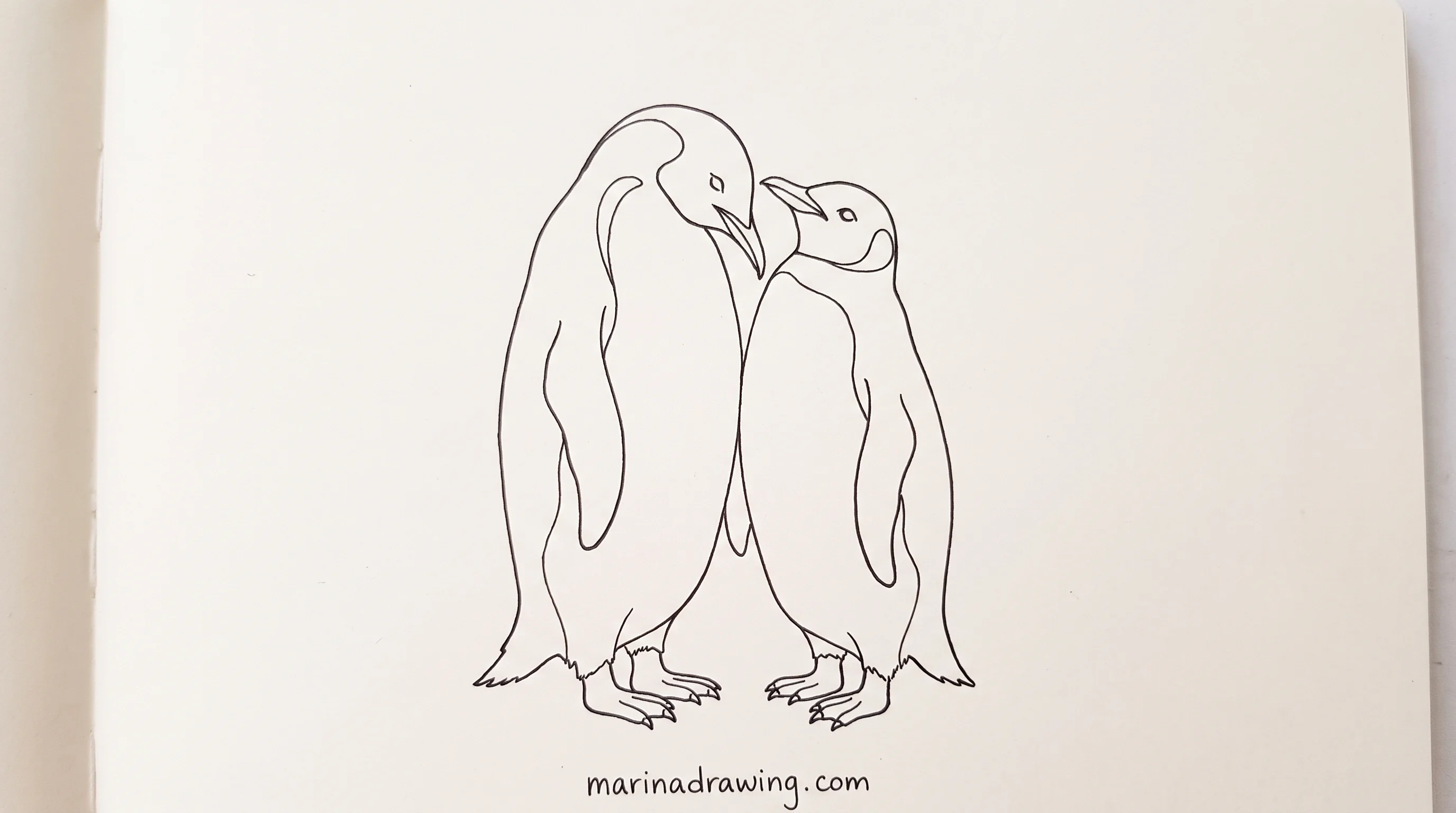
A penguin reads as a penguin because of where the light and dark sit, not how the feathers are drawn.
A dark back that wraps over the head, a pale belly cut in with a clean curve, and feet set forward of the body. Lose any of them and you get a sack, a duck or a bowling pin.
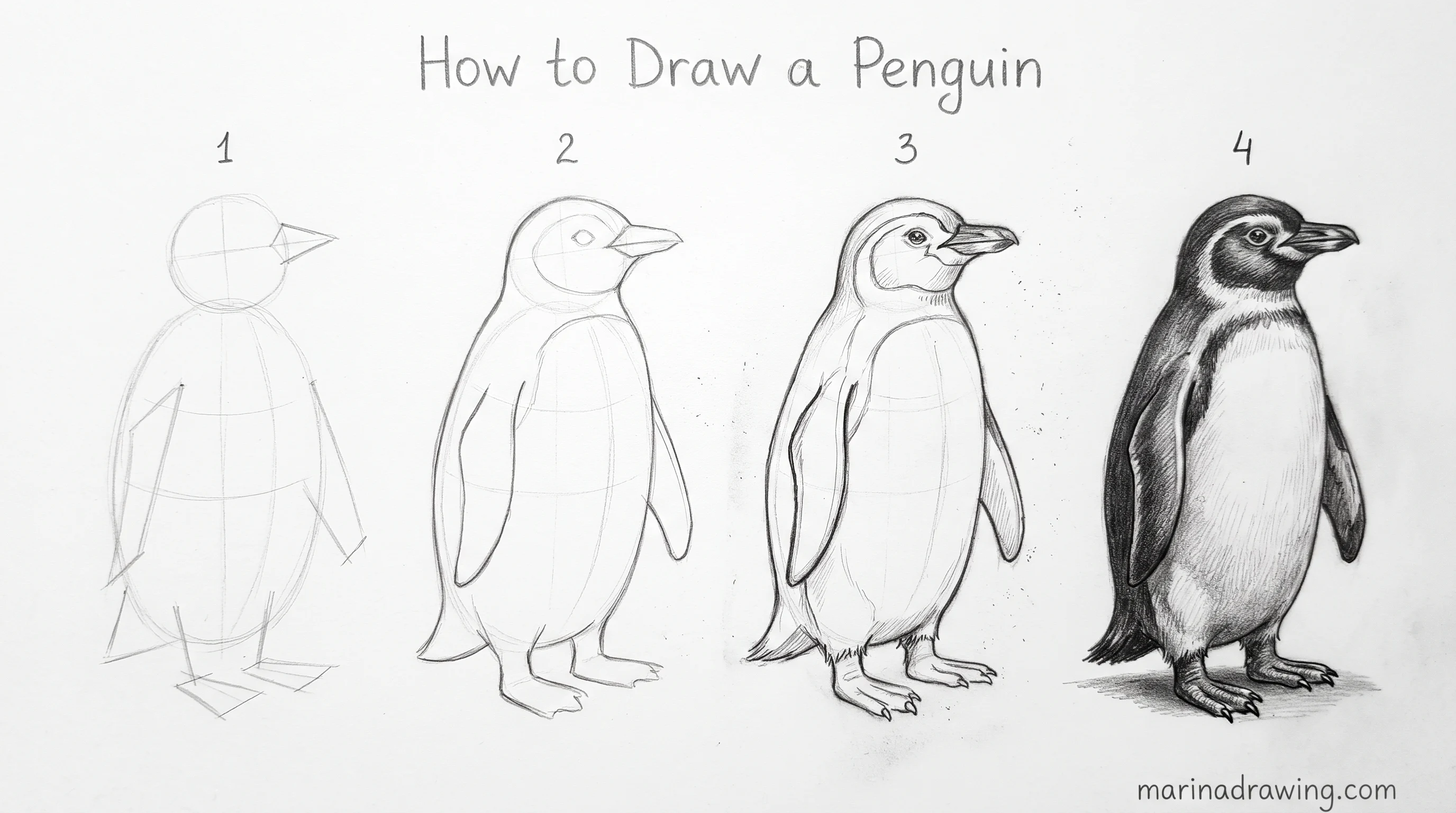
Quick answer: draw one tall egg-shaped oval, tilt it a little, and cut a U-shaped belly into the front. Add a small diamond beak, two flippers that hang from the shoulders and two flat feet pointing outward at the base. Then pick your penguin from the nine below and read the table near the end for your mistake. A penguin is mostly a black-and-white value problem, and the Shading Techniques in Pencil class is a beginner-friendly class on light and shadow.
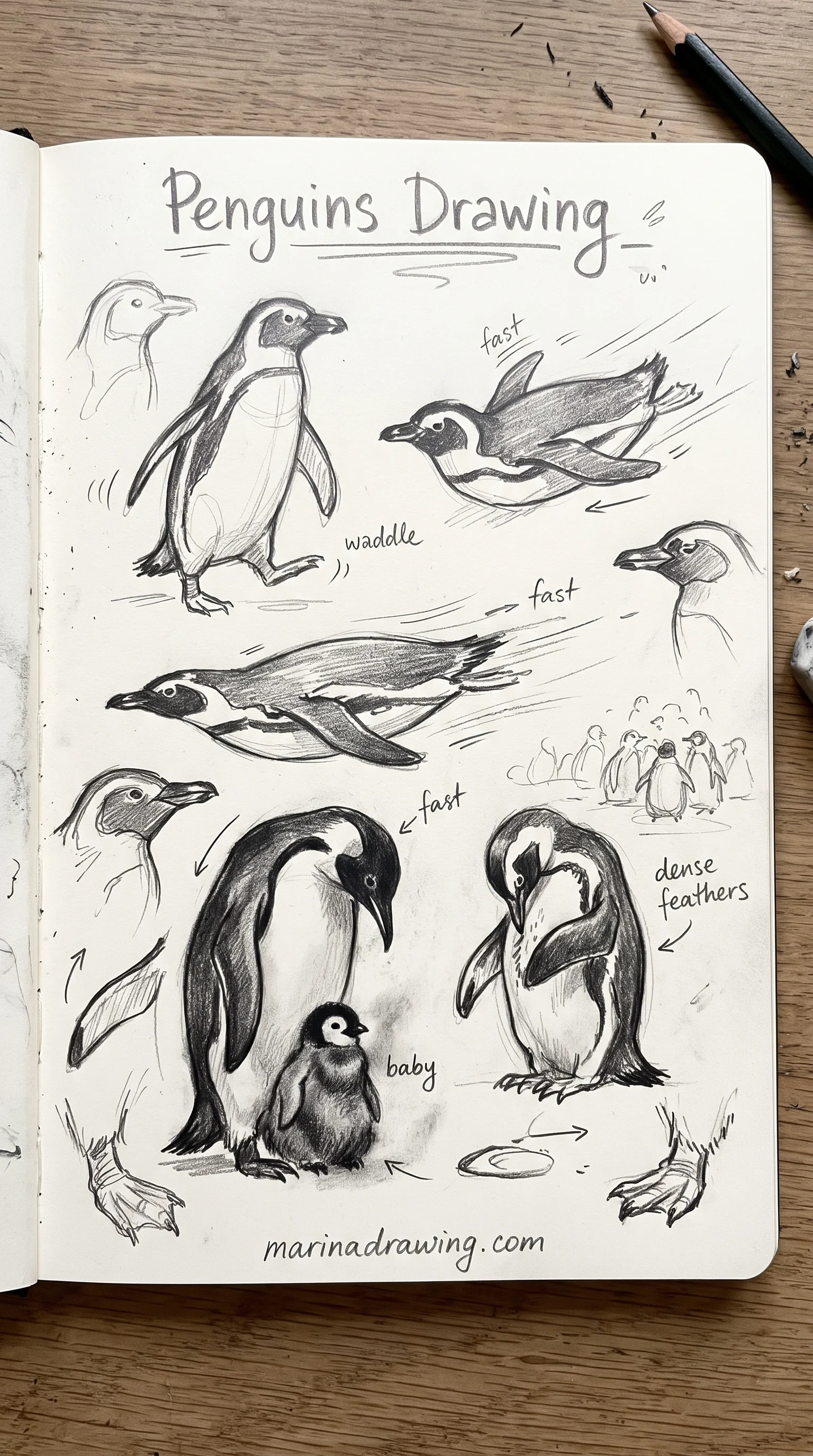

The oval and the belly mask make the penguin, not the face
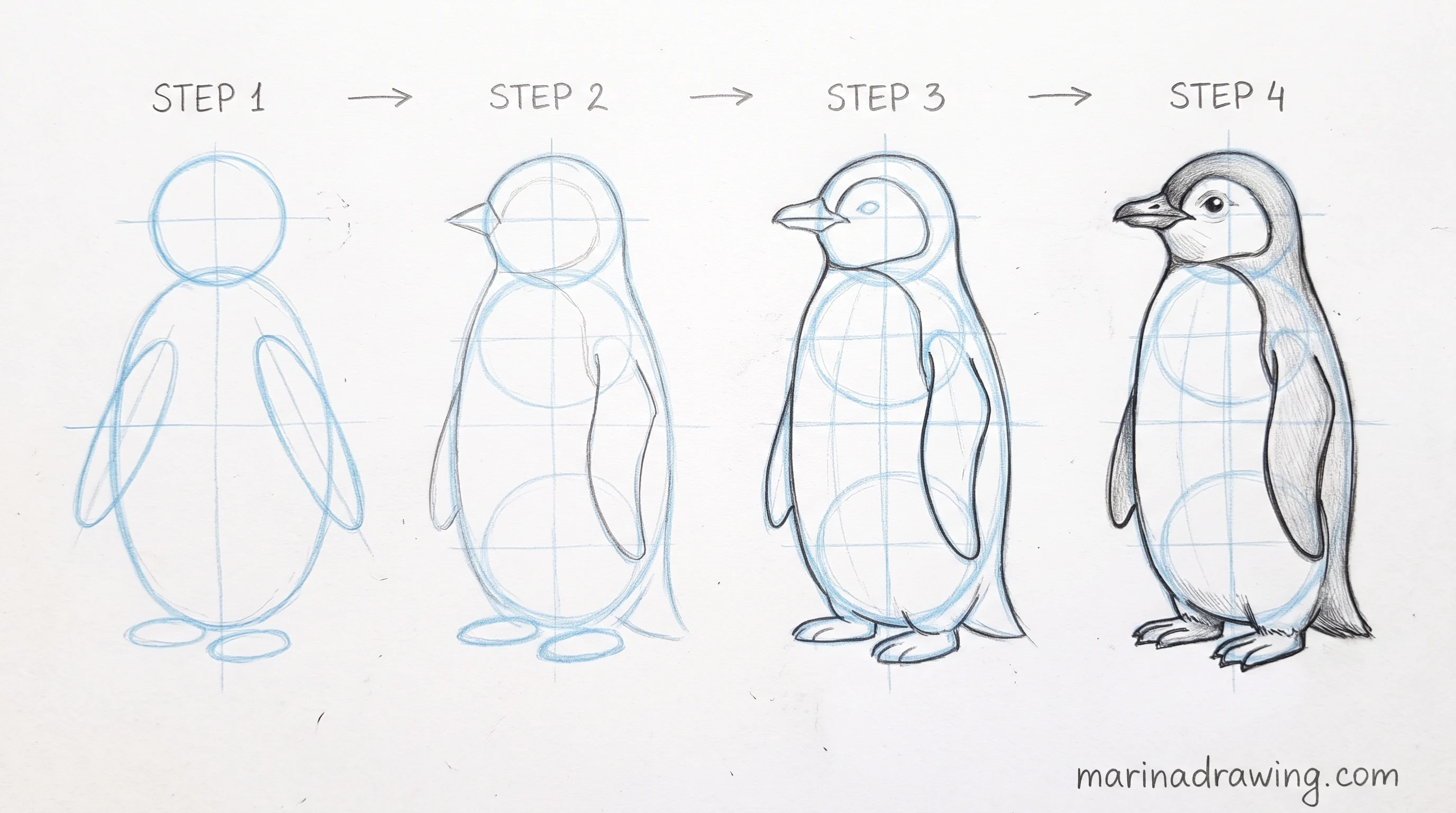
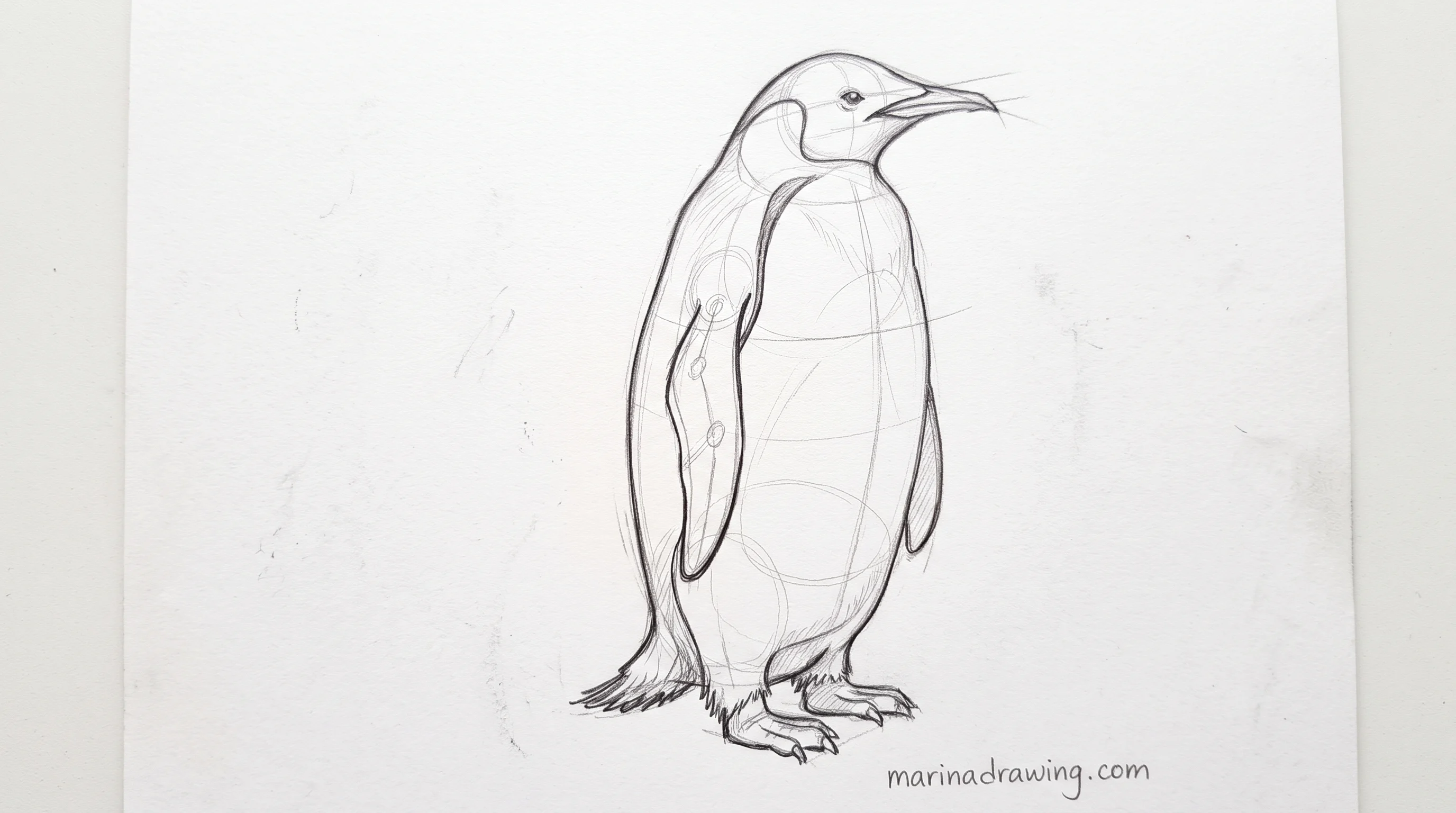
Every penguin here starts with the same four light marks, put down before any detail.
- The body oval. One tall egg, wider at the bottom than at the top. Tilt it slightly so your penguin leans forward. A perfectly vertical oval gives you a bowling pin.
- The belly mask. A U-shaped curve inside the oval, starting just under the head and running down to the base. Everything outside the curve is dark, everything inside is pale.
- The flippers. Two long, flat shapes hanging from the upper sides of the oval, thinner than a wing and angled slightly back.
- The feet. Two flat triangles at the base, pointing outward, set a little in front of the body so the penguin does not tip backwards.
Now the face. You put small eyes on the dark head, above the top of the belly curve. Your beak is a small diamond, wider where it meets the face, with a line across the middle.
Leave a tiny dot of bare paper in each eye. That dot is the light.
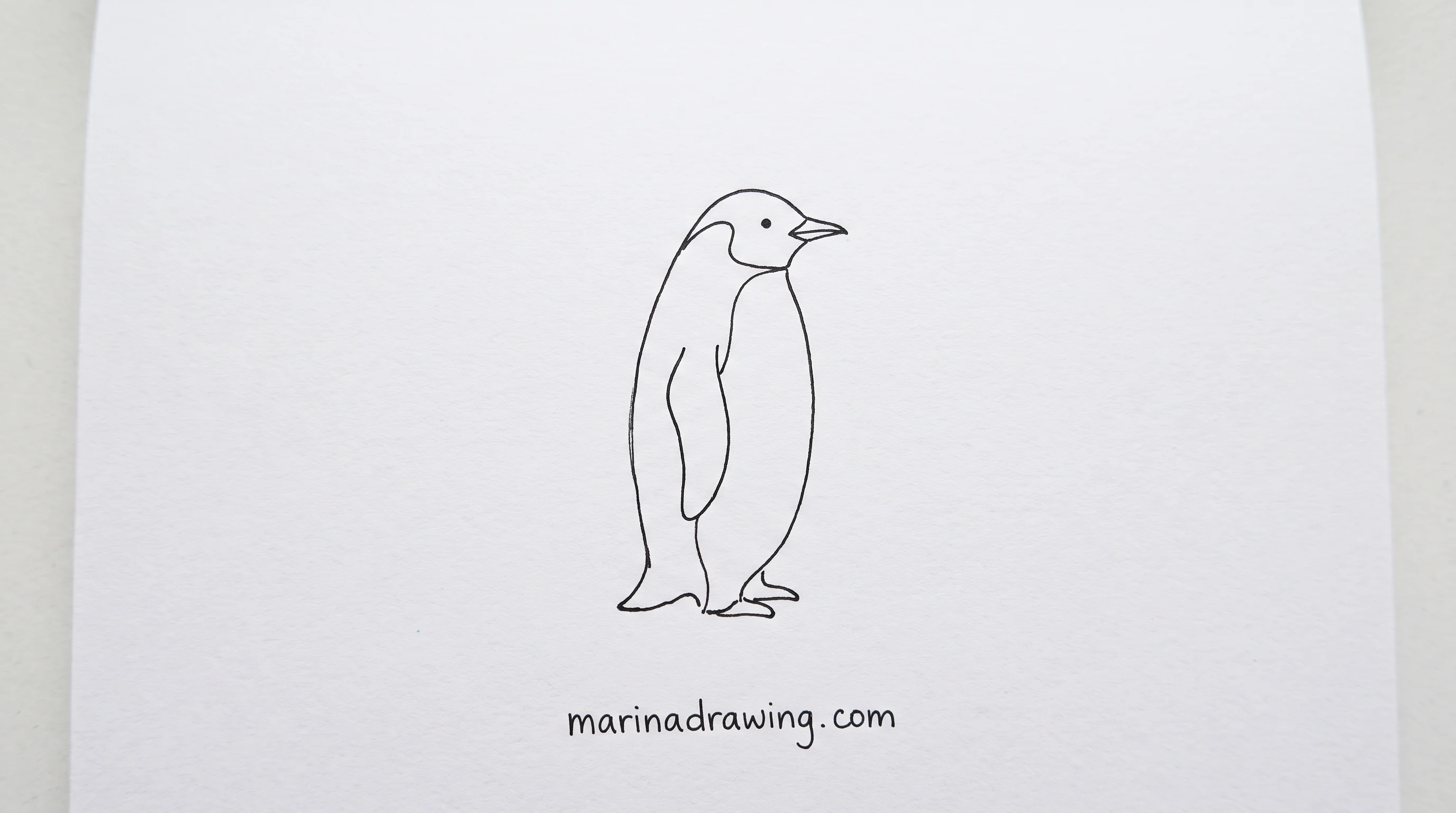
Without it your face goes dull and the penguin looks stuffed. Check these four placements while your pencil still lifts.
You decide whether your penguin works when you cut the belly mask. Everything after that is filling in a decision you already made. A strongly patterned bird follows the same rule in peacock drawing ideas: mark first, detail later.
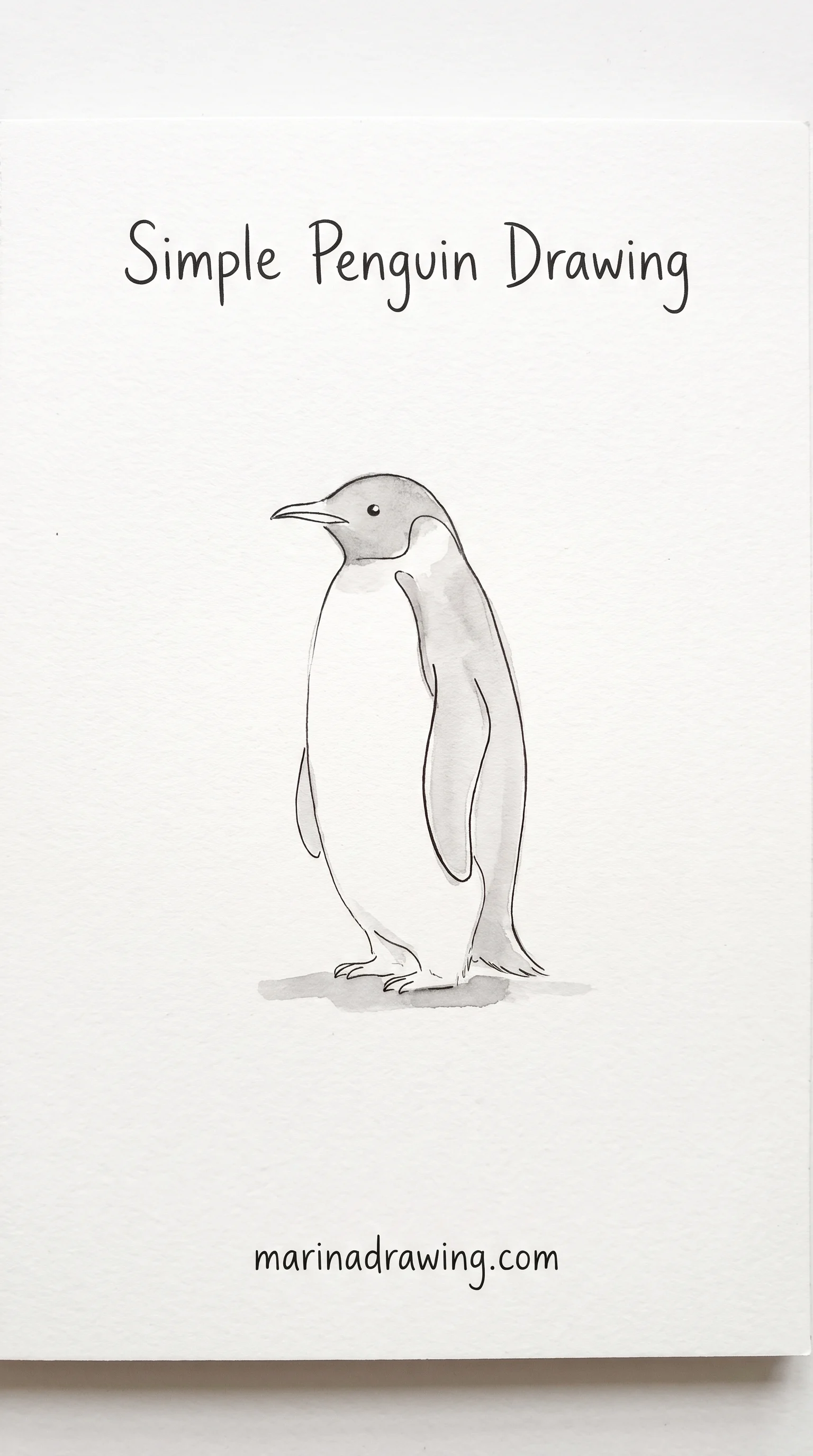
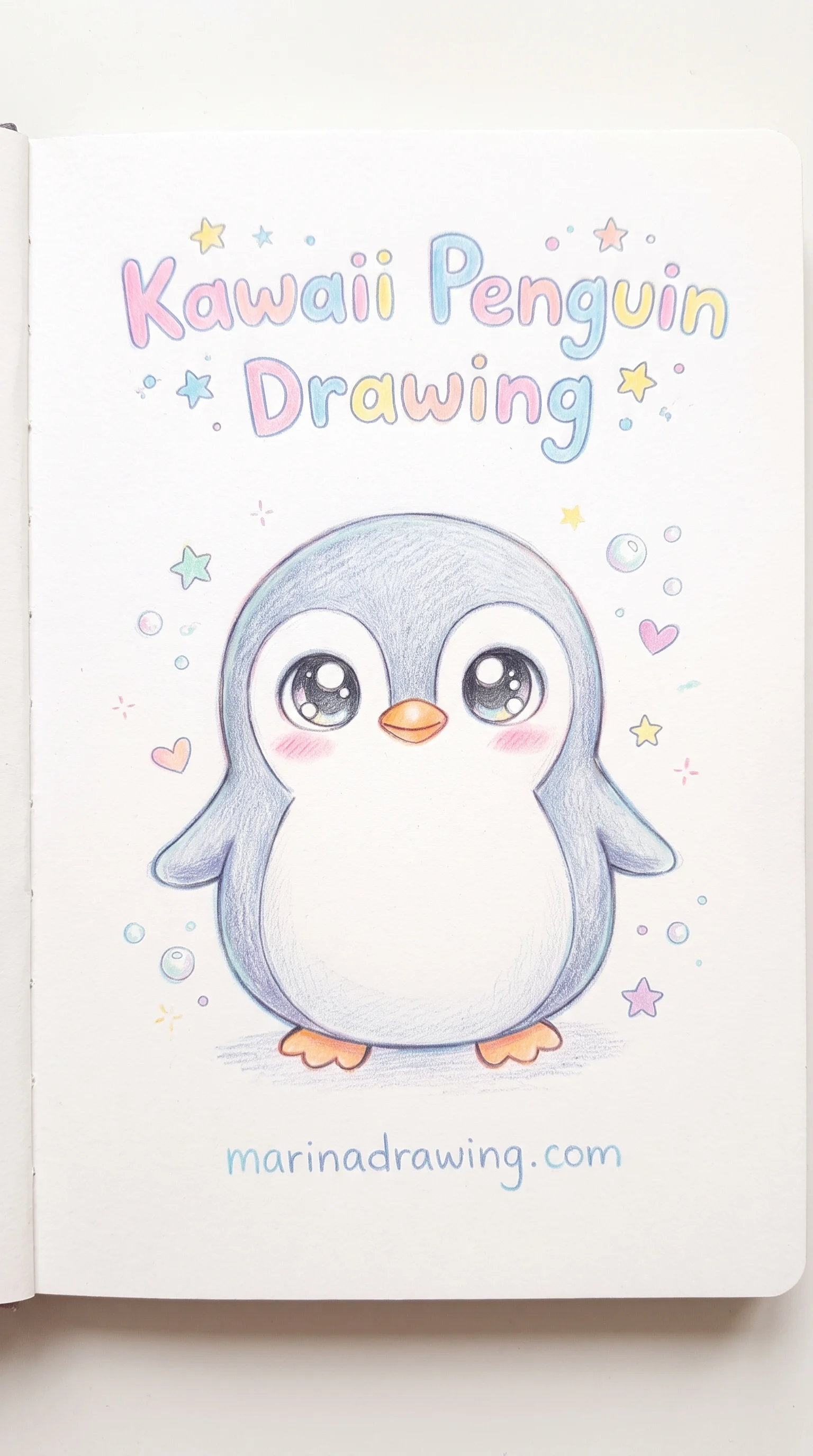
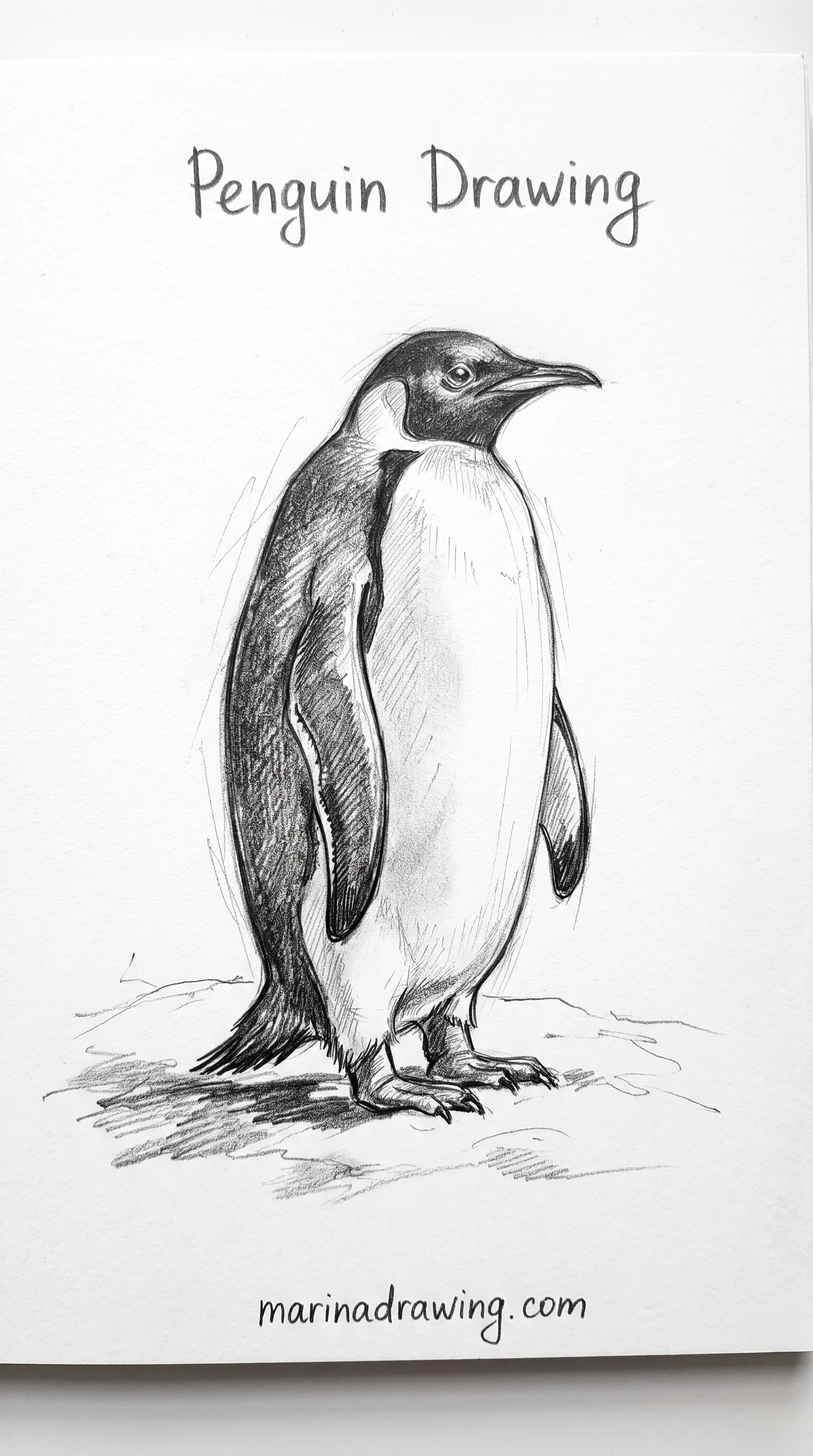
Why your penguin looks like a sack: four mistakes
Among the pages that hold the top spots for this subject, only one in five has a section on what goes wrong. None of them shows nine different penguins in one place. You get one character per page, drawn going right.
| What was checked | Pages that had it |
|---|---|
| A section on common mistakes | 1 of 5 |
| A set of different penguins, each with its own method | 0 of 5 |
| A baby and an adult compared by proportion | 0 of 5 |
| Feet and flippers treated as a separate problem | 0 of 5 |
The numbers you do find are about steps and minutes, never about where the belly curve starts.
Four mistakes account for almost all of the sacks, and you have probably made one of them:
- Your belly mask is a plain circle stuck on the front, so it floats instead of wrapping the body.
- Your oval has no taper at the top, so there is no neck and no shoulder line.
- Your feet sit under the body or point inward, so the penguin looks like it is about to fall over.
- Your flippers are drawn like bird wings, long and feathered, instead of short flat paddles.
All four are placement problems you settle in the first minute, which is why another set of steps rarely helps. The steps are fine. The thing they skip is the thing you got wrong.
The same trap shows up on the owl and the panda.
What you actually need: one pencil and a soft eraser
You need very little for every penguin here.
- One sharp 2B pencil for the construction lines.
- A soft kneaded eraser that lifts guides out without scrubbing the paper.
- Cheap printer paper. Penguins go wrong in the first minute, so spend nothing on the surface.
1. Penguin drawing easy: the oval and the mask
Draw this one first. It takes under a minute: a tilted egg, a U-shaped belly, two paddle flippers, two flat feet, a diamond beak, two dots for eyes. Nothing else.
You make seven or eight marks, and it reads as a penguin from across the room.
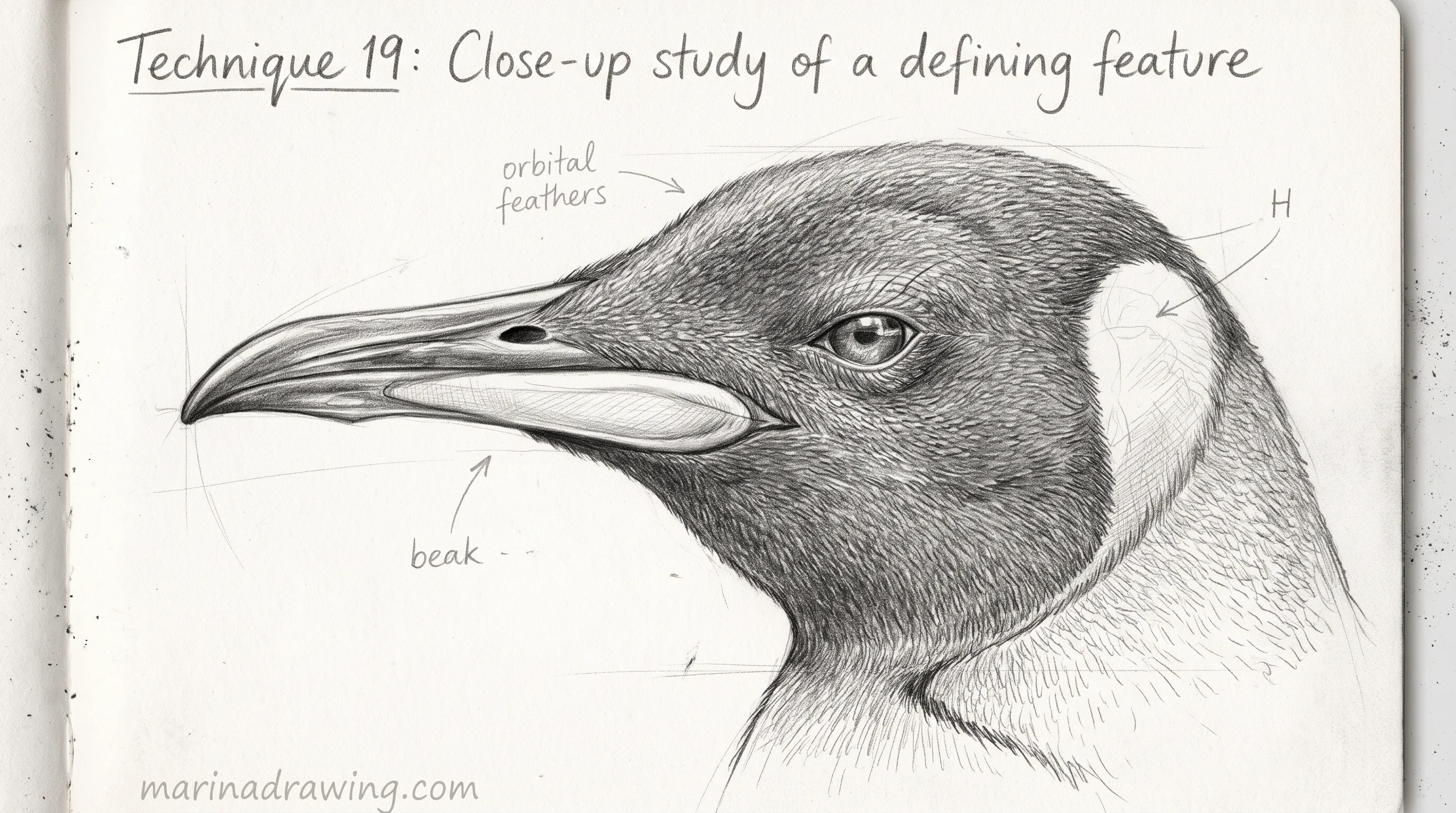
Treat it as a five-day challenge: draw it five times, moving the belly curve a little each time: higher, wider, narrower. Keep your hand loose and let the line wander before you commit. You will see the character change before you add a single detail.
2. A cute baby penguin
Cute is a ratio, not a style.
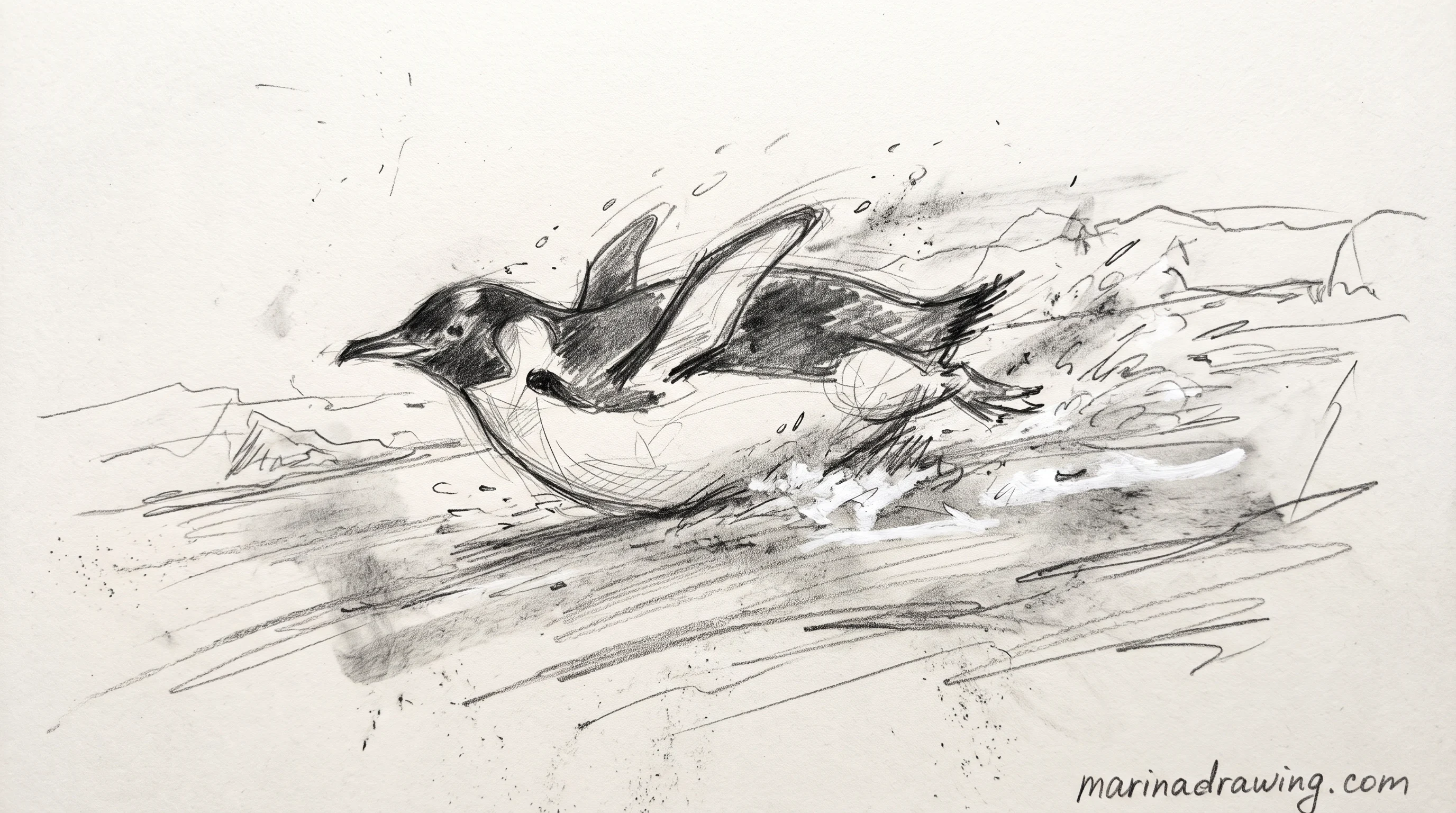
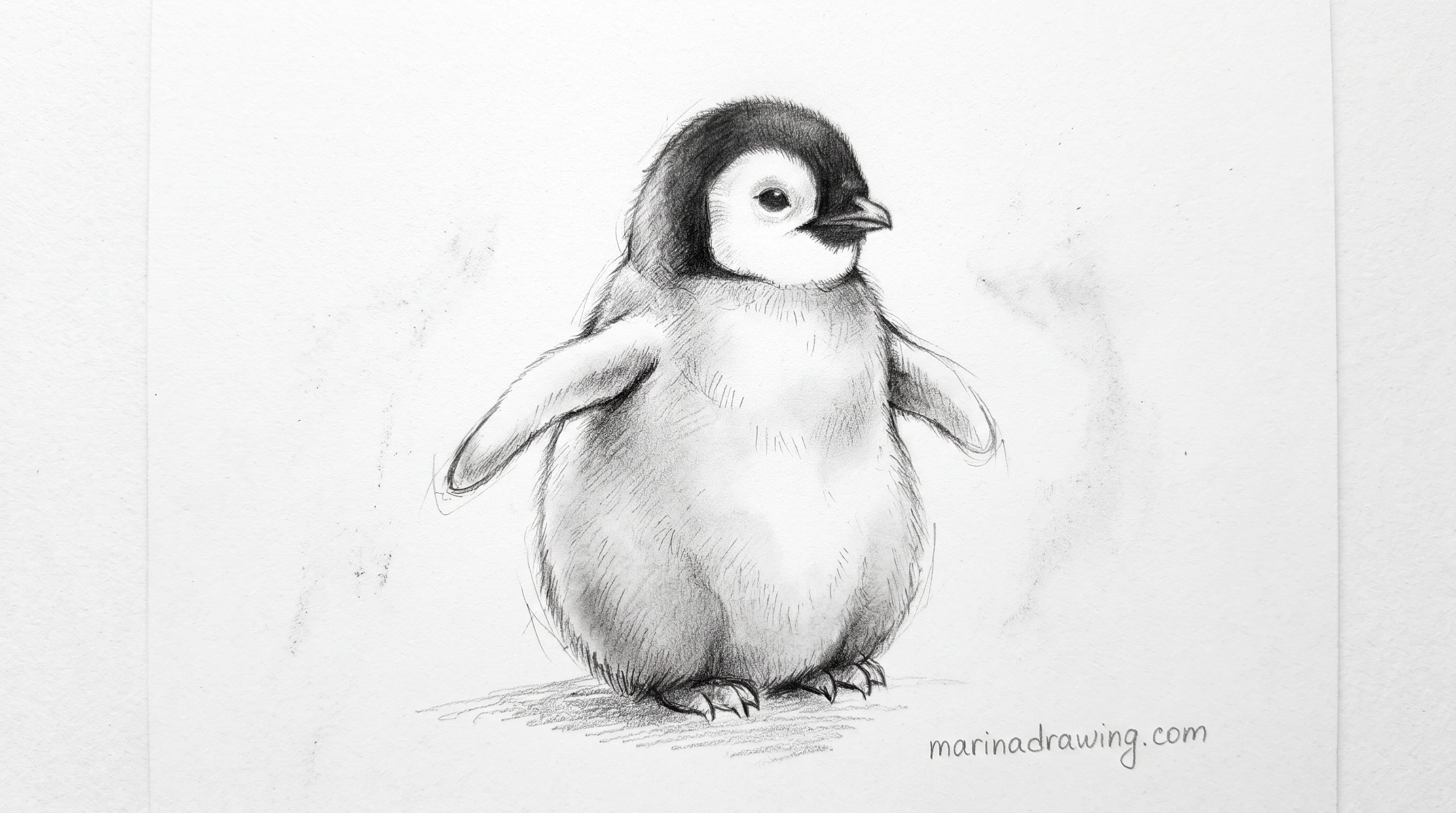
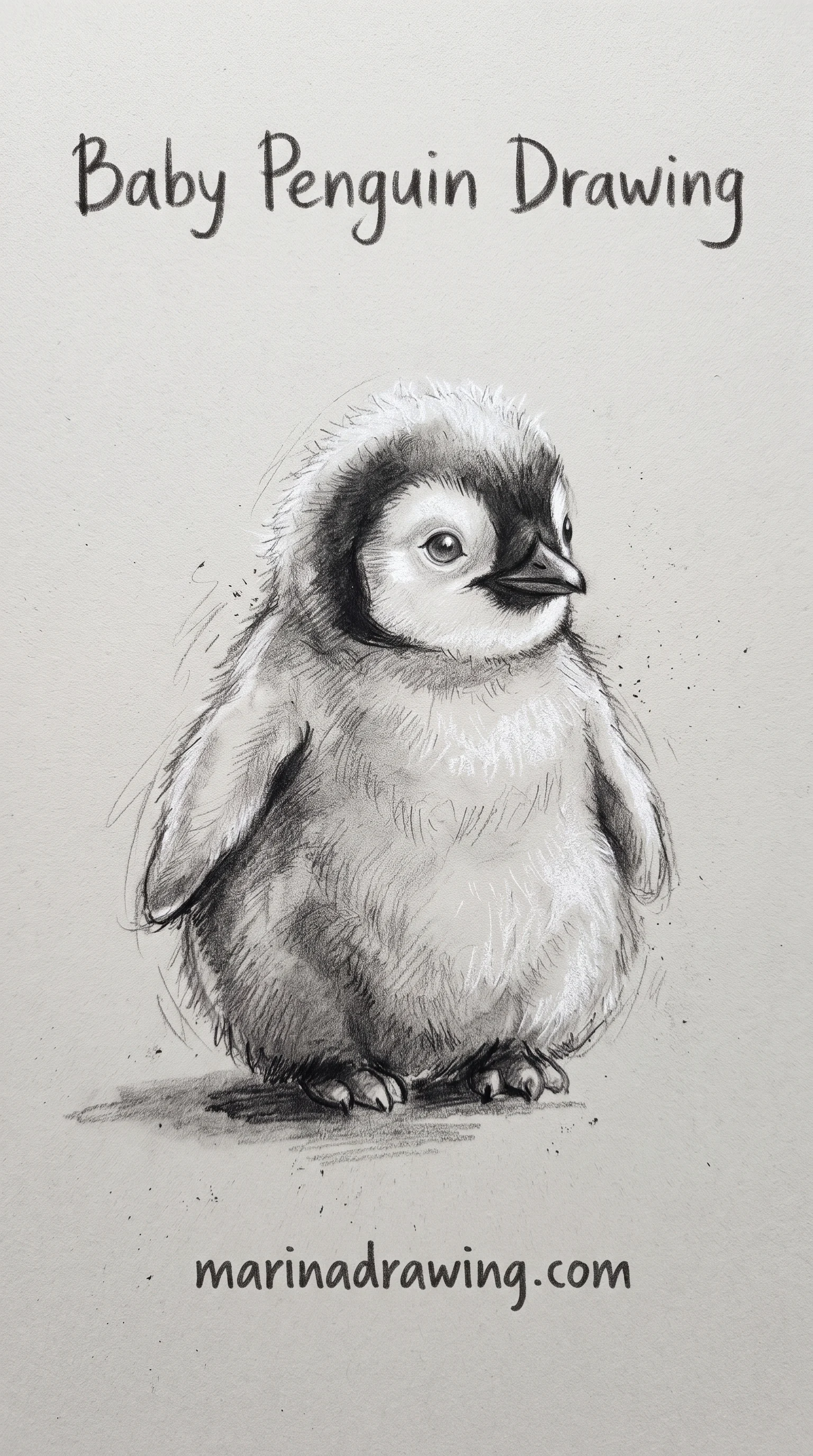
Give a baby penguin a head that is large against the body, so your oval is closer to a round pebble than an egg. You drop the eyes lower than feels right, make them big and round, and keep the beak small and close to them. Low and big reads as young. High and small reads as an adult.
Chicks are fluffy and grey, not black and white. Keep your outline soft and broken with short feathery ticks, and leave the belly lighter than the back without a hard edge. I never close a chick’s outline in one clean line.
Make your flippers stubby and your feet oversized. A baby penguin drawing works because the feet look too big to walk on. For ready-made fluffy-chick reference sheets, a library of drawing guides saves guessing.
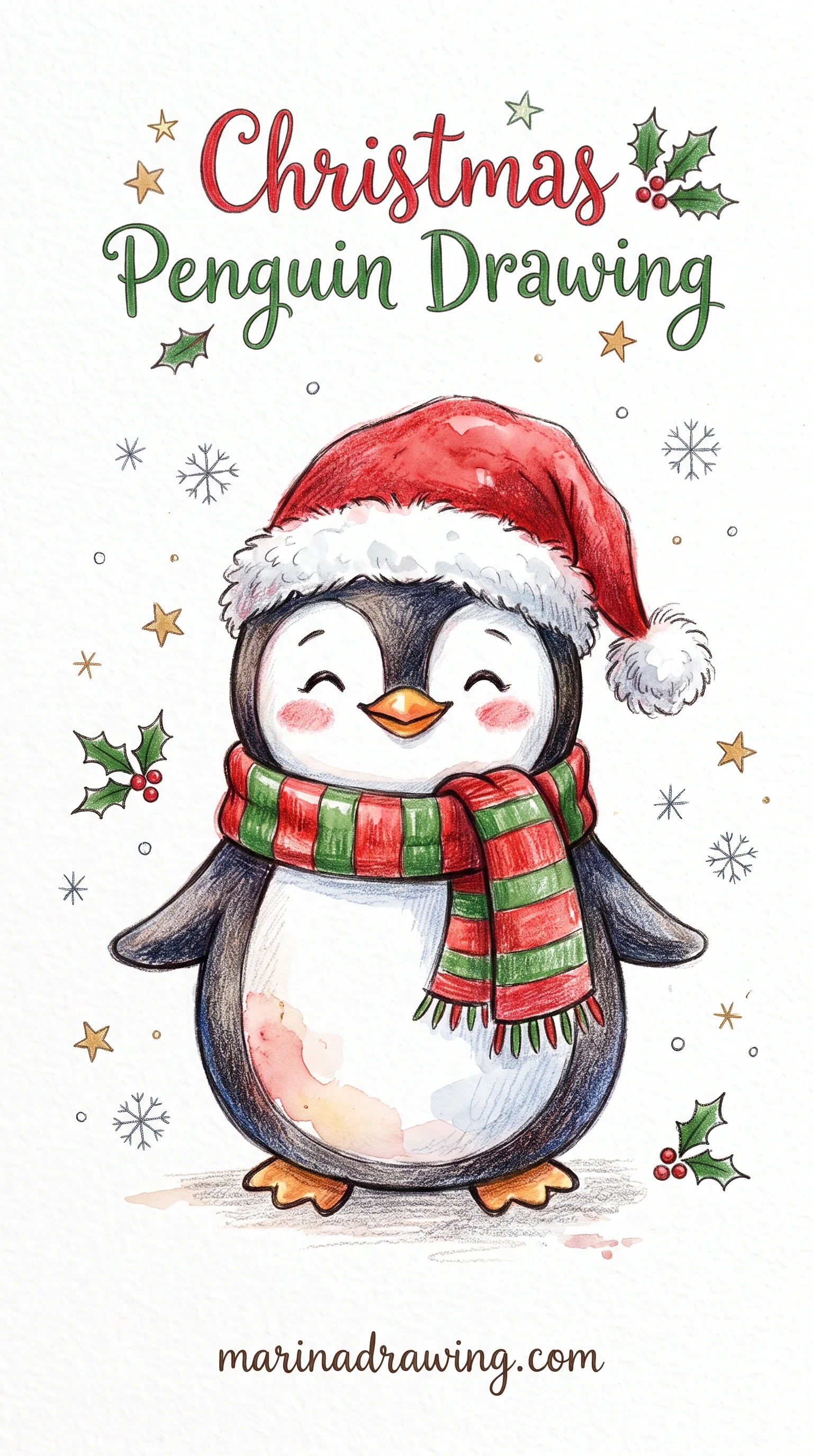
3. A Christmas penguin drawing with a scarf
This is the same penguin with the neck given a job. Draw the body, then wrap your scarf where the head meets the oval, two curved bands that follow the roundness and hide the join.
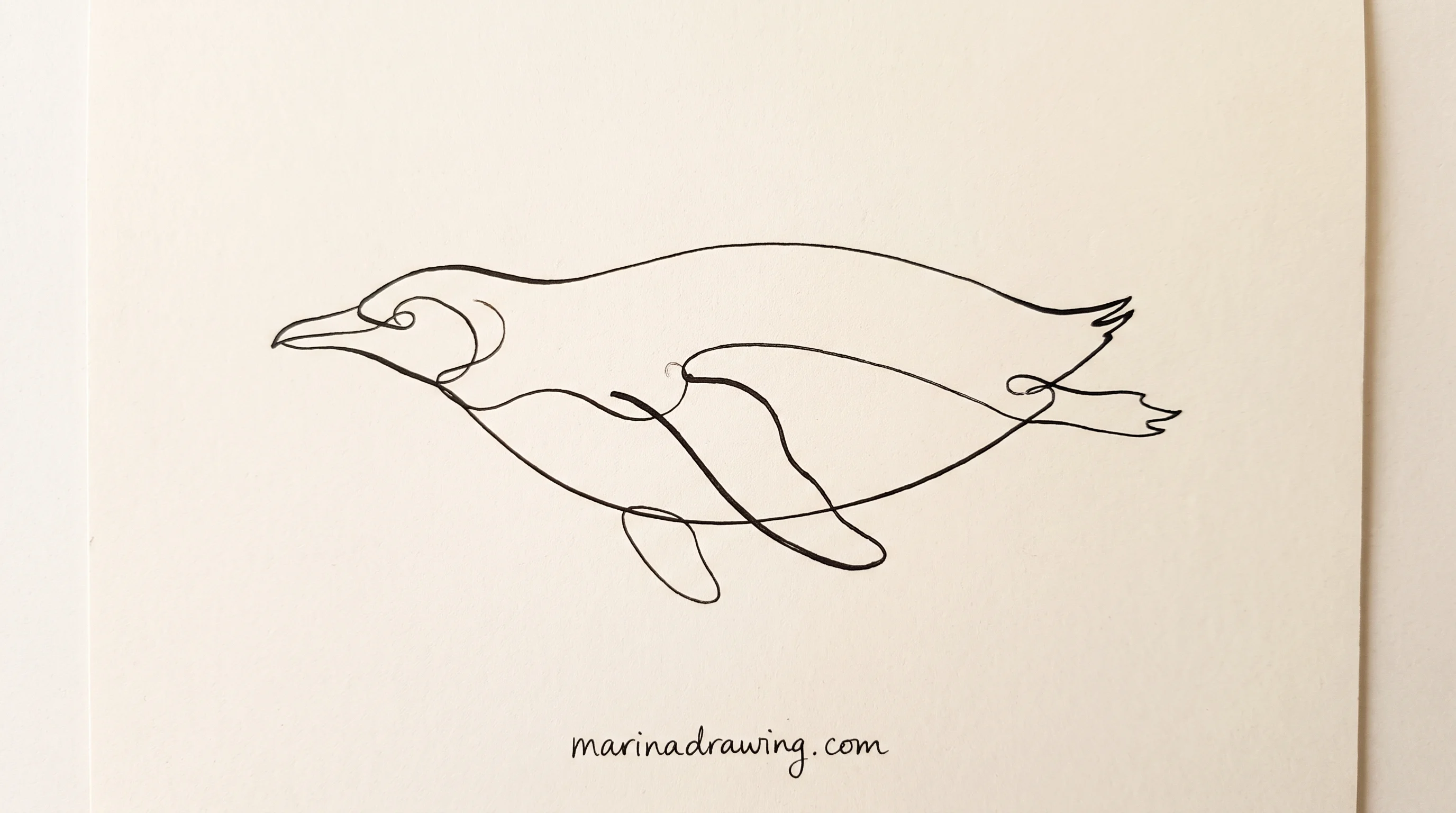
A small hat comes next: a half-oval on top of the head with a pom-pom and a band that curves with the skull. Keep it tilted, because a hat you set straight on top looks like a lid.
If your stripes are straight lines, the scarf looks like a sticker.
4. A penguin sliding on its belly
In the sliding pose you turn the penguin sideways and flatten the oval into a long, low torpedo.
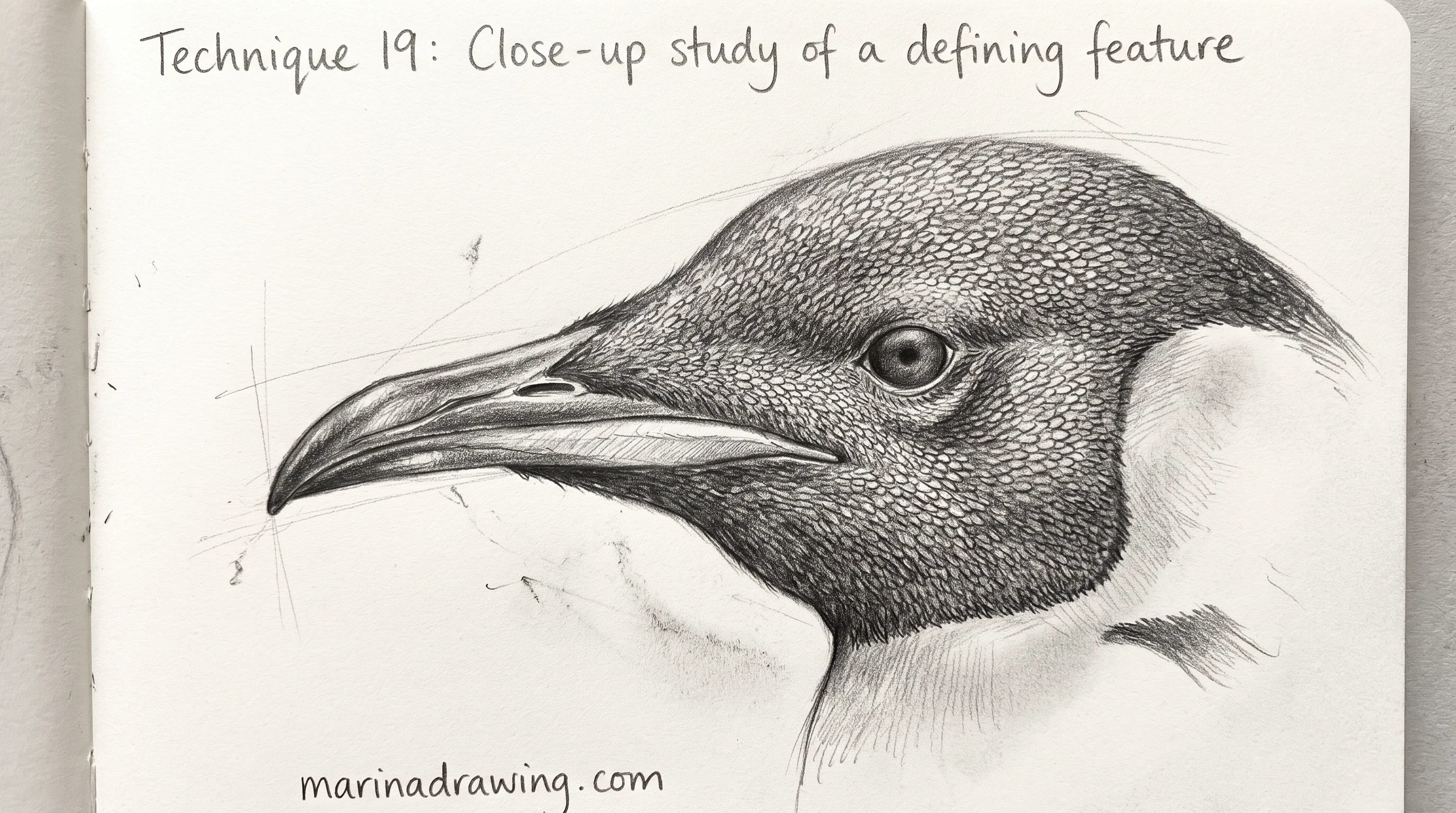
I lay it in lightly first, because the head end is easy to misjudge. Draw one smooth curve for the back, a flatter curve for the belly, and the head at the front pushed forward.
Your order matters here:
- Draw the torpedo body first, with the head end slightly higher.
- Sweep both flippers back along the body, like arms at the sides of a diver.
- Put the feet at the back, soles up, lifted off the ground.
If your slider looks like a seal, the flippers are too long. Shorten them to paddles. The same smooth torpedo body is the starting point for easy dolphin drawing ideas.
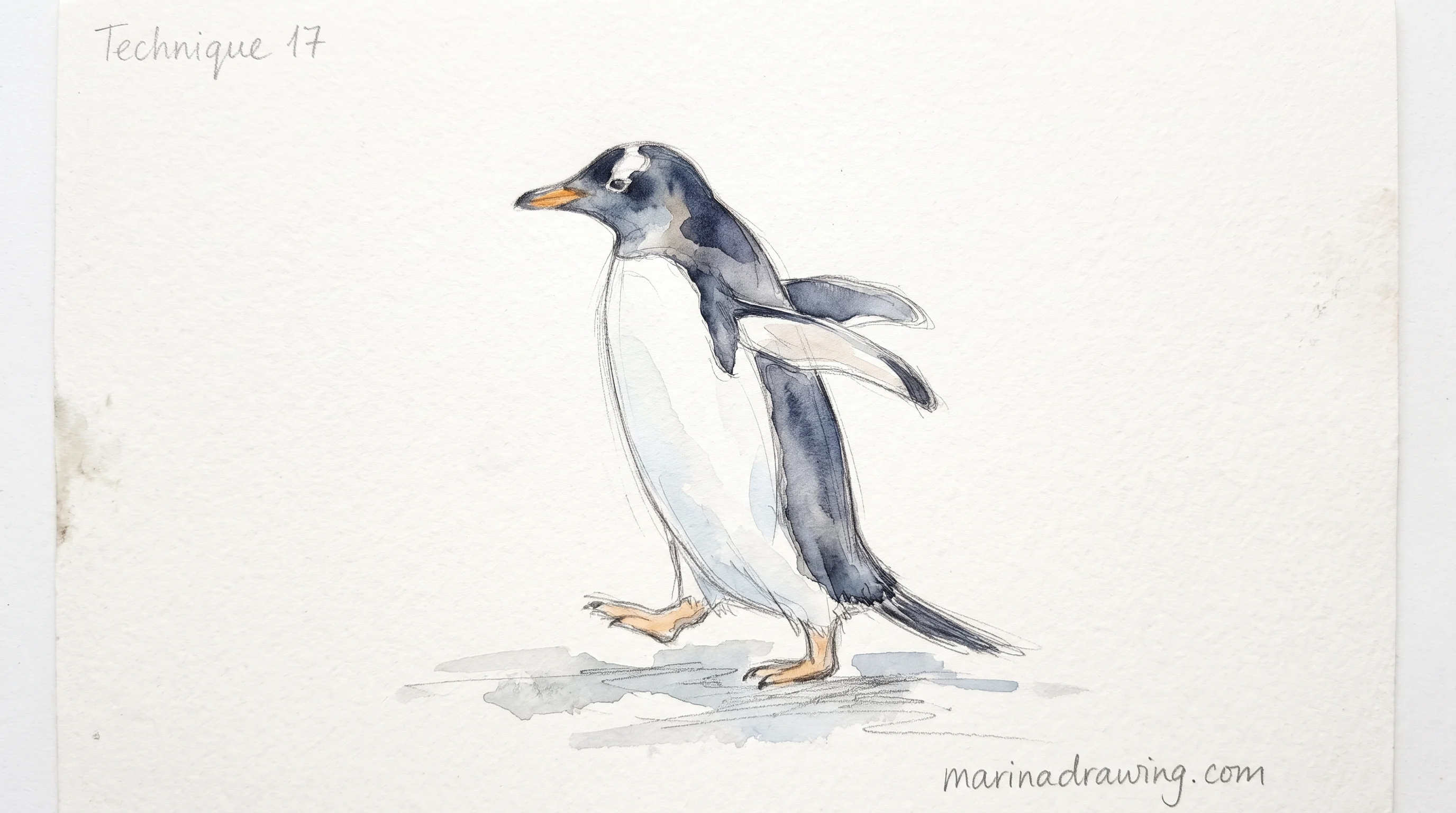
5. A waving penguin
Here you lift one flipper. It leaves the shoulder at an angle, bends slightly at the middle and ends in a soft rounded tip. The other flipper stays down.
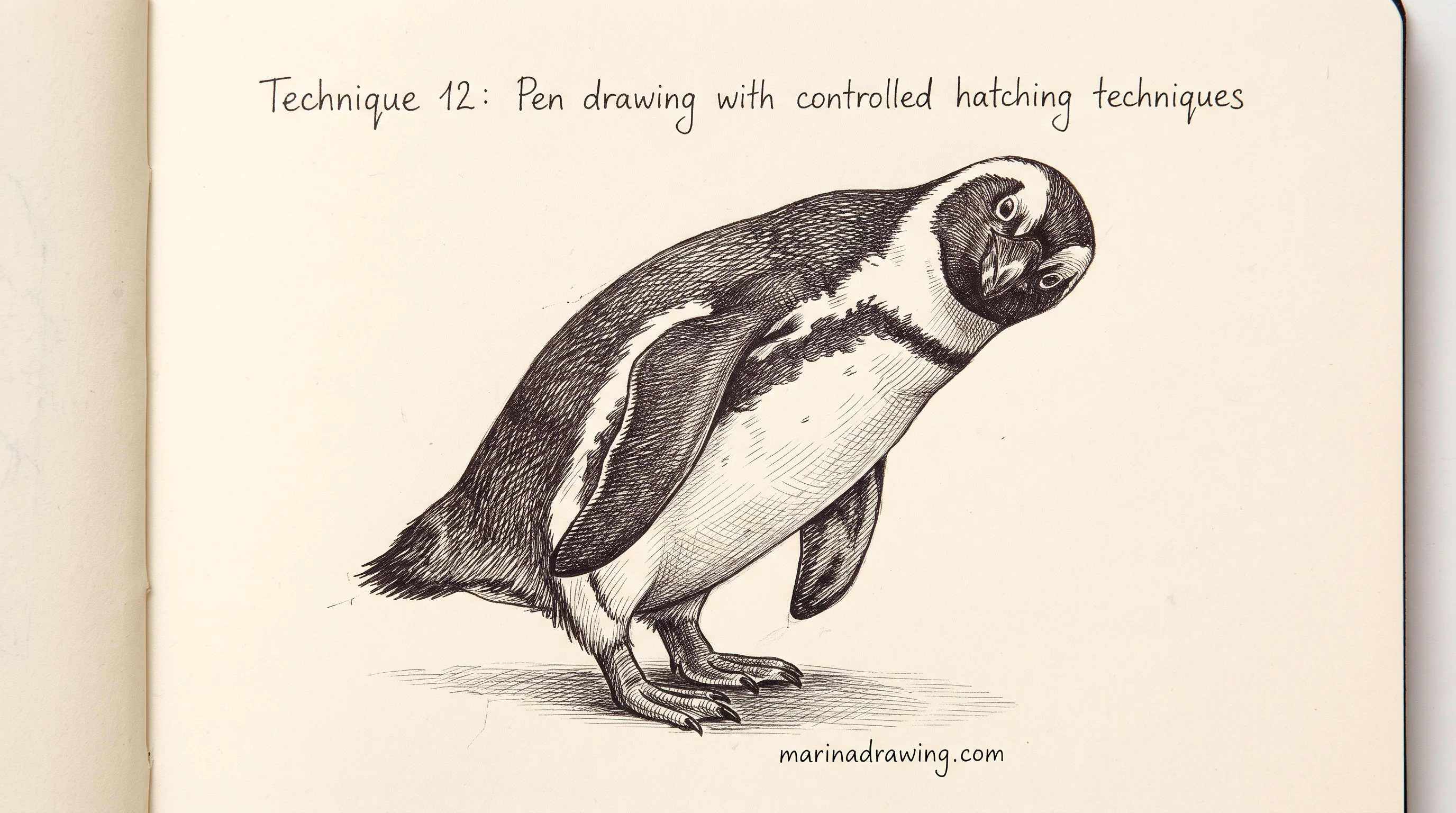
Tilt the head a little toward the raised side, and the whole body leans into the wave. That small lean is what stops the pose from looking stiff.
I tilt the head first and the flipper second. Keep your feet planted and wide, because a raised flipper changes the balance and the base has to answer it.
6. A kawaii penguin drawing
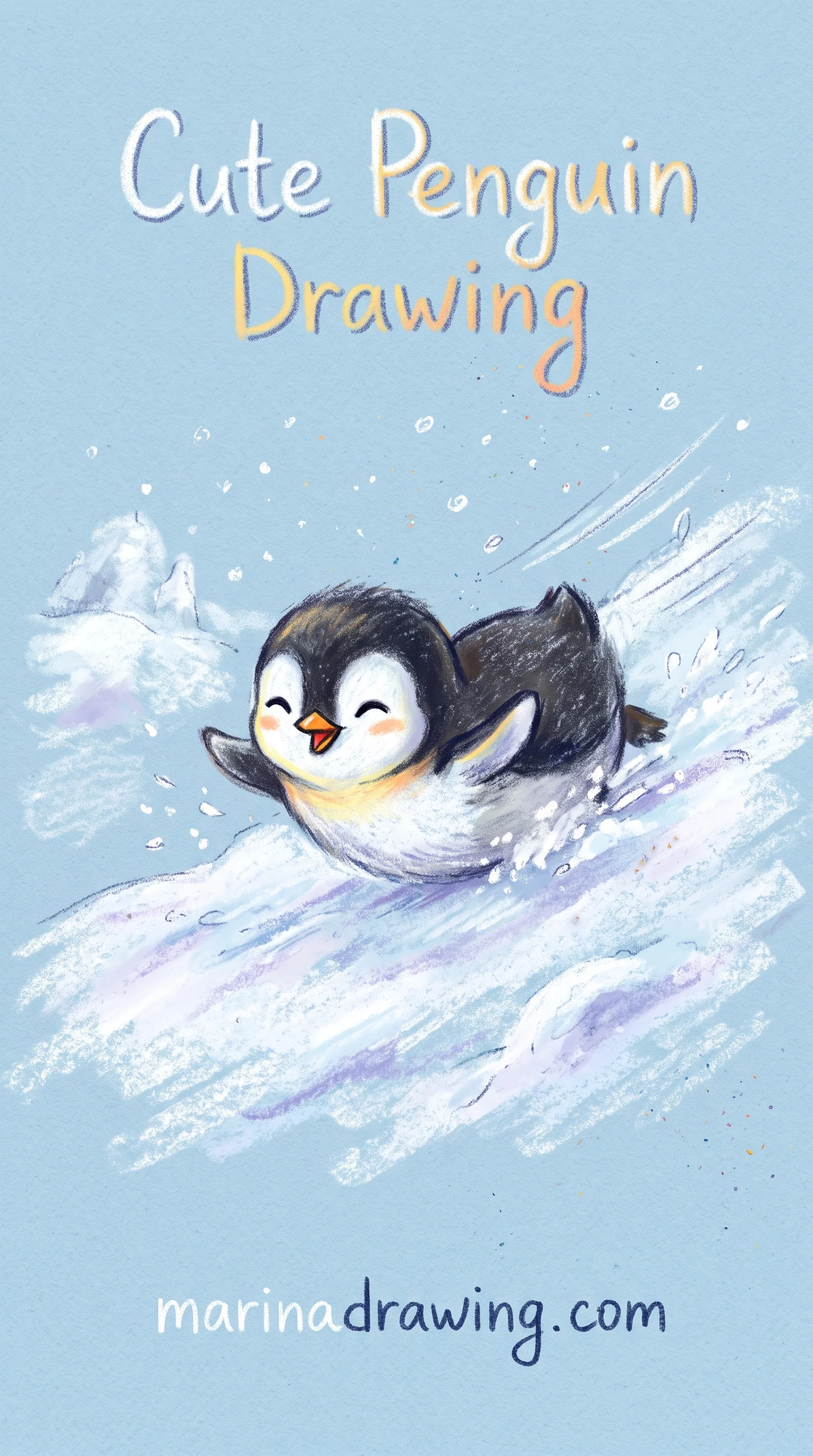
Kawaii is the baby ratio pushed further. A round body, nearly a circle, a head that merges into it with no neck, tiny dot eyes set wide apart and a very small beak.
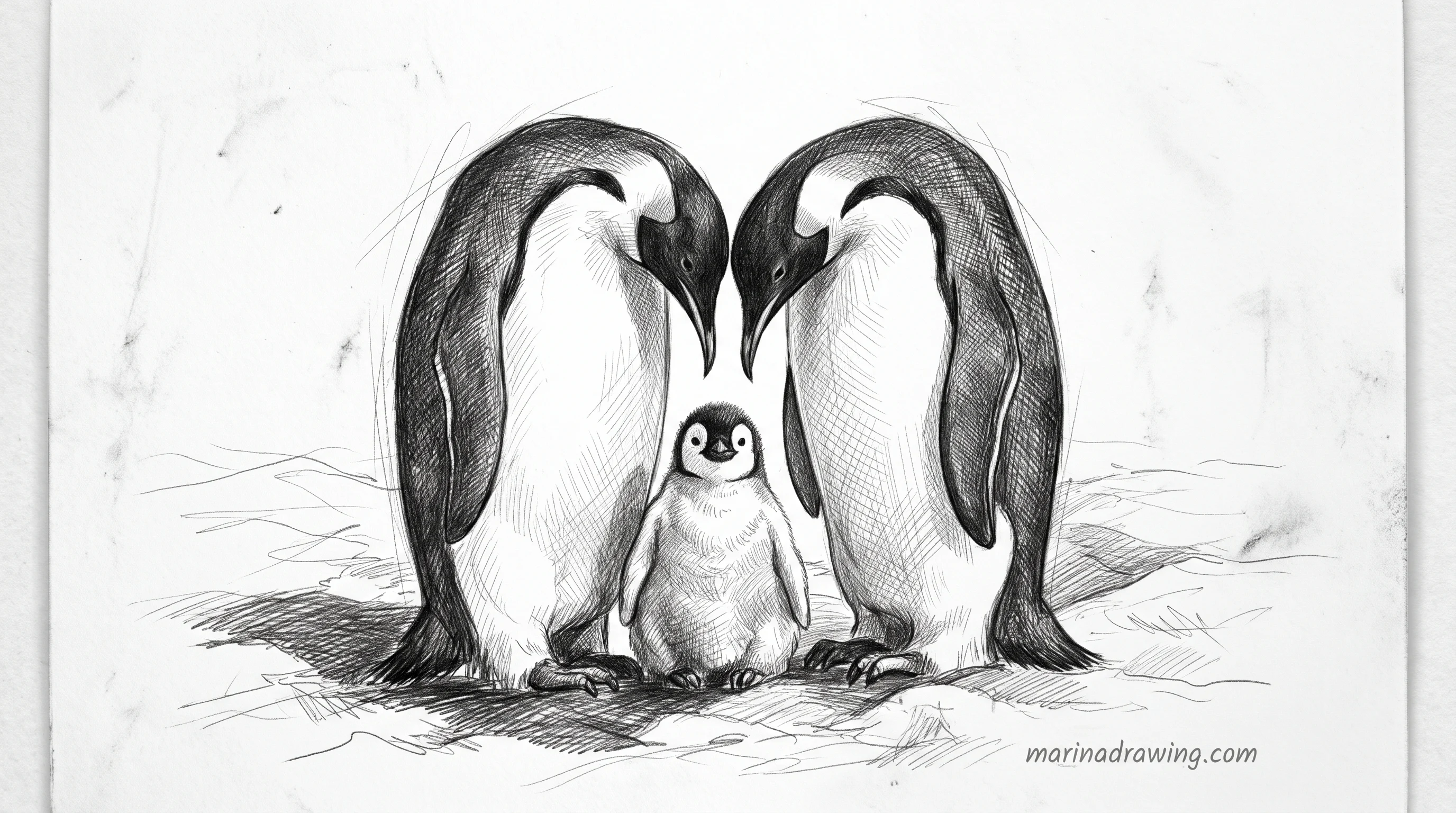
One line weight for the whole outline, thicker than you think, and every shape closed. The silhouette carries everything. If it still reads as a penguin when you fill it solid black, the drawing is done. For drawing fast and accurately, the How to Draw Quick Sketches class is a practical place to start.
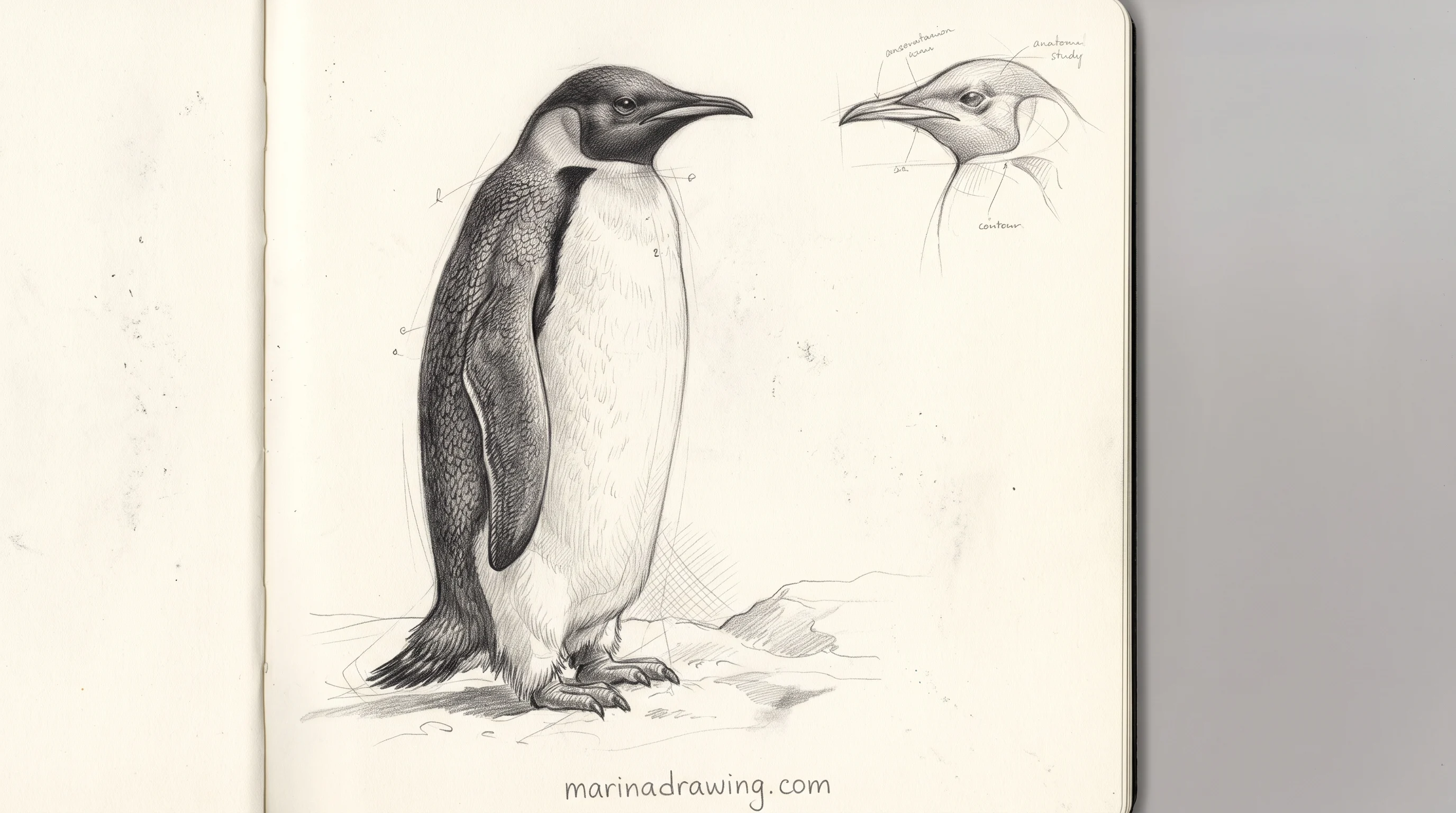
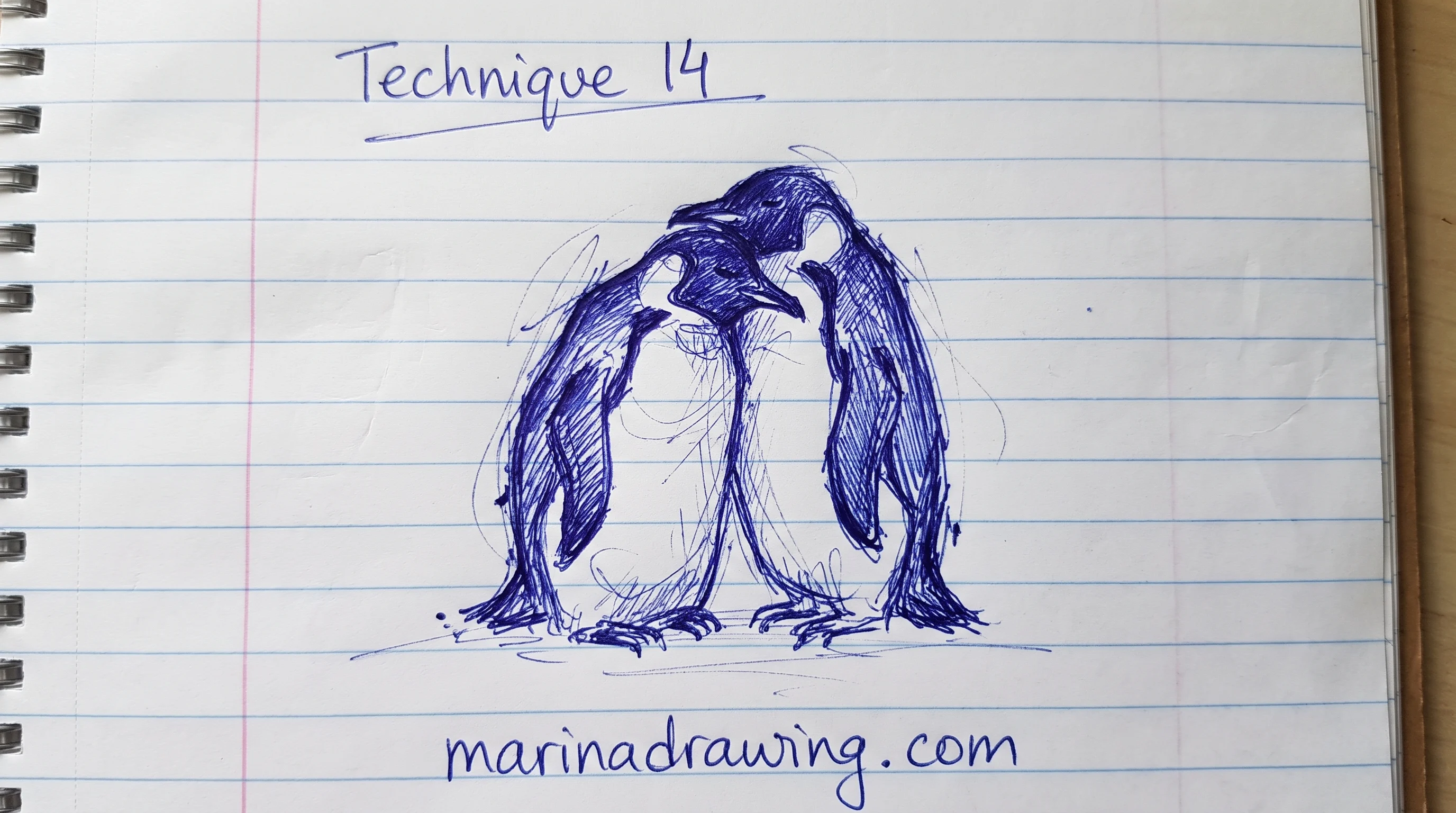
7. A penguin couple drawing
Two penguins are one drawing with a relationship in it.
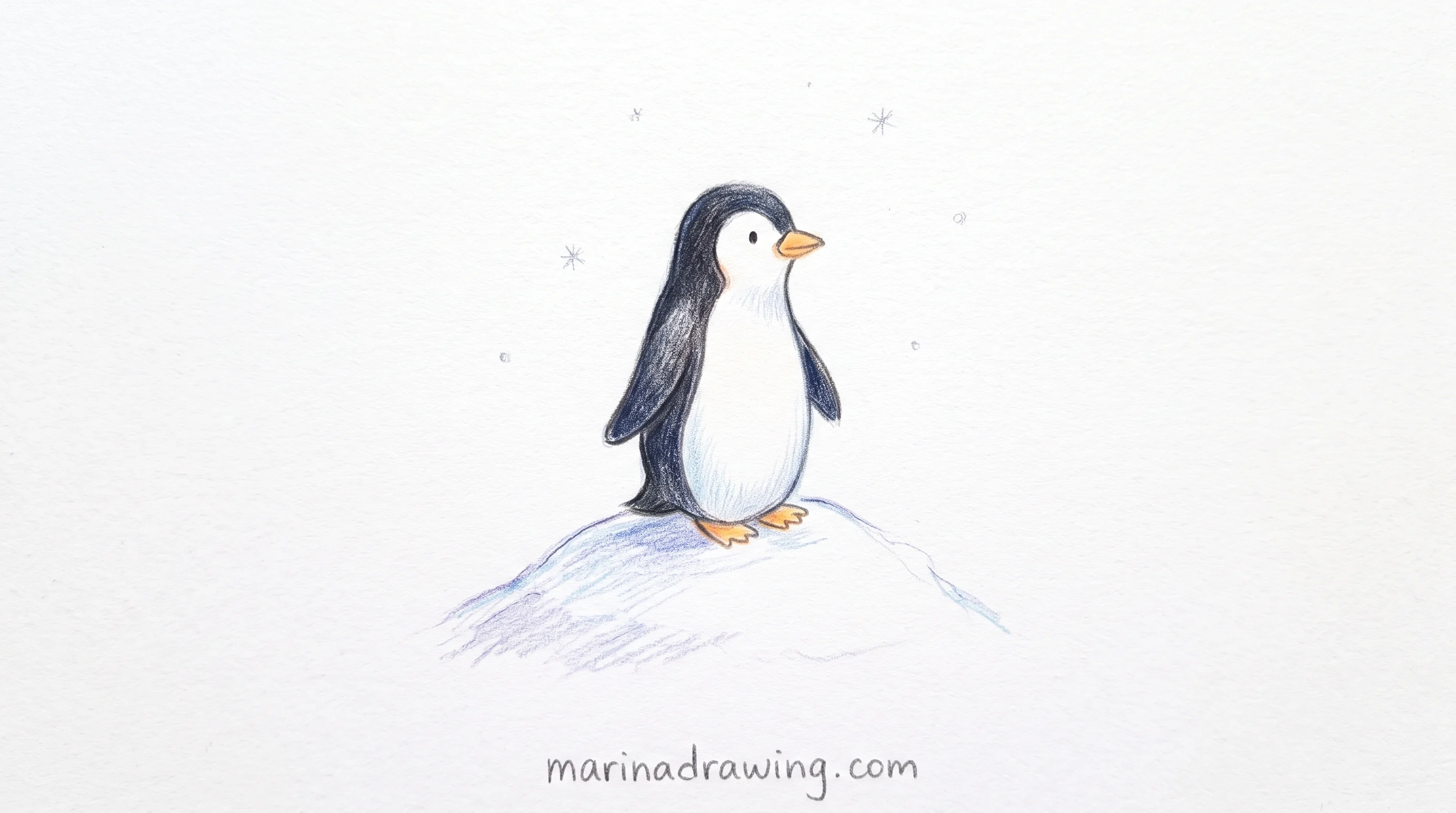
Draw the larger one slightly behind and the smaller one in front, with their heads turned toward each other. Overlap the bodies by a third so they read as a pair rather than two separate sketches.
Your belly masks should follow the lean of each body.
If both curves are identical, the pair looks copied. You make one belly a little wider and one head a little lower. I always start with the bigger penguin.
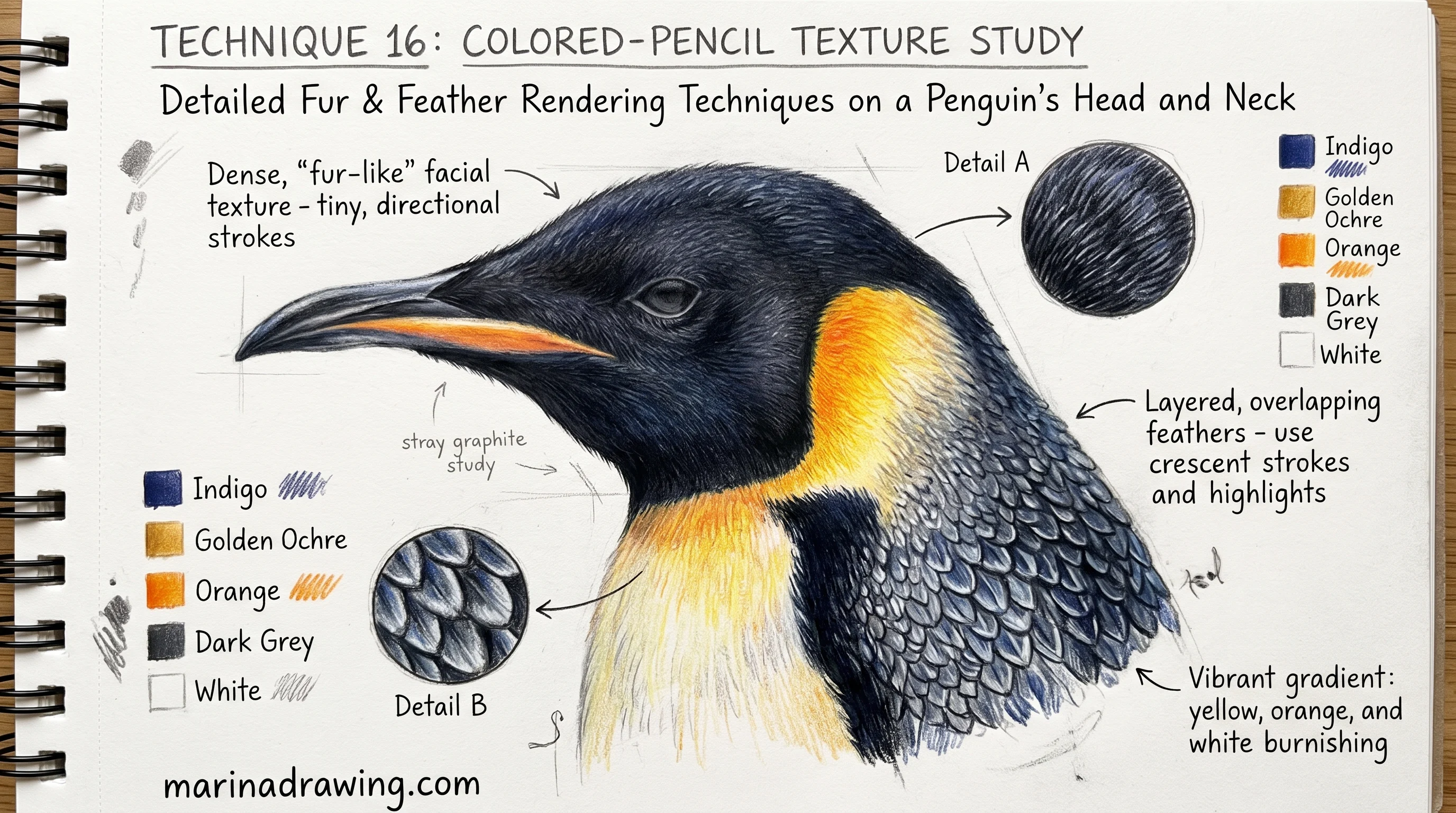
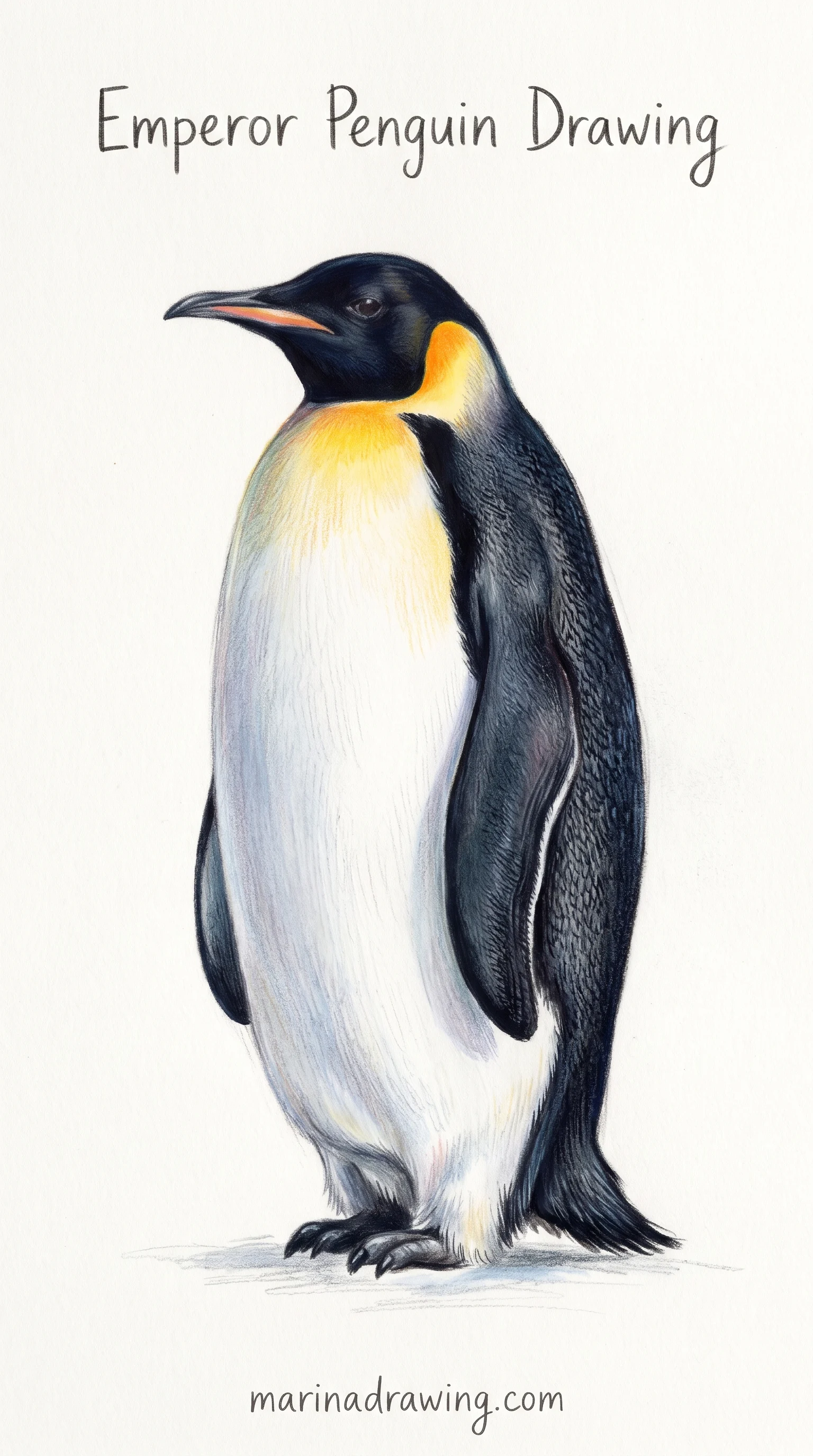
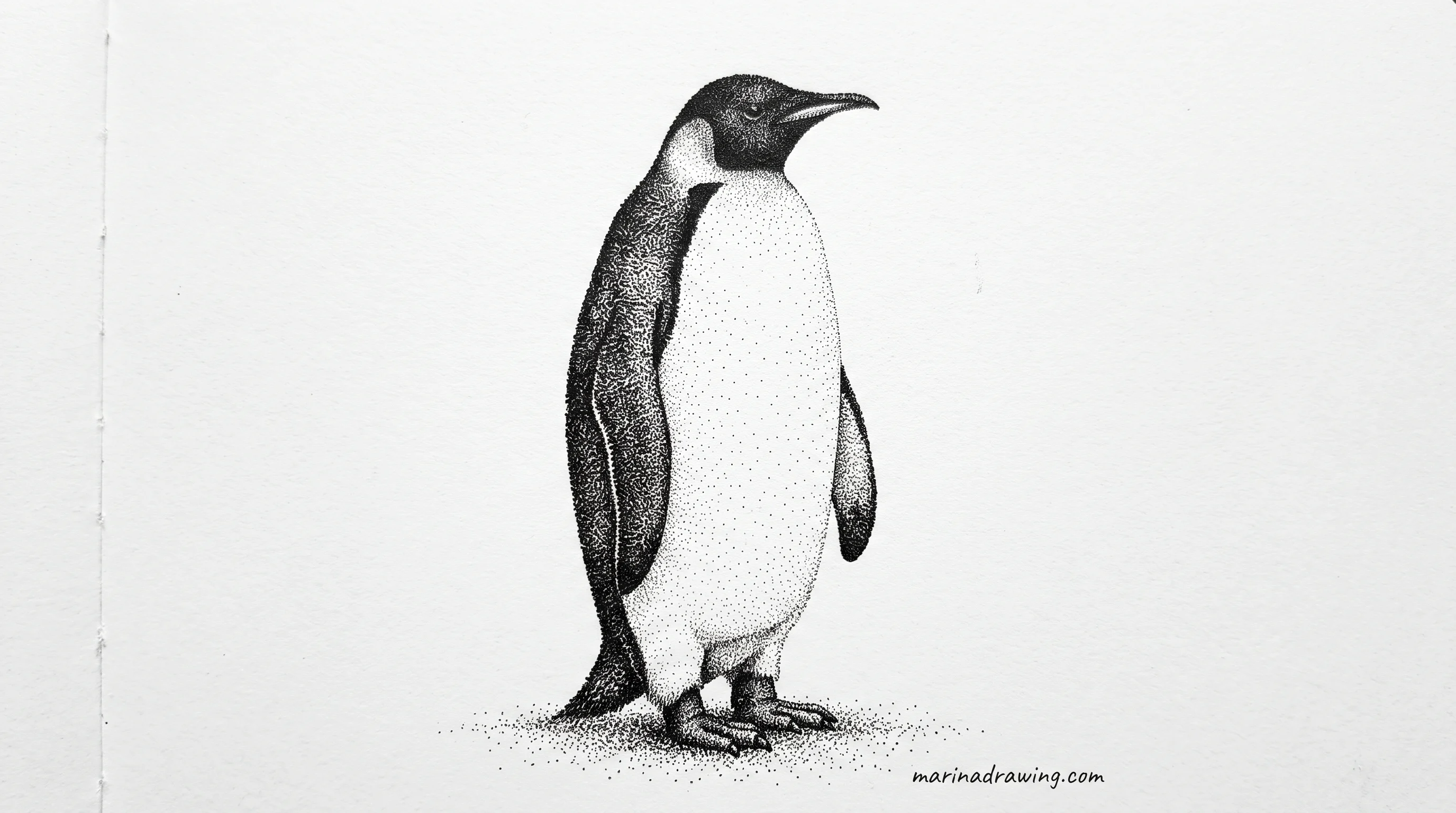
8. An emperor penguin drawing, realistic
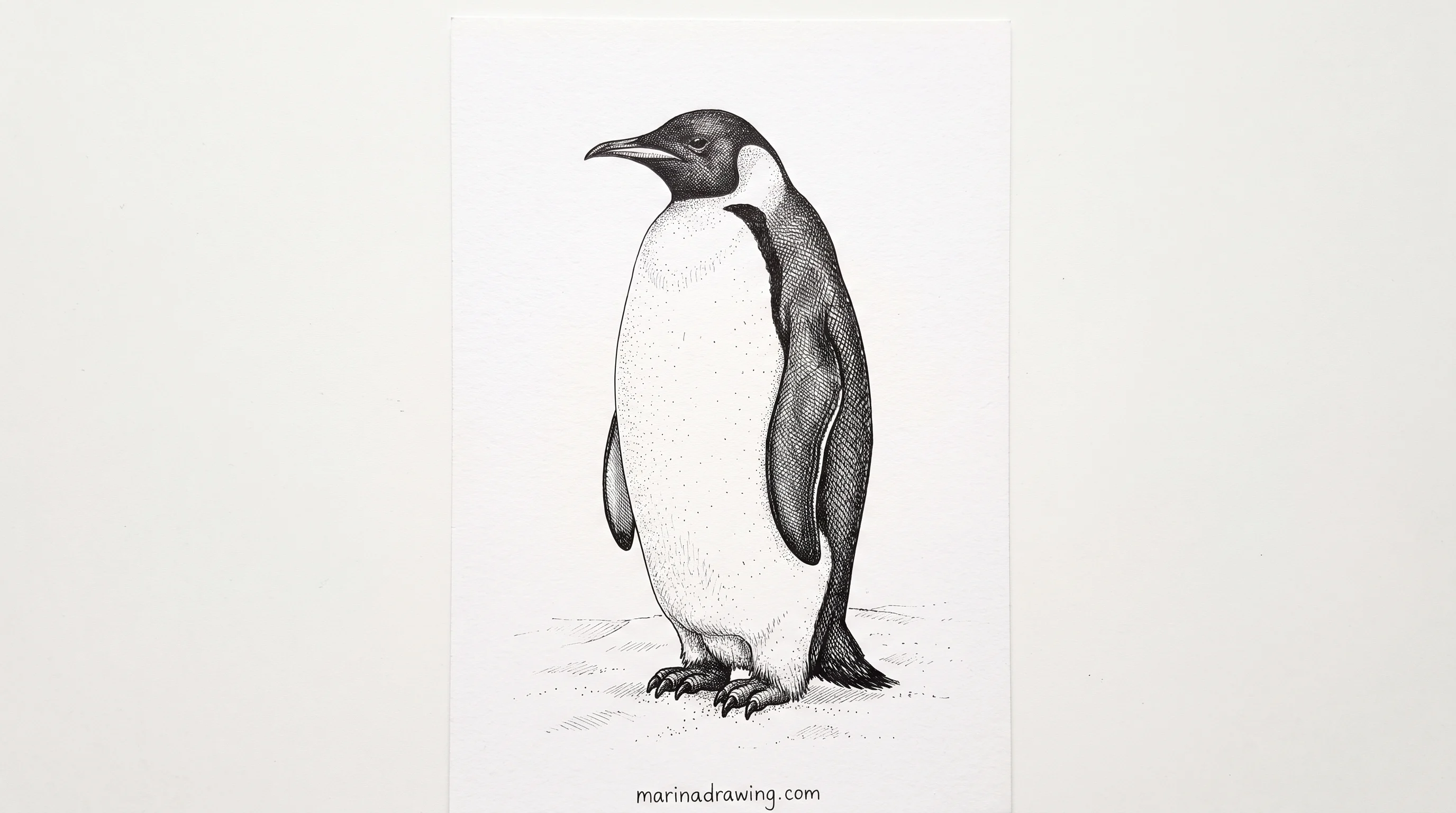
The emperor is the one that needs tone. The head is nearly black, the cheek patch fades from pale yellow to white, and the chest is a long soft shield of light grey.
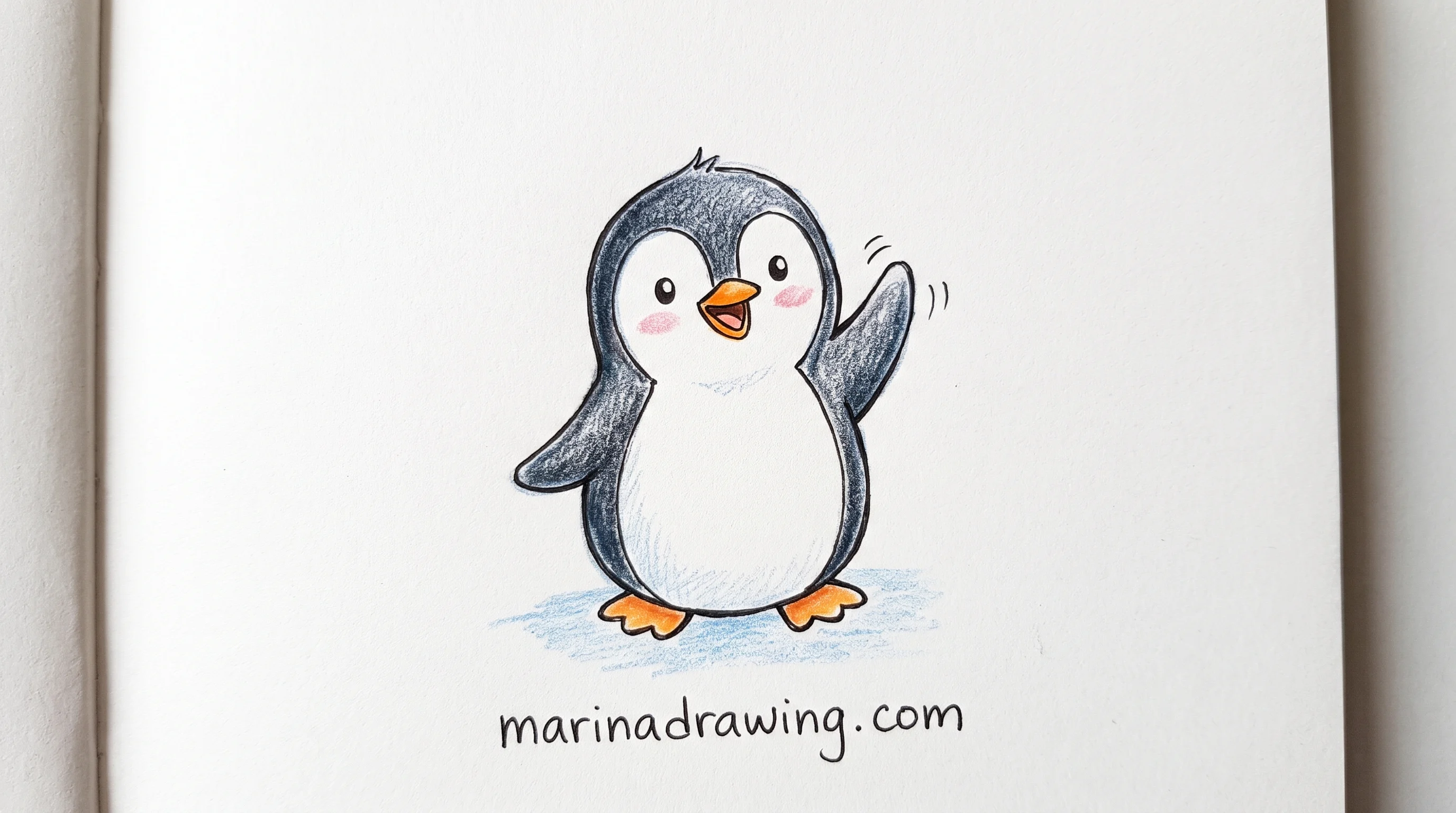
I start with the darkest areas: the head, the back and the flippers. Then a mid grey around the edge of the belly, so it turns with the form. Last, almost nothing on the chest.
The same value habit runs through realistic shading.
For texture, follow the direction the feathers grow with short, light strokes, and let a few break the outline. If yours looks flat, you are missing a dark, not a detail.
This one takes an hour, and it is where knowing the shapes stops being enough. The Shading Techniques in Pencil class covers the light and shadow side.
9. A space penguin
Two quick ones use the base penguin with a prop, and the space penguin comes first. You draw the body, then a round helmet around the head as a big circle with a highlight curve.
10. A penguin with a fish
For the fish, tilt the head up and open the beak a little. Draw the fish as a simple lens shape with a triangle tail and one eye, held in the beak or tucked under a flipper.
Keep your prop about as big as the head. Make it bigger and it takes over the page, so the penguin becomes the accessory. For a starry backdrop, a pack of space and winter scenes gives you reference.
Which mistake did you make?
Put your drawing next to this and read down the left column. I still check my own penguins against it.
| What you see | What is actually wrong | Your fix |
|---|---|---|
| It looks like a sack | The oval has no taper and the belly is a plain circle | Narrow the top of the egg and cut the belly as a U that wraps the body |
| It looks like a bowling pin | The oval is perfectly vertical with no lean | Tilt the body forward a few degrees |
| It looks like a duck | The beak is long and flat, the feet are webbed and small | Use a short diamond beak and two flat triangle feet |
| It is about to fall over | The feet sit under the body or point inward | Set them wide and slightly forward of the base, pointing out |
| The flippers look like bird wings | They are long and feathered | Draw them as short flat paddles, thinner than the body |
If the same row describes every penguin you draw, your gap is construction rather than practice.
Questions people ask about drawing a penguin
How to make penguin drawing easy?
Draw a tilted egg-shaped oval, cut a U-shaped belly into the front, add two paddle flippers, two flat feet and a small diamond beak. Eight marks. Add nothing until that reads as a penguin to you.
How to draw a penguin step by step?
Start with the body oval, then the belly curve, then the flippers and feet. Eyes and beak come last, on the dark head above the belly. Fill in the dark areas after the shapes are right.
How to make cute penguin drawing?
Round the body, drop the eyes low, make them big, and keep the beak tiny. Oversize the feet and shorten the flippers. It is a ratio, not extra detail.
How to make penguin drawing for kids?
Use the oval and mask version and let them add the face and the colour. Nothing to shade, so it finishes before interest runs out.
How to make penguin drawing realistic?
Build the same oval, then work in three tones: dark head, back and flippers first, a mid grey around the edge of the belly, and bare paper on the chest. Add the soft yellow of the cheek patch last.
How to make penguin drawing with pencil?
Block in the shapes with a light 2B line, lift the guides out with a soft eraser, then build tone in layers. Follow the direction the feathers grow with short strokes.
Which penguin should I draw first?
The easy oval one, then the baby, then the waving one.
Key takeaways
- A penguin is read by its tilted oval and its belly mask. Get those right and the face barely matters.
- The belly is a U-shaped curve that wraps the body, not a circle stuck on the front.
- Feet are flat triangles set wide and slightly forward. Under the body they make the penguin fall over.
- Flippers are short flat paddles, not bird wings.
- Cute is a ratio: round body, low big eyes, a tiny beak, oversized feet.
- The emperor needs tone, so draw the darks first.
Draw two or three and you will know which row is yours. I keep the same habit on other animals: the fox, the duck, plain drawing practice.