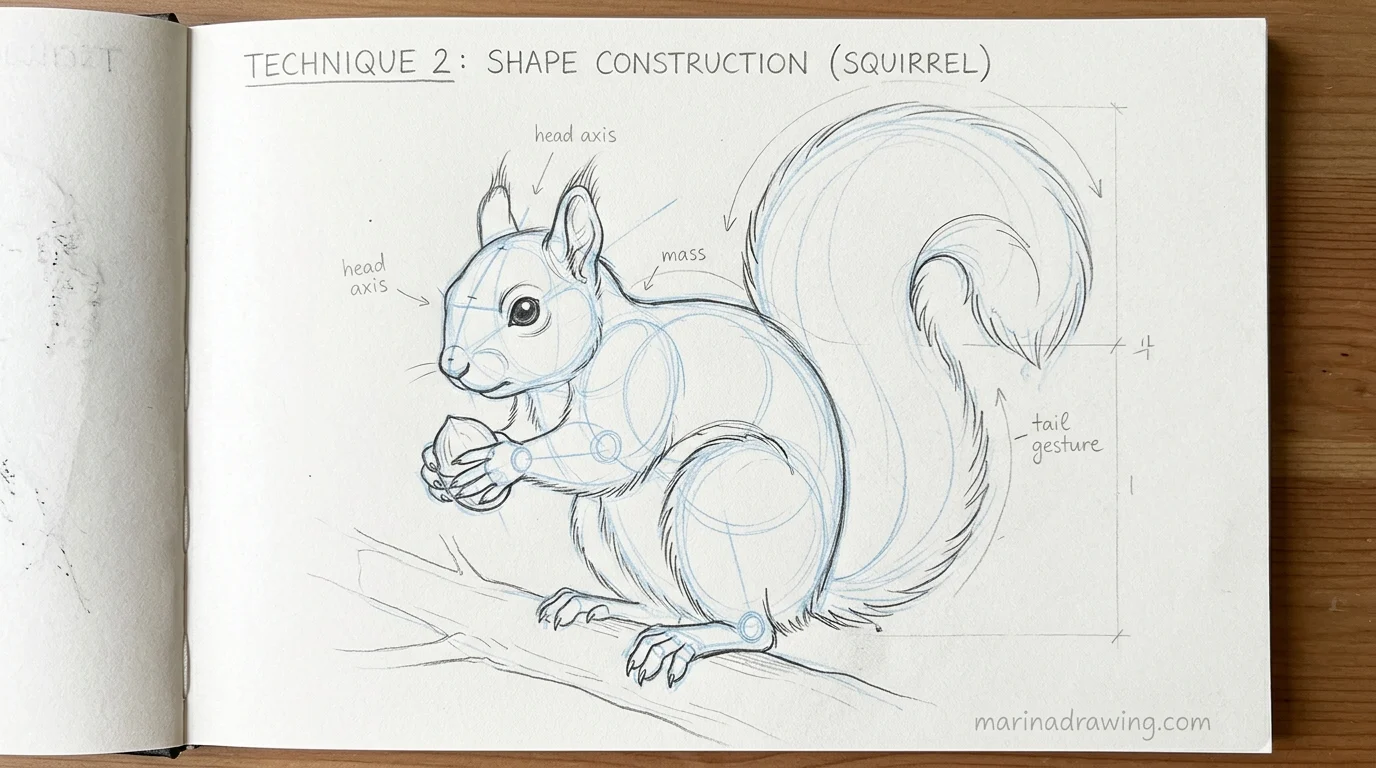
A squirrel is a small upright body, a head that is large for it, long hind legs and a tail as big as everything else put together. That is the whole animal, and it is why a squirrel drawing easy enough to finish in a couple of minutes still works. If your squirrel drawing looks like a rat with a feather duster, the cute face did not fail. The tail and the pose did.
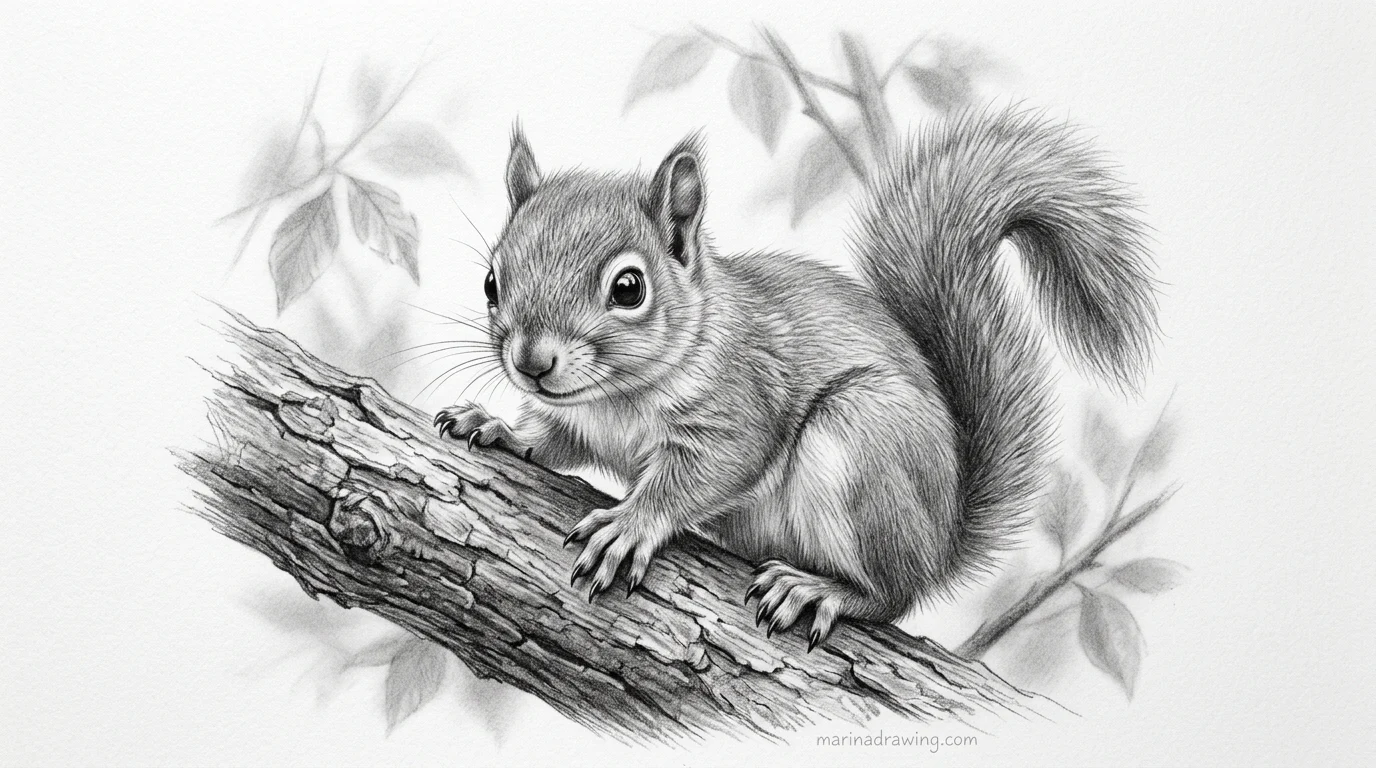
A squirrel reads as a squirrel because of its tail and its sitting pose, not because of its face.
A tail that starts at the base of the spine and curves up behind the head, hind legs longer than the front ones, and a body that sits upright. Lose any of them and you get a rat.
Quick answer: draw a circle for the head, a slightly larger oval below it for the body, two small paws at the chest and a bent hind leg at the bottom. Then draw the tail as one big S-curve that starts at the base of the back and rises above the head. Add the eye, the nose and an acorn. Pick your version from the seven below and read the table near the end for your mistake.
If you would rather watch one built, the Drawing a Squirrel in a Tree lesson at Online Art Lessons is a step-by-step lesson with tips on realistic fur, detailed eyes and natural textures.
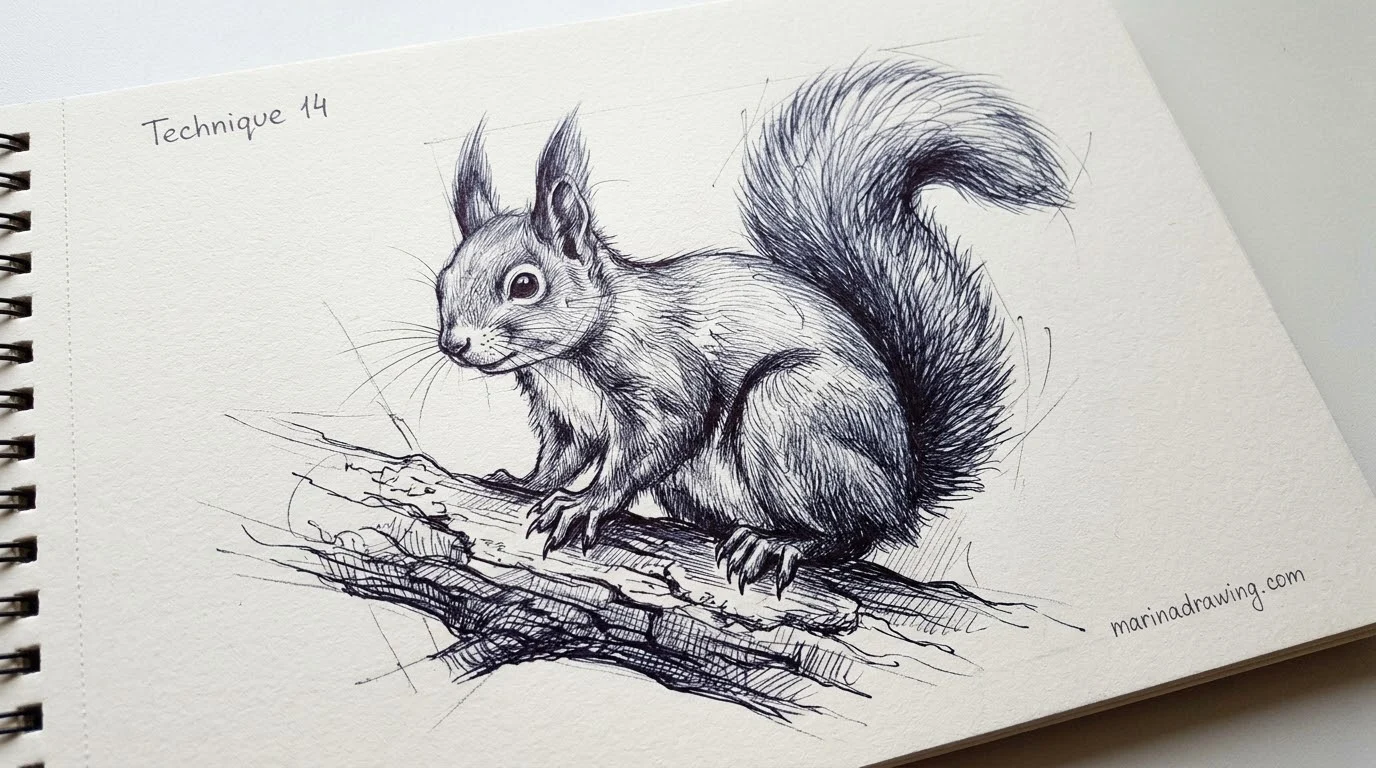
A big tail and a tall sitting pose make the squirrel
Every squirrel here starts with the same four light marks, and you put them down before any detail.
- The body. Draw one upright oval, leaning a little forward. A squirrel sits like a person on a stool, with its back curved.
- The head. Make a circle that is about half the height of the body. Squirrels have big heads for their size, and that is a large part of why they look friendly.
- The hind leg. A big rounded thigh at the bottom with a long narrow foot pointing forward. Keep it longer than the front paws, always, or your squirrel cannot sit.
- The tail. One S-curve from the lower back, rising up behind the head and curling over at the tip. It is about as tall as the whole sitting body.
Now the small things. Your eye is a dark round dot, set to the side of the head, with a thin light ring around it. Keep the ears short and rounded, and make the nose a tiny oval at the end of a short muzzle.
Leave the fur for last, and you put it down only after the shape is right. I check the tail before anything else. A fluffy animal with a different build, like in these koala drawing ideas, follows the same order.
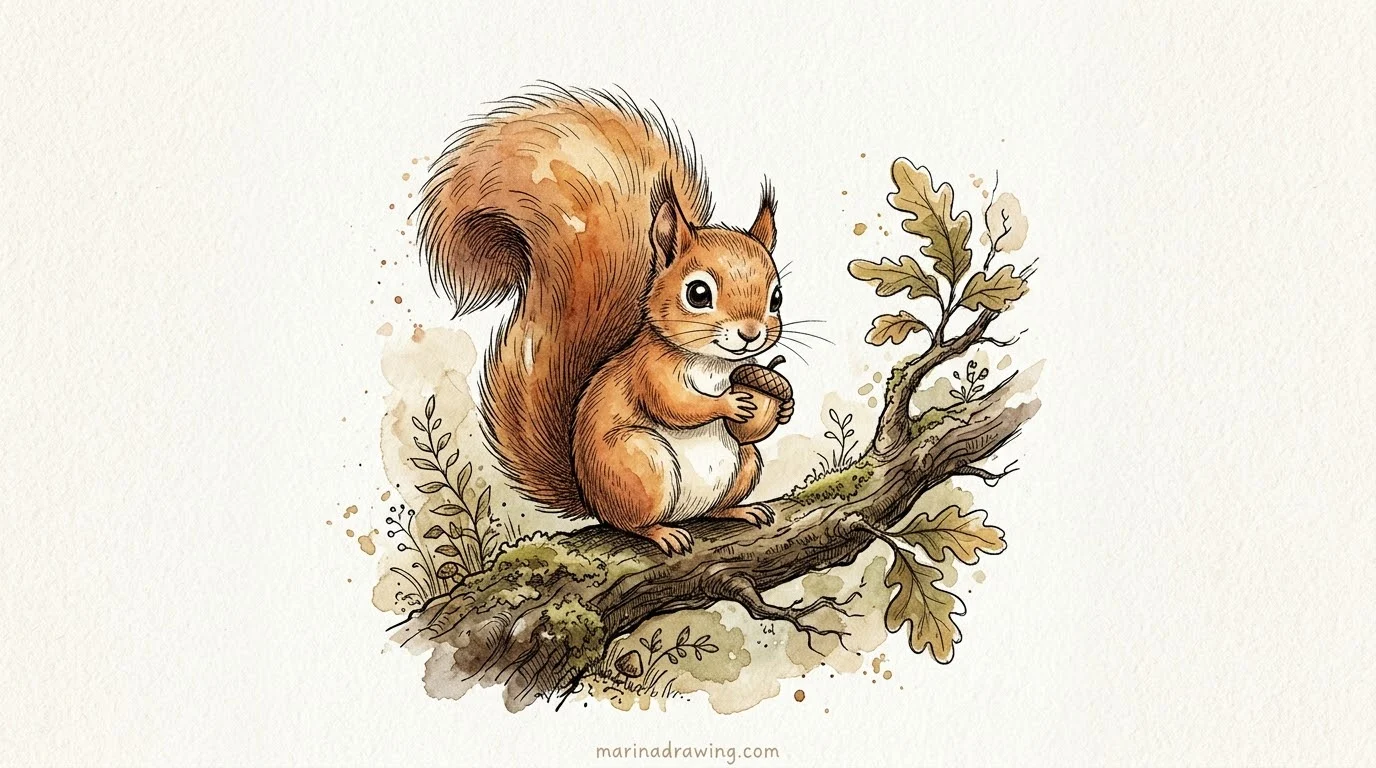
You decide whether your squirrel works when you draw the tail. Everything after that is filling in a decision you already made.
Why your squirrel looks like a rat: four mistakes
Among nine pages that survive the filters for this subject, none is about drawing squirrels in particular, none has a section on the tail, and none shows more than one version of the animal. Open the page with the most trust in the results and you find a hub of lesson thumbnails with no sections at all.
| What was checked | Pages that had it |
|---|---|
| A page about drawing squirrels specifically | 0 of 9 |
| A section on the tail and why it goes wrong | 0 of 9 |
| A set of different squirrels, each with its own method | 0 of 9 |
| Sections on the page at all | 8 of 9 |
Four mistakes account for almost all of the rats, and you have probably made one of them:
- Your tail is a separate sausage stuck on the side, so it has no connection to the back and the animal stops being a squirrel in the first curve.
- Your head is small and your body is long and low, which is a rat or a ferret.
- Your hind legs are the same length as the front ones, so the squirrel cannot sit.
- Your tail is the same width all the way, instead of thin at the base and wide in the middle.
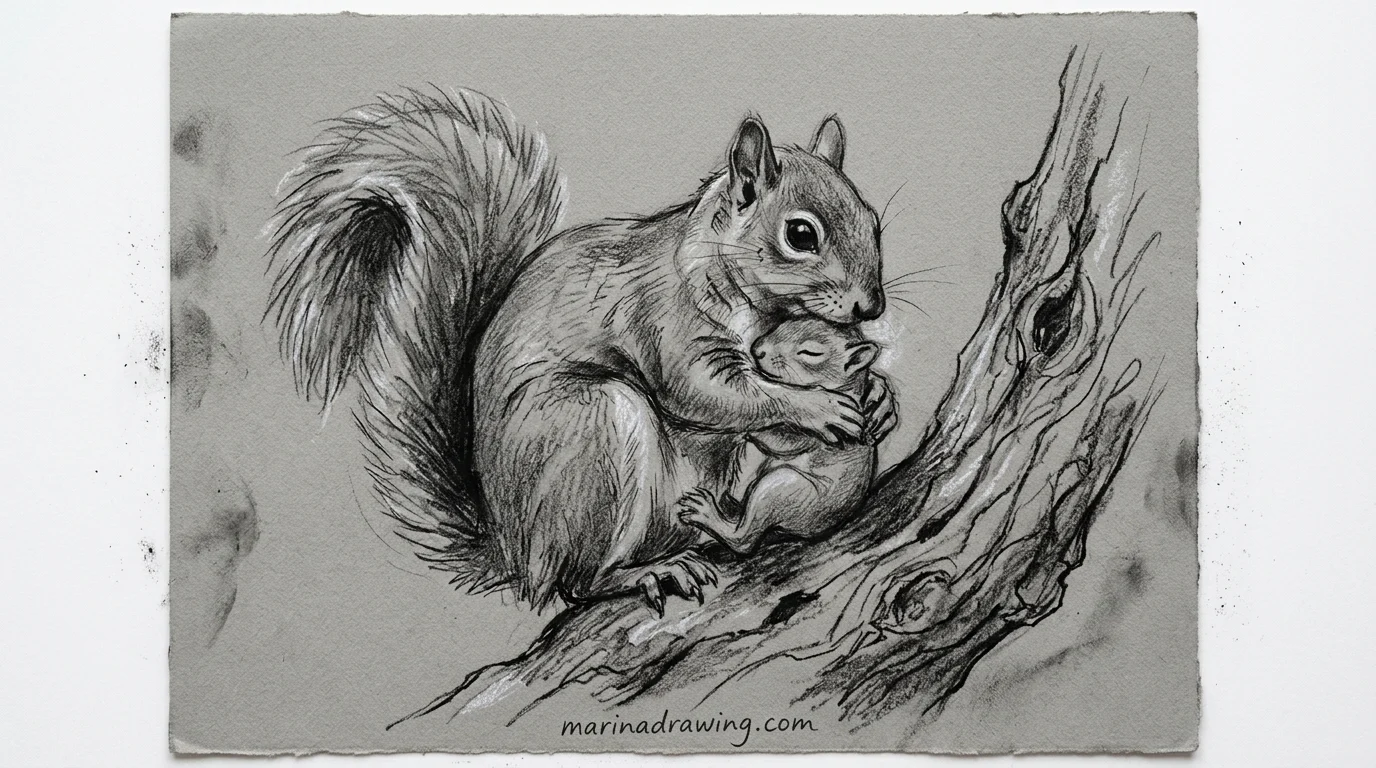
A squirrel drawing tutorial in one line is this: tail first, face last. The same trap shows up on the fox, where the tail also carries the whole silhouette, and on the rabbit.
What you actually need: one pencil and a soft eraser
You need very little for the first six versions here, even if you are an intermediate artist.
- One sharp 2B pencil for the construction lines.
- A soft kneaded eraser that lifts guides out without scrubbing the paper.
- Cheap printer paper. Your squirrel goes wrong in the first minute, so spend nothing on the surface.
- For the red squirrel only: an orange, a brown and a dark brown colored pencil.
1. Squirrel drawing easy: three circles and an S tail
You draw this one first, and your kids can do it too. It takes a couple of minutes: a circle head, a taller oval body, two paws, a bent hind leg, the S tail, one eye and a nose. Nothing else.
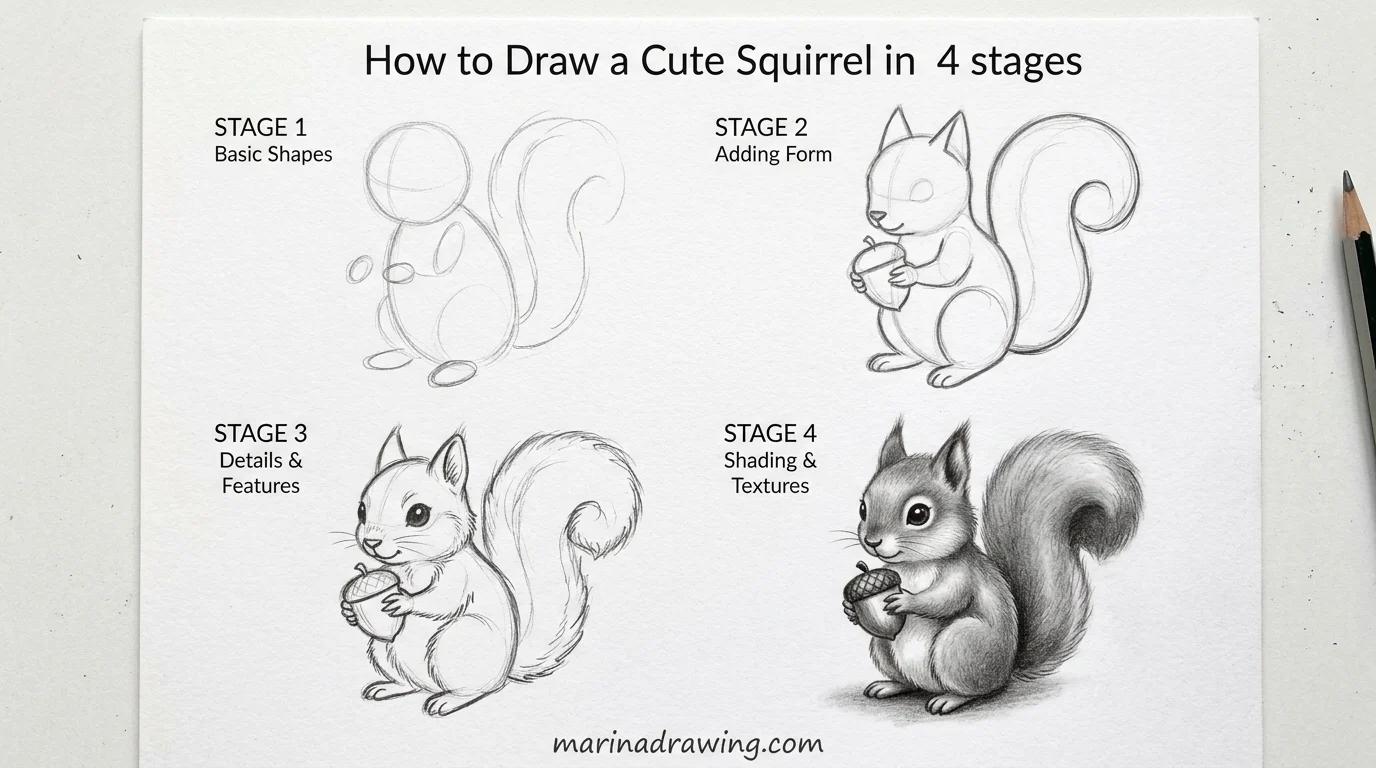
The tail is the part you will probably get backwards, so treat the squirrel tail drawing as its own step. Start it low on your squirrel’s back, let it swing out and up, and finish above the ears. Keep it wide in the middle and narrow at the base, and you will see the whole drawing lean the right way.
Treat it as a five-day challenge, one of those drawing prompts artists use: draw it five times, making the tail a little bigger each time. Keep your hand loose. I always do it this way, and you will see the animal change before you add a single line of fur. A ringed tail changes the job, as in these raccoon drawing ideas.
2. A cute squirrel holding an acorn
A cute squirrel drawing is a ratio, not a style. Make the head bigger, nearly as wide as the body, and drop the eyes lower than you think they should go. Big and low reads as young.
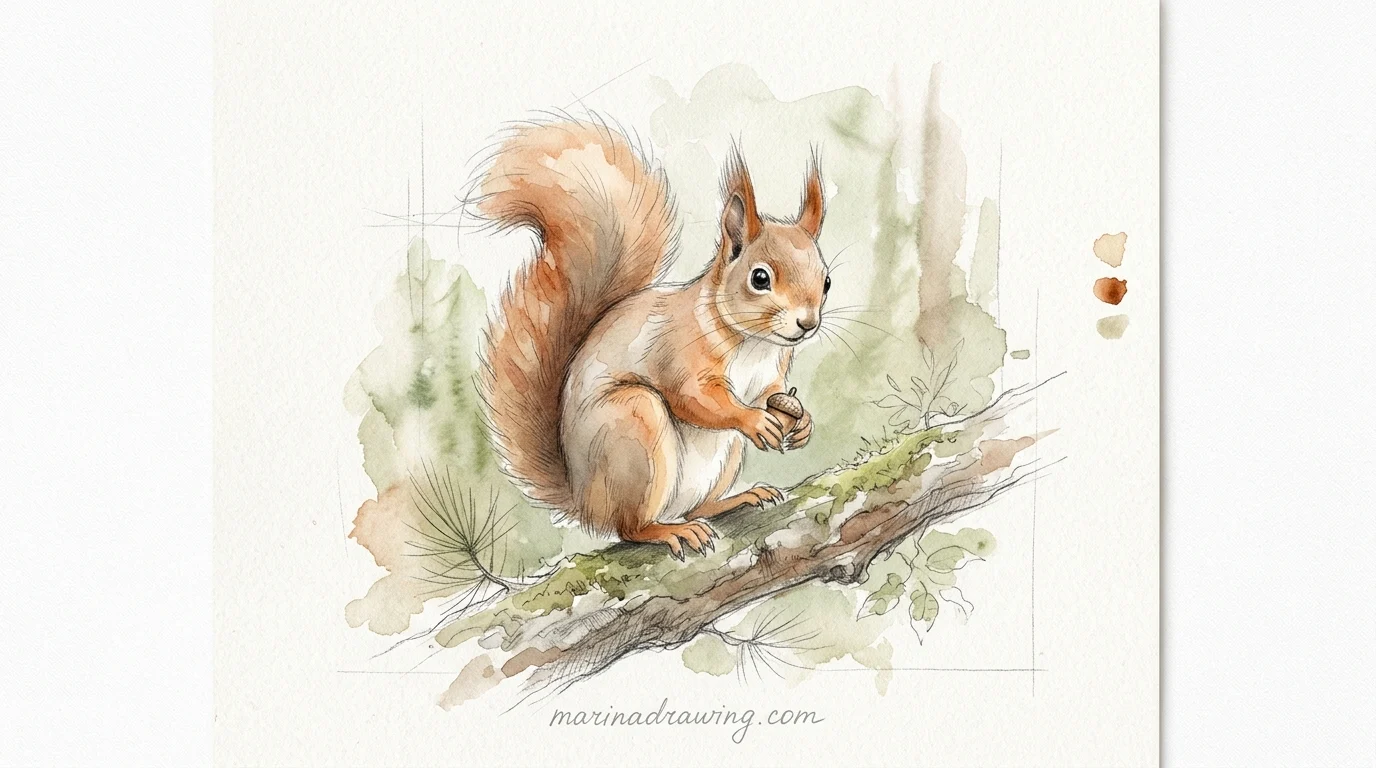
Bring both paws to the chest and put an oval acorn between them, with a small cap on top. The acorn tells your viewer what the squirrel is doing, so you can keep the face plain.
Keep the tail soft and round at the tip, with two or three curved lines inside it and no more.
For ready-made reference sheets of woodland animals, a library of drawing guides saves guessing.
3. A flying squirrel drawing
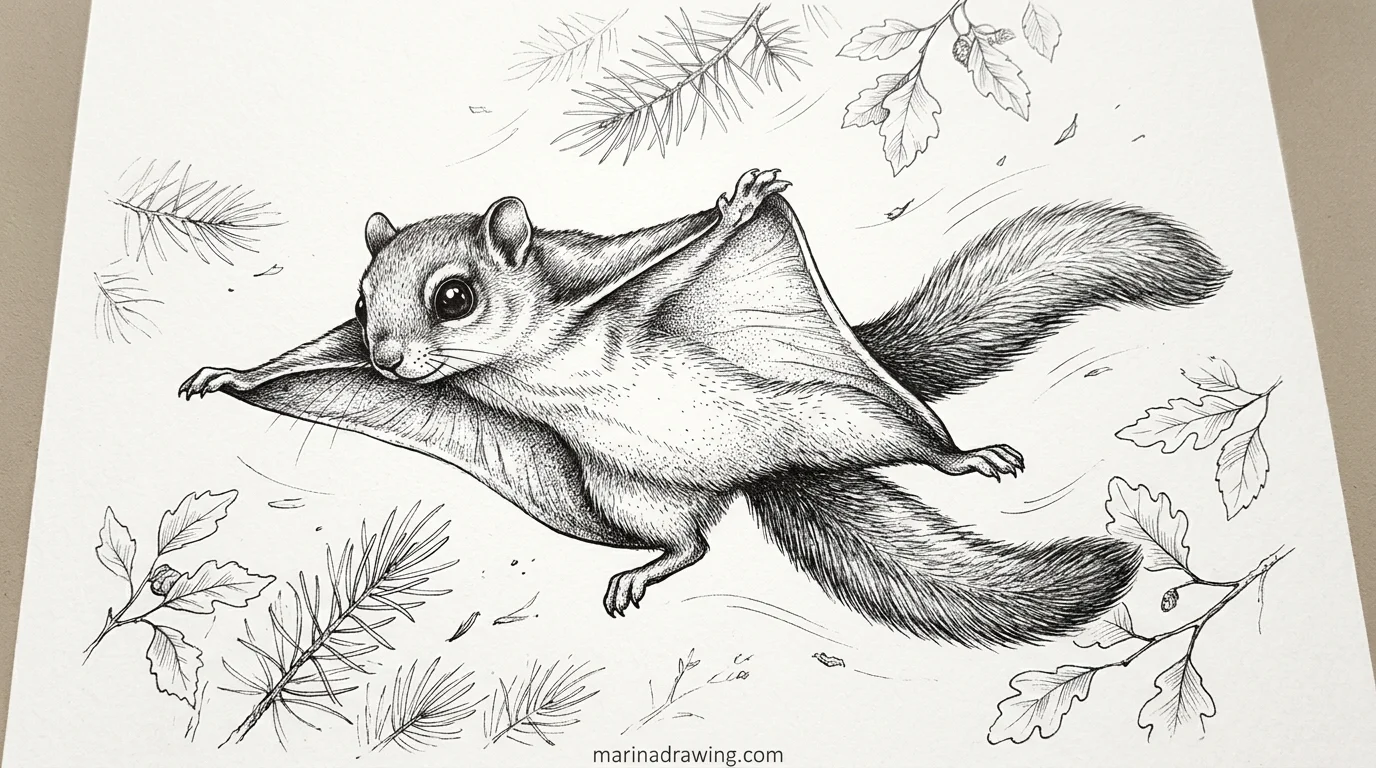
A flying squirrel drawing is the same animal with a different outline. The legs stretch out to the sides, and a thin fold of skin joins each front leg to the hind leg, forming a flat rectangle around the body.
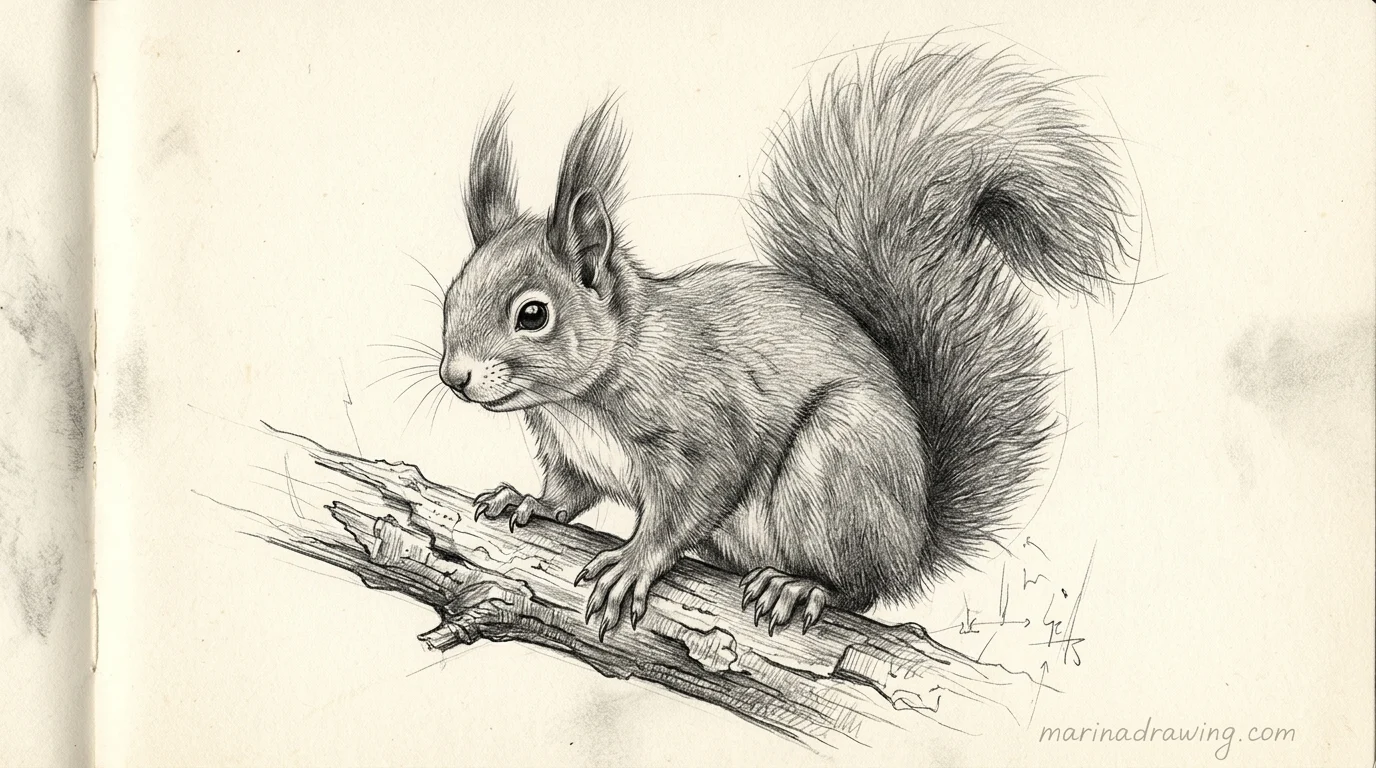
Draw the body first, as a small oval in the middle. Then you pull four limbs outward like an X, and connect them with gently curved edges. The tail stays behind, flat and narrow rather than bushy.
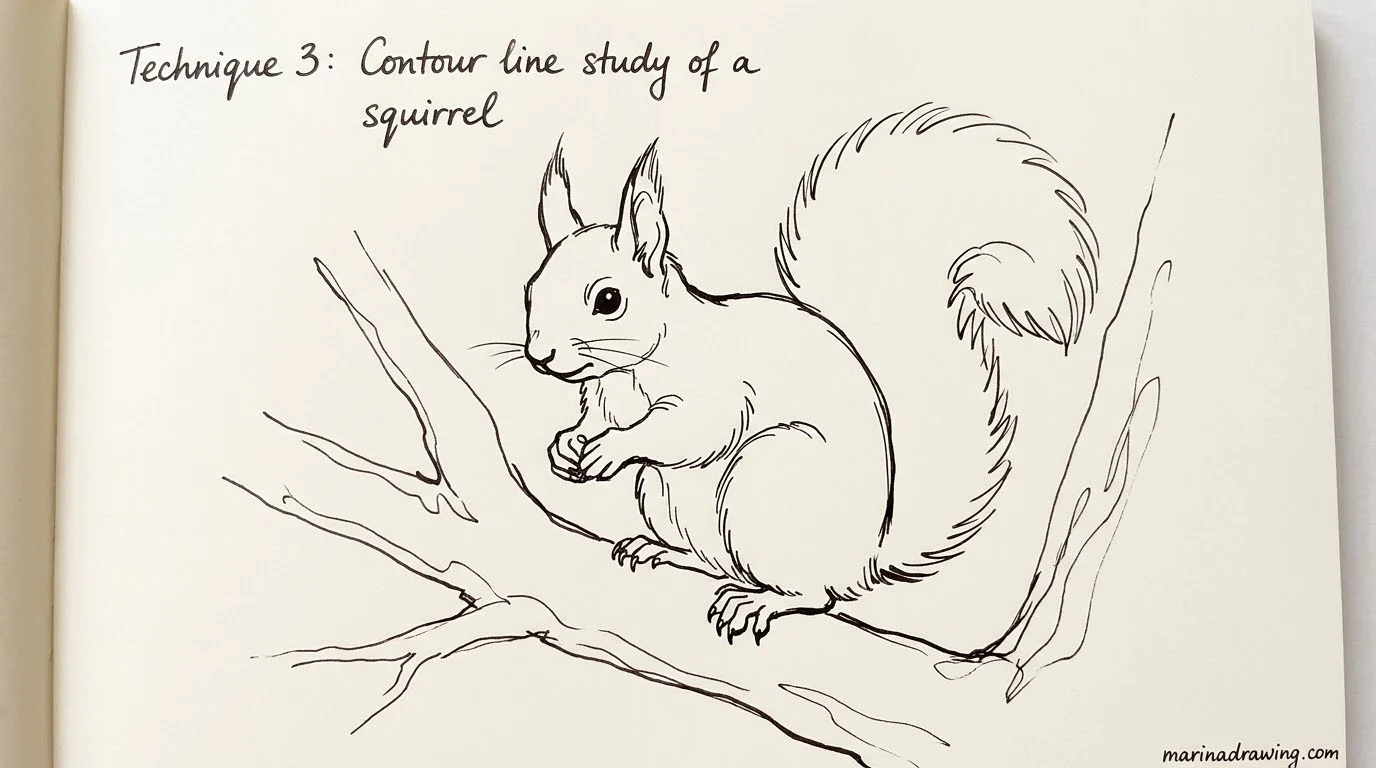
The eyes are huge and round compared with a ground squirrel. That one change tells people you drew a night animal.
4. A squirrel sketch from a quick pose
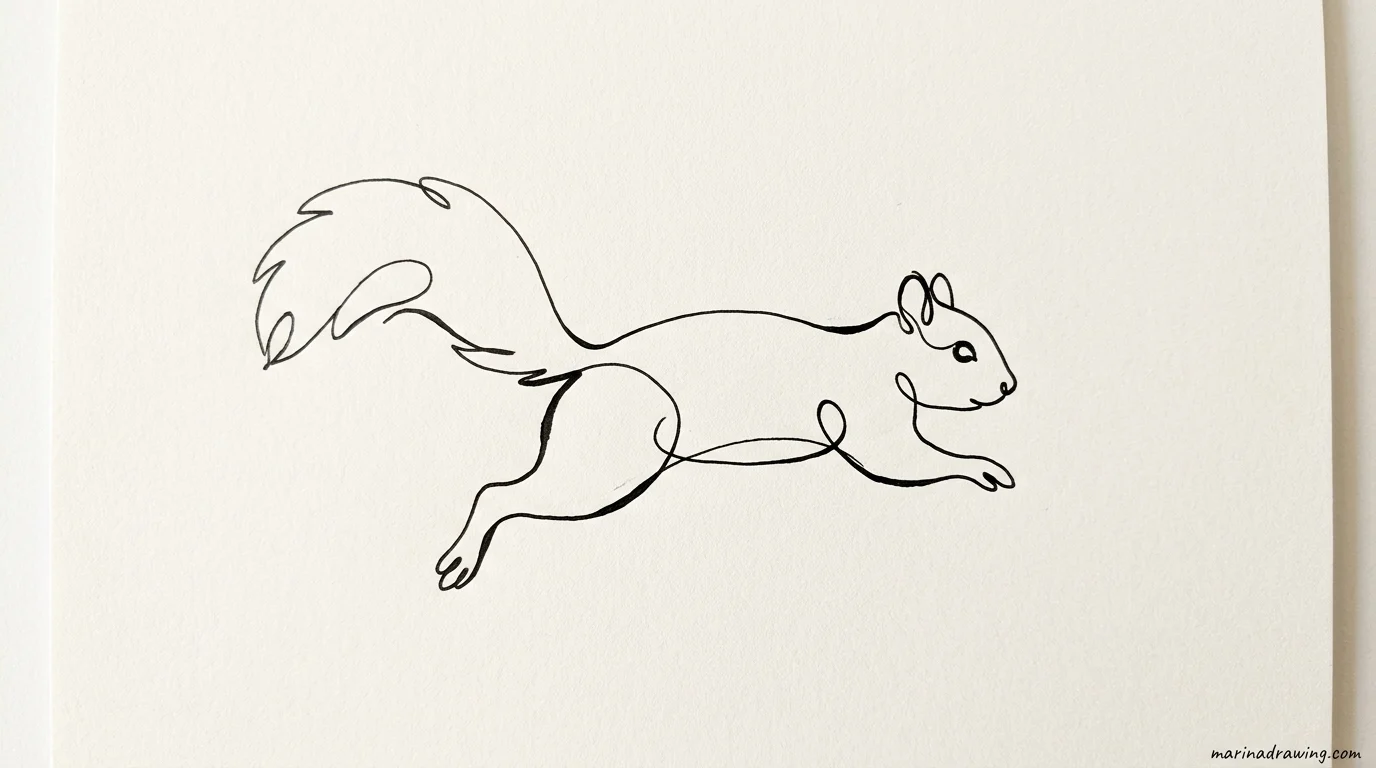
Squirrel drawing sketches are about speed. A squirrel never holds a pose for more than a few seconds, so you have to work in three marks.
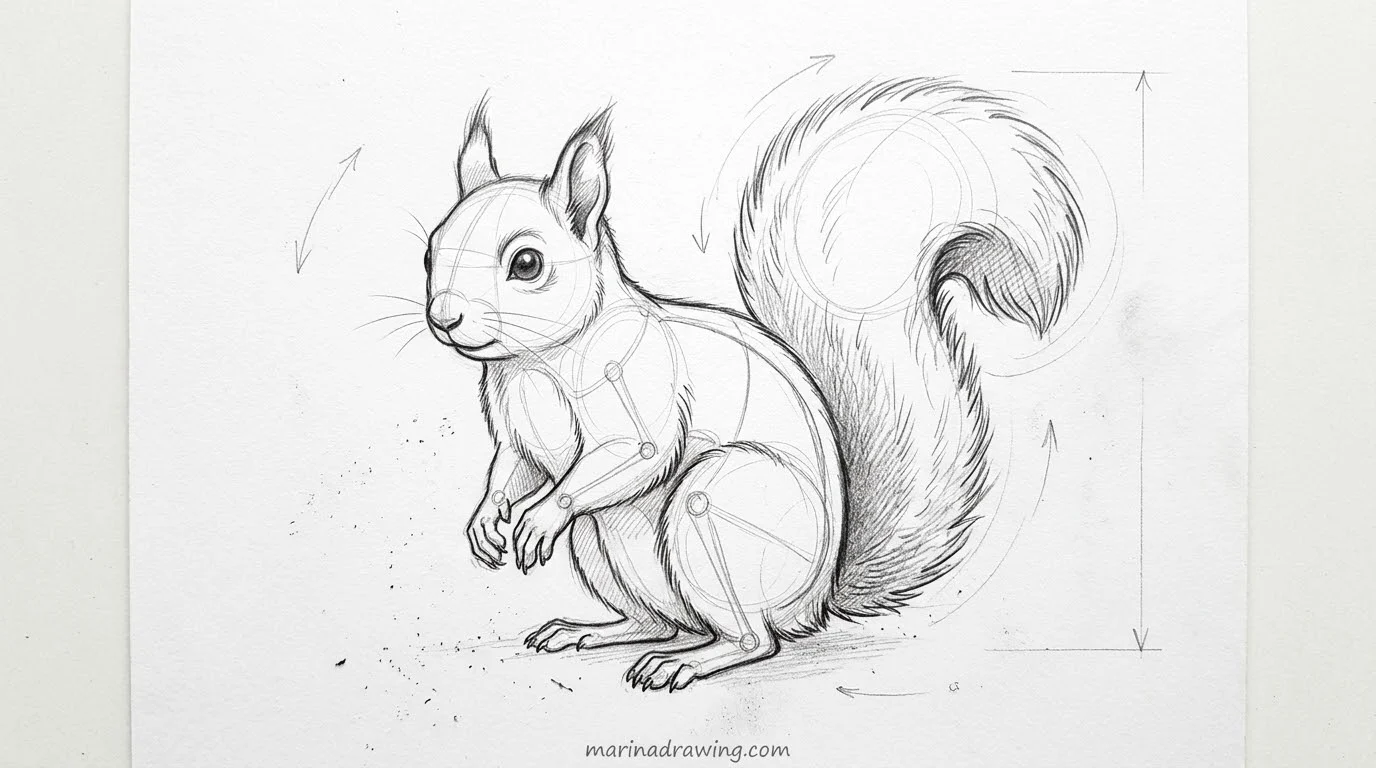
Make a single line for the spine, curved like a question mark. Add a circle at the top for the head and a larger loop at the bottom for the haunch. Then sweep the tail in one stroke that echoes the spine.
Do ten of these in a row, thirty seconds each. Yours will look rough, and that is the point: you are learning where the weight sits. The same spine-first habit suits the long curve of dolphin drawing ideas.
5. A realistic squirrel drawing in pencil
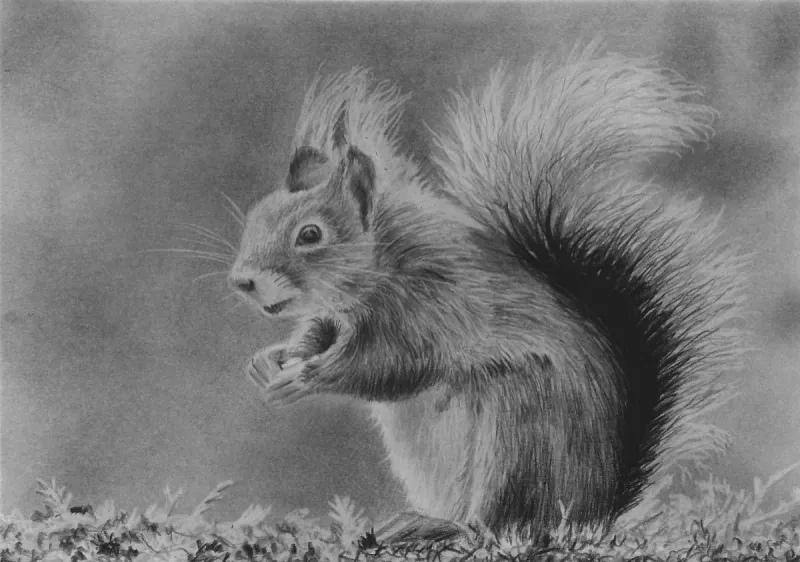
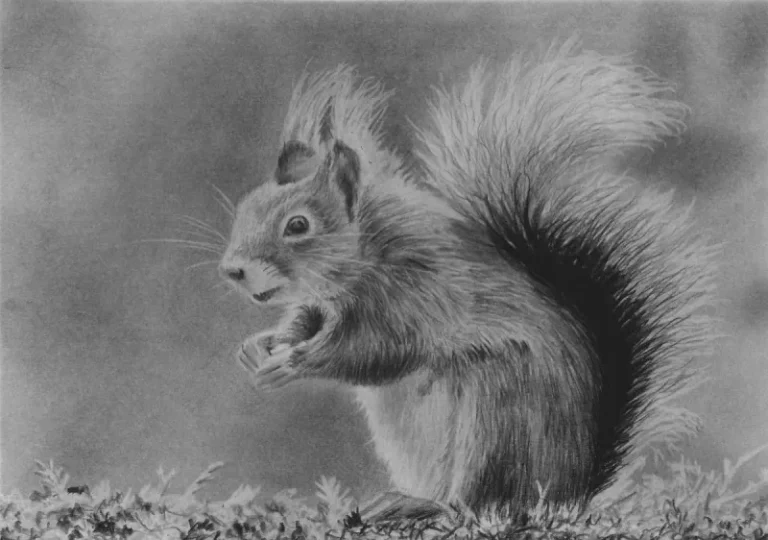
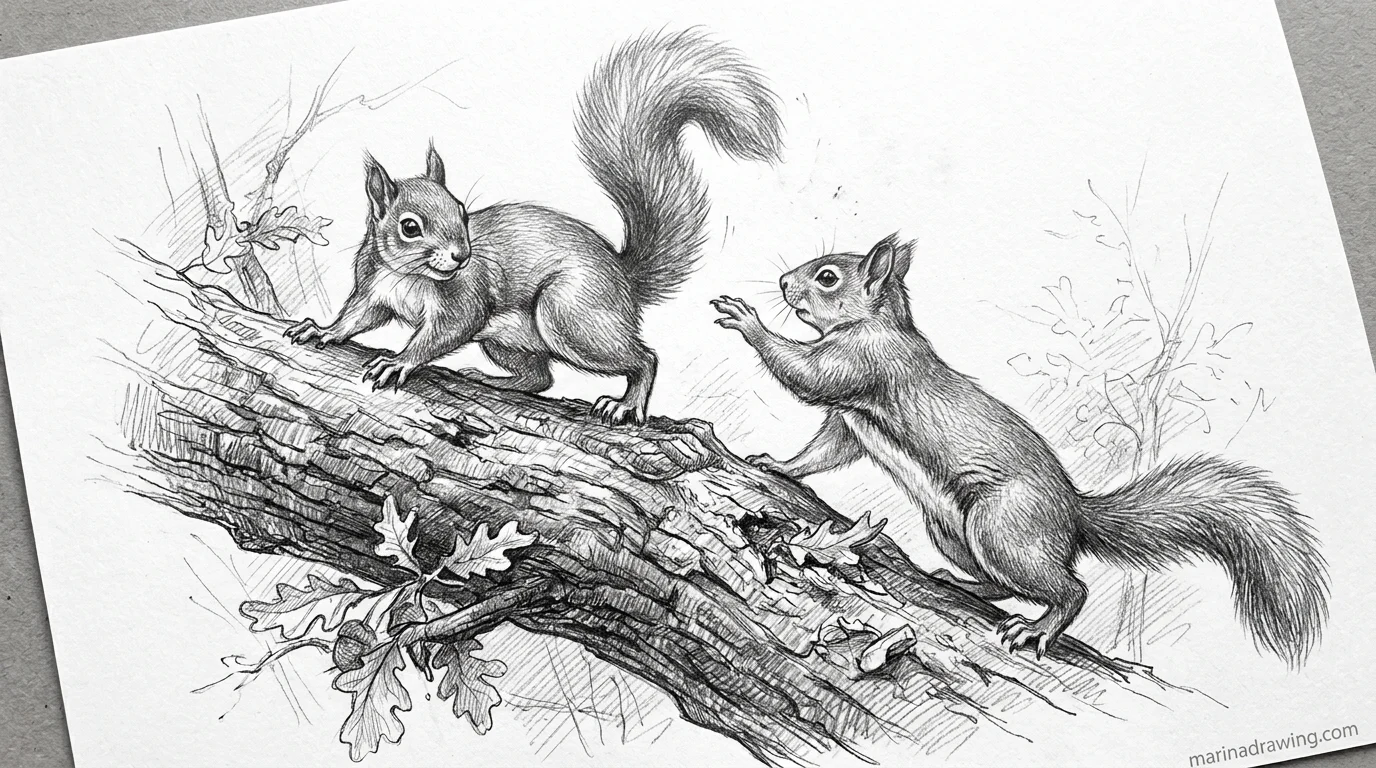
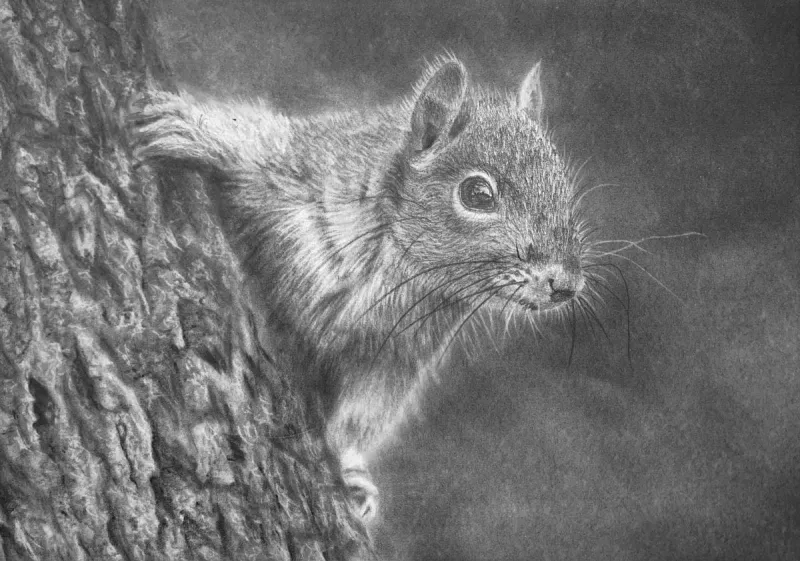
A realistic squirrel drawing needs tone. You see a dark grey-brown back, mid grey sides and a nearly white belly, with a soft transition between them.
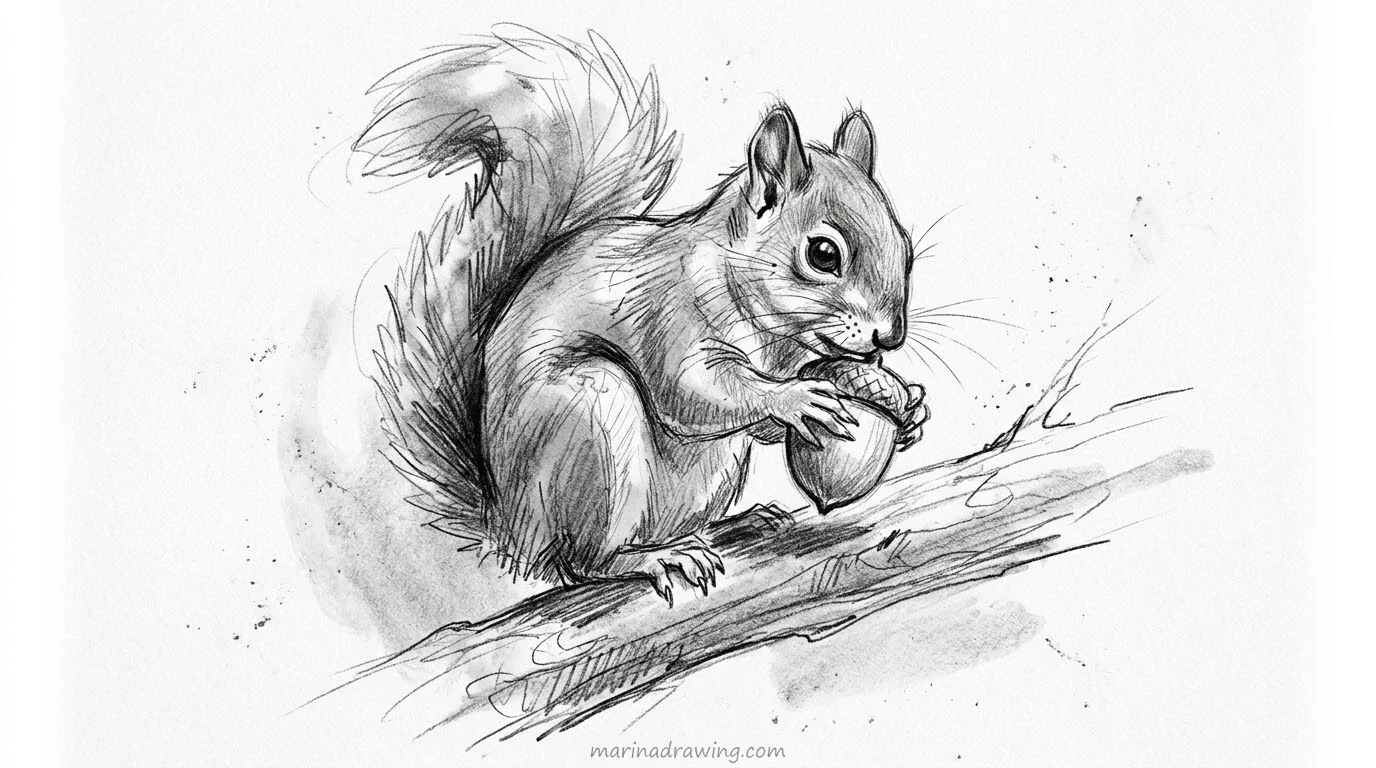
I start with the darkest areas: the top of the head, the back and the underside of the tail. Then add a mid grey down the flanks. You give the belly almost nothing.
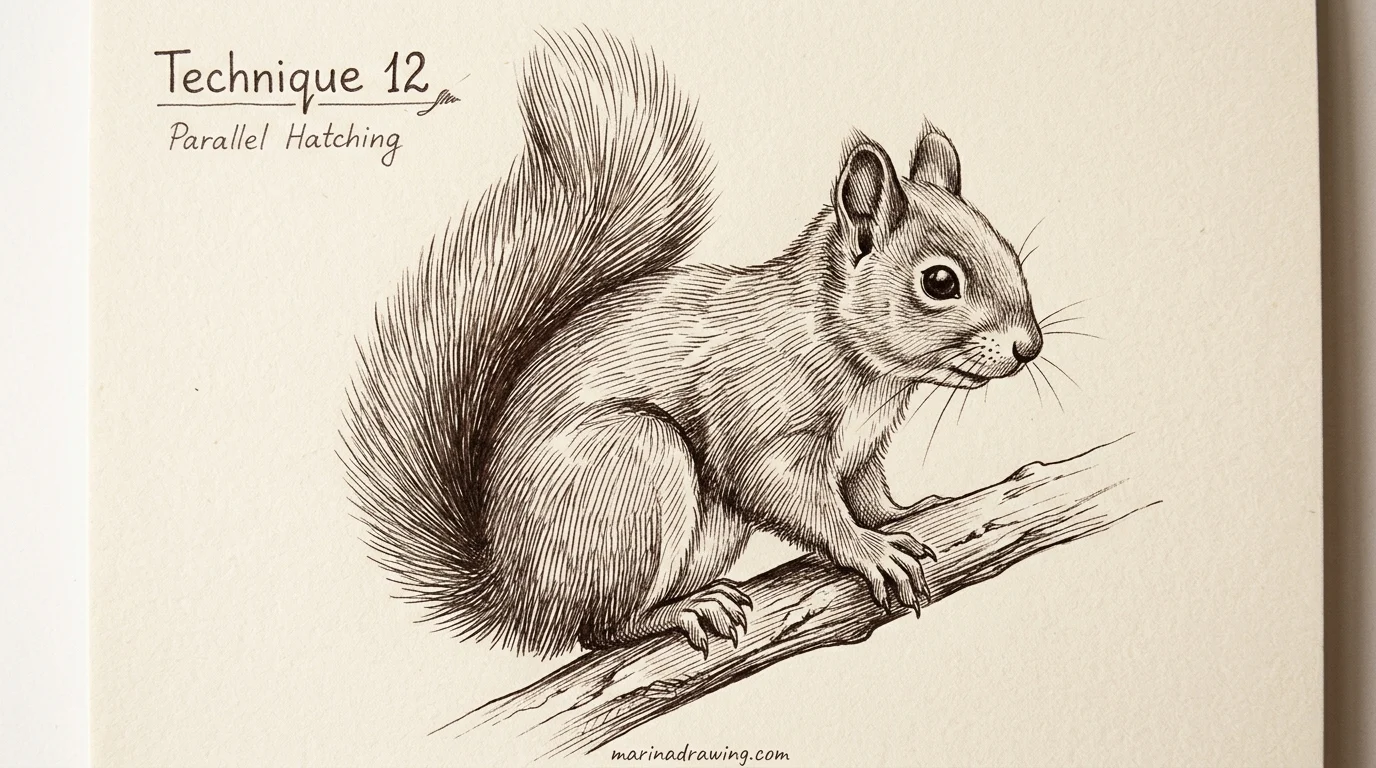
For the fur, follow the direction of growth: short strokes along the body, longer ones along the tail, fanning toward the tip. The same value habit runs through realistic shading.
If yours looks flat, you are missing a dark, not a detail. This takes an hour, and it is where knowing the shapes stops being enough. For fur in pencil, the How to Draw a Squirrel class goes through short and long fur and backlighting.
6. A cartoon squirrel with a simple outline
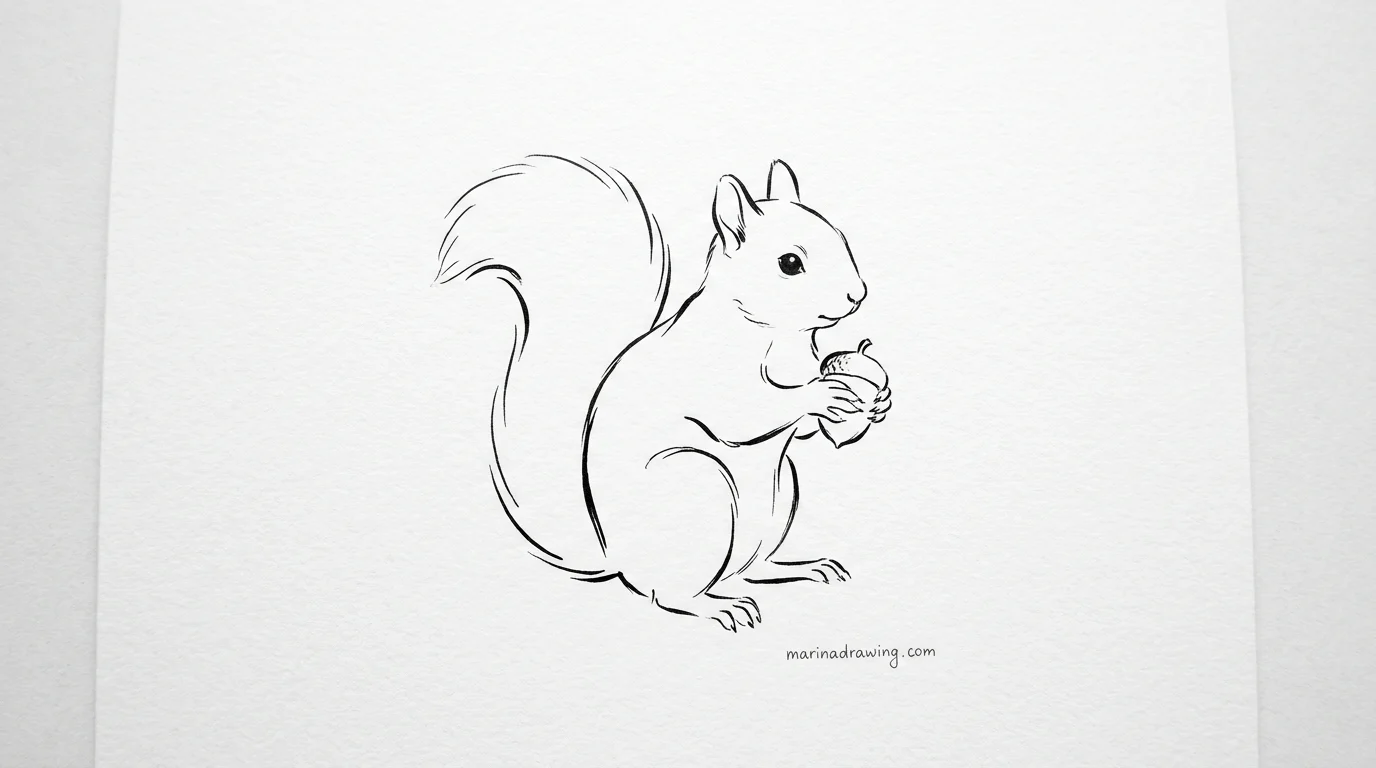
A cartoon squirrel drawing lives on its outline. Use one steady line weight, thicker than you think, and close every shape.
Cut the body down to a pear shape, make the head a clean circle and the tail a single bold S with a rounded tip. Skip shading, and you add only the eye, a tiny nose and a smile.
Fill it in solid black in your head. If you can still tell it from a rat, you are done.
7. A red squirrel with ear tufts
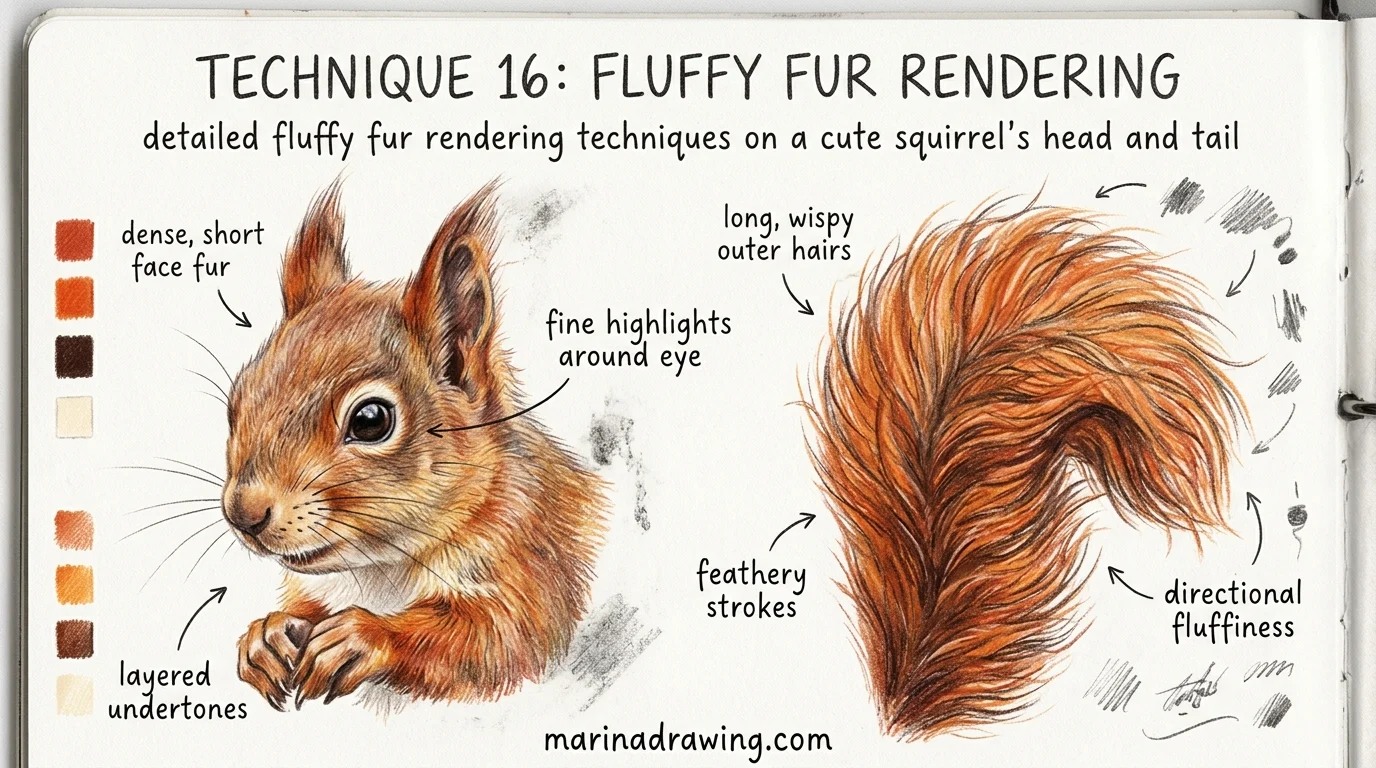
A red squirrel drawing has two traits the grey one lacks: tall tufts of fur on the ears and a rust-orange coat with a white belly.
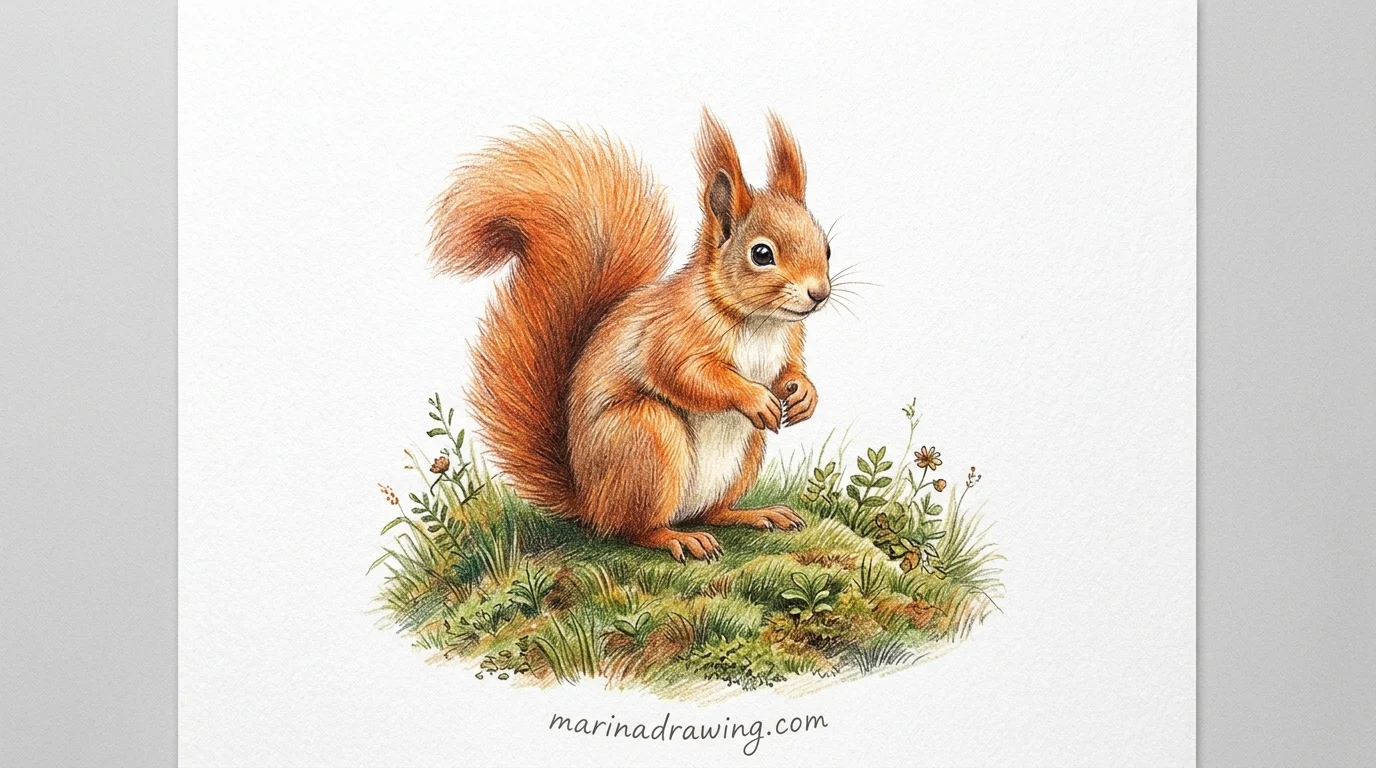
Draw the usual construction first, then extend each ear into a pointed tuft, longer than the ear itself. The tail is a little narrower than the grey squirrel’s and often paler at the tip.
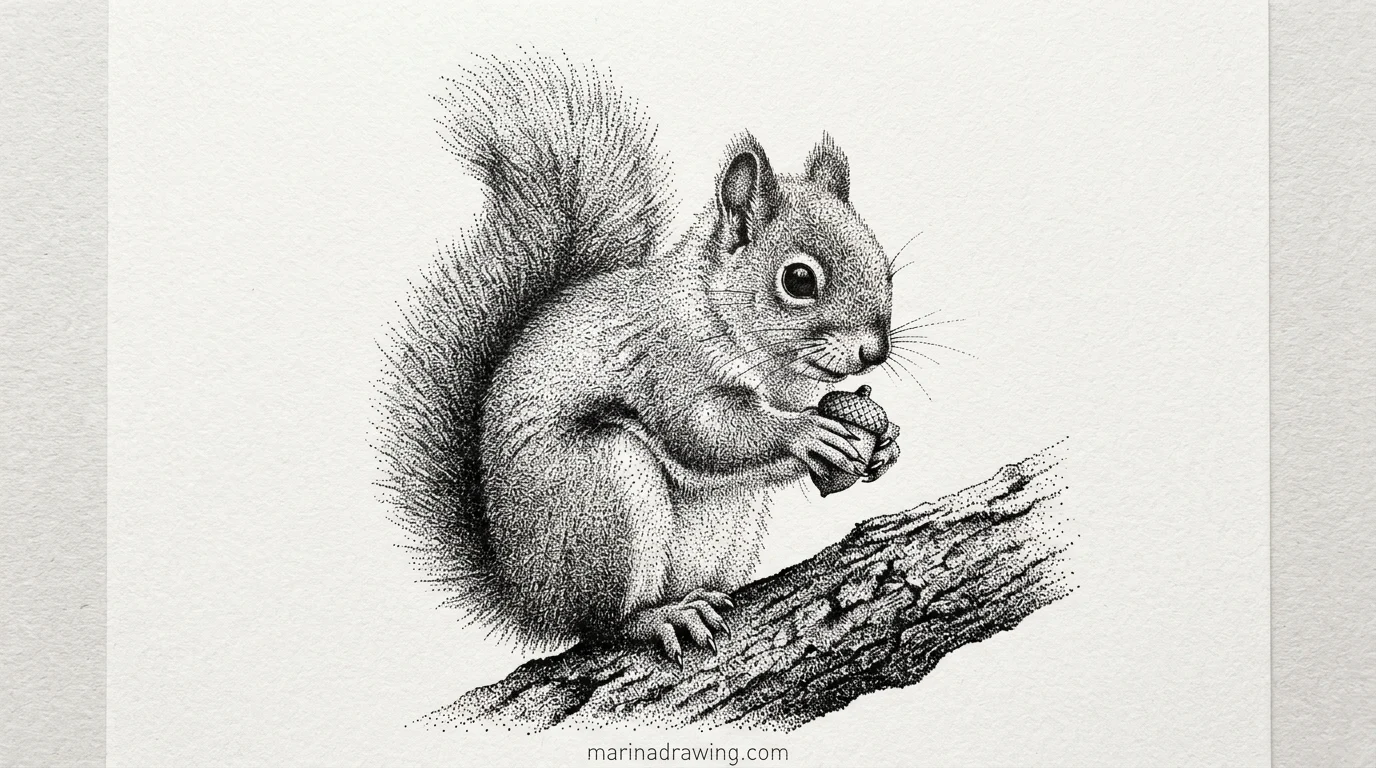
Layer the colour. Start with a light orange over the whole coat, add brown along the back and the top of the tail, and keep the belly bare paper. Three pencils are enough for you. Woodland references help you choose the oranges.
8. A squirrel eating an acorn
An eating squirrel drawing is the sitting pose with one change: the paws come up to the mouth. Keep the body upright and tilt the head down a little.
Draw both front legs bent at the elbow, with the paws meeting just under the chin. The acorn is a small oval with a rough cap, and it sits between the paws, not in front of them. Add a few short lines on the cheek to show the chewing.
9. Two squirrels playing
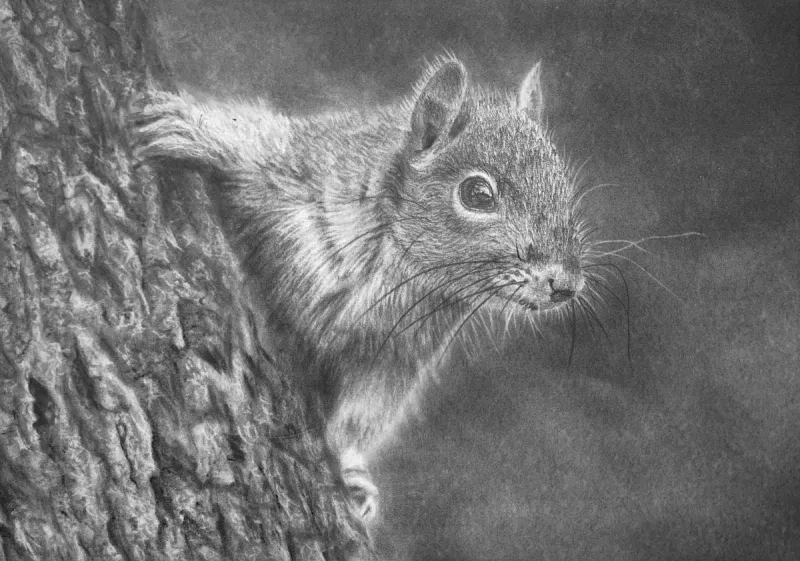
Two squirrels in one frame look hard, but you only need to keep their bodies apart. Draw the first squirrel in the usual sitting pose, then the second one in a lower, stretched pose beside it.
Let one tail overlap the other body so the pair reads as one scene. Vary the angles: if one head faces left, turn the other toward the viewer. Shade the overlap with a darker tone so the front squirrel stands out.
10. A squirrel sitting on a grassy mound
A squirrel on a mound gives the animal a place to sit and a reason to look alert. Draw a low curve for the ground first, then place the squirrel on top with its hind feet slightly sunk into the grass.
Finish with short upward strokes for the grass in front of the feet and tail. The strokes hide the base of the body and make the squirrel look settled. Keep the grass lighter than the fur so the animal stays the focus. Once the squirrel feels settled, try the same construction-first order on a bigger animal, like the horse in these easy horse drawing steps.
Which mistake did you make?
Put your drawing next to this and read down the left column. I still check my own squirrels against it.
| What you see | What is actually wrong | Your fix |
|---|---|---|
| It looks like a rat | The head is small and the body is long and low | Enlarge the head and stand the body upright |
| The tail looks stuck on | It starts at the side of the body instead of the base of the spine | Begin the S-curve low on the back and sweep it up behind the head |
| It cannot sit | The hind legs match the front ones | Draw a large rounded thigh and a long foot at the bottom |
| The tail looks like a sausage | It has the same width along its length | Make it thin at the base, wide in the middle and rounded at the tip |
| It looks flat and grey | No dark back and no pale belly | Darken the back, leave the belly bare paper and soften the join |
If the same row describes every squirrel you draw, your gap is construction rather than practice.
Questions people ask about drawing a squirrel
How to draw a squirrel step by step?
Start with a circle for the head and an oval for the body, add two paws and a bent hind leg, then draw the tail as one big S-curve from the lower back. The eye, the nose and an acorn go in last.
How to draw a squirrel for beginners?
You can use the circles and S-tail version: a head, a body, two paws, a foot, a tail, one eye. About a dozen marks, and it reads as a squirrel.
How to draw a squirrel tail?
Begin low on the back, and keep it thin at the base. Let it widen in the middle and rise above the head, then round the tip over. Two or three curved lines inside are enough for fur.
How to draw a cute squirrel?
Enlarge the head, drop the eyes low, make them big, and give it an acorn so you keep it cute. It is a ratio, not extra detail.
How to draw a realistic squirrel?
Build the same shapes, then work in three tones: dark back and tail first, a mid grey on the flanks, and bare paper on the belly. Use short strokes in the direction the fur grows.
How to draw a simple squirrel?
Cartoon outline: a pear body, a circle head and one bold tail. Close every shape and add only an eye and a nose.
Which squirrel should I draw first?
The easy circles one, then the quick sketch, then the cute one.
Key takeaways
- A squirrel is read by its large tail and its upright sitting pose, not by its face.
- The tail is one S-curve from the base of the spine, thin at the root and wide in the middle.
- Hind legs are always longer than the front ones, which is what lets it sit.
- Cute is a ratio: bigger head, big low eyes, an acorn.
- A flying squirrel is the same animal with limbs stretched and a skin fold between them.
- The realistic one needs tone, so draw the darks first.
Draw two or three and you will know which row is yours. I keep the same habit on other animals: the giraffe, the duck, plain drawing practice.