A bear is a wide head with a blunt muzzle, two small round ears set apart, and a heavy body that sits on flat paws. That is the whole animal, which is why a bear drawing easy enough to finish in a minute still works. If your bear looks like a pancake with ears, the eyes did not fail. The muzzle, the ear placement and the weight of the body did.
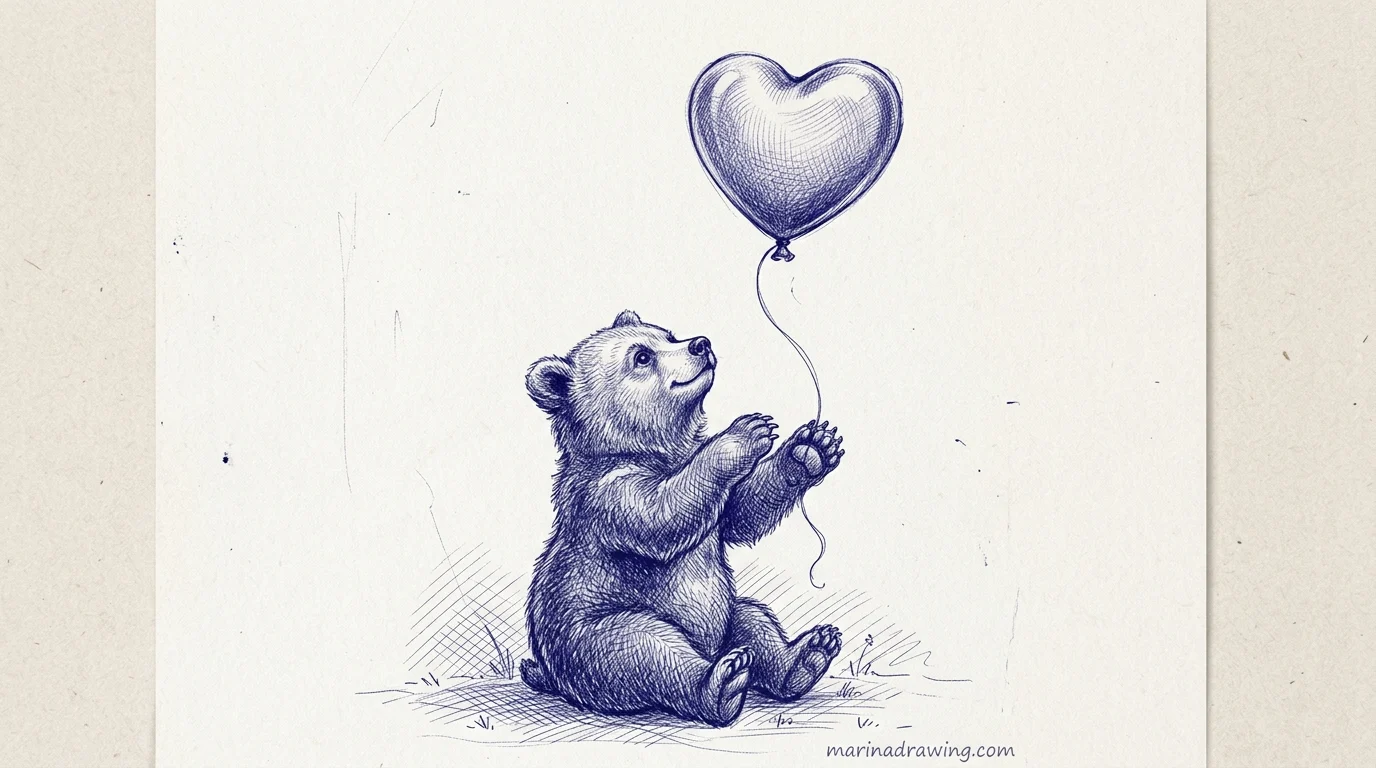
A bear reads as a bear because of where the mass sits, not how the fur is drawn.
A broad head, a muzzle that sticks out from it, ears that sit wide on the sides, and legs that look like columns. Lose any of them and you get a cat, a mouse or a cushion.
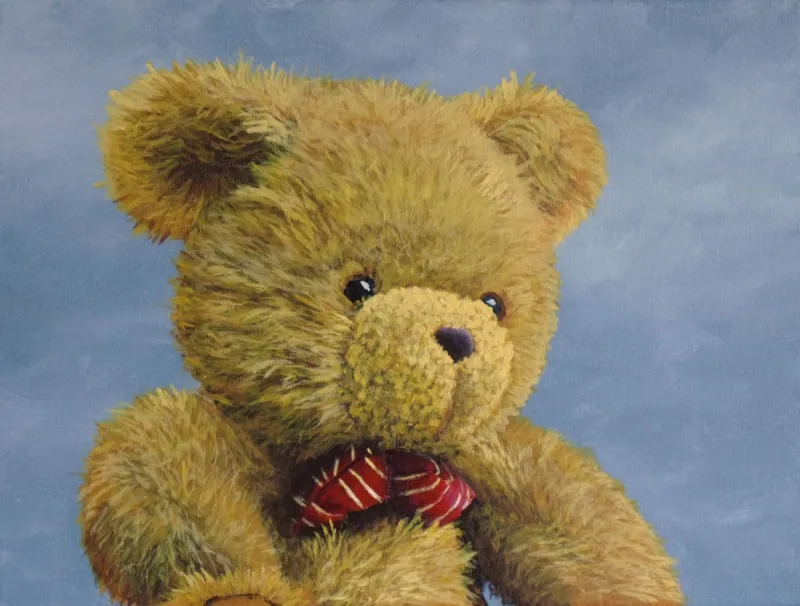
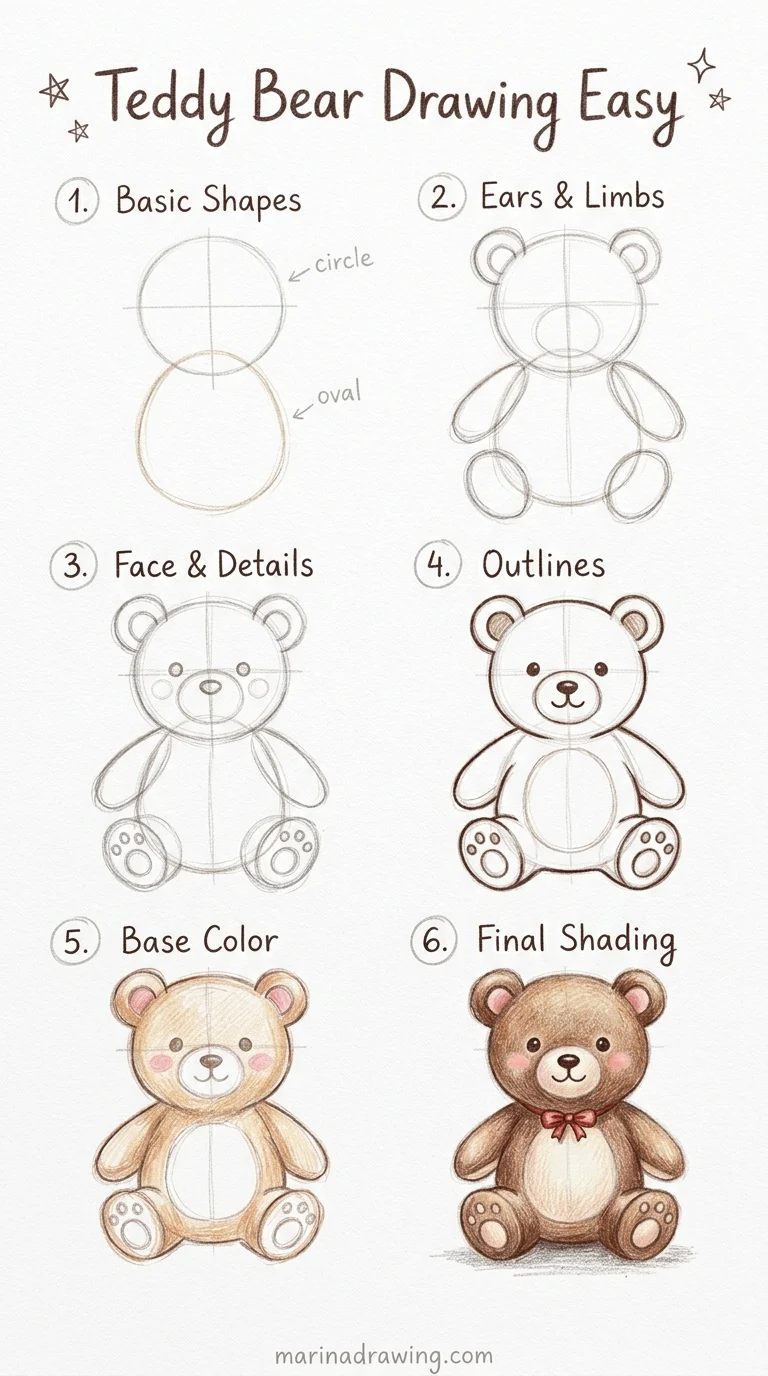
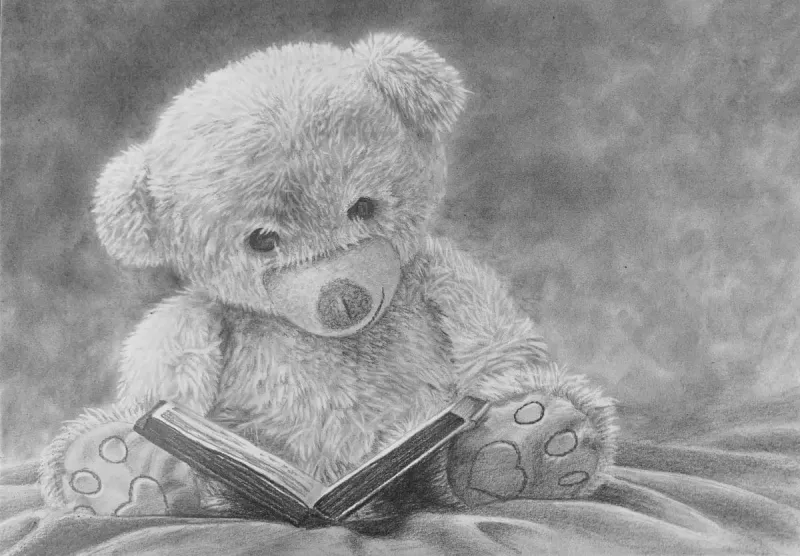
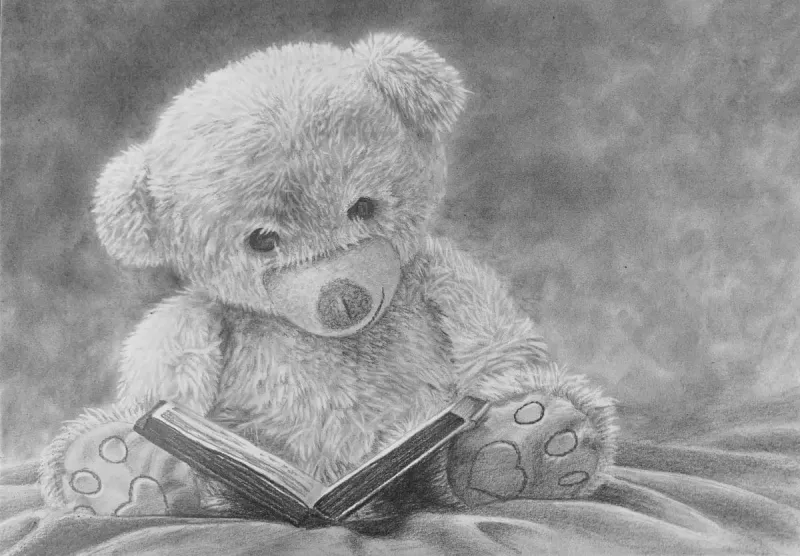
Quick answer: draw a wide, slightly flattened circle for the head and add a smaller oval muzzle low on the face. Put two half-circle ears on the upper corners, then hang a pear-shaped body under the head with short rounded arms and oval feet. Then pick your bear from the nine below and read the table near the end for your mistake. If you would rather watch a bear built step by step, a pencil teddy bear class covers fur texture, fluffy material effects and stitching.
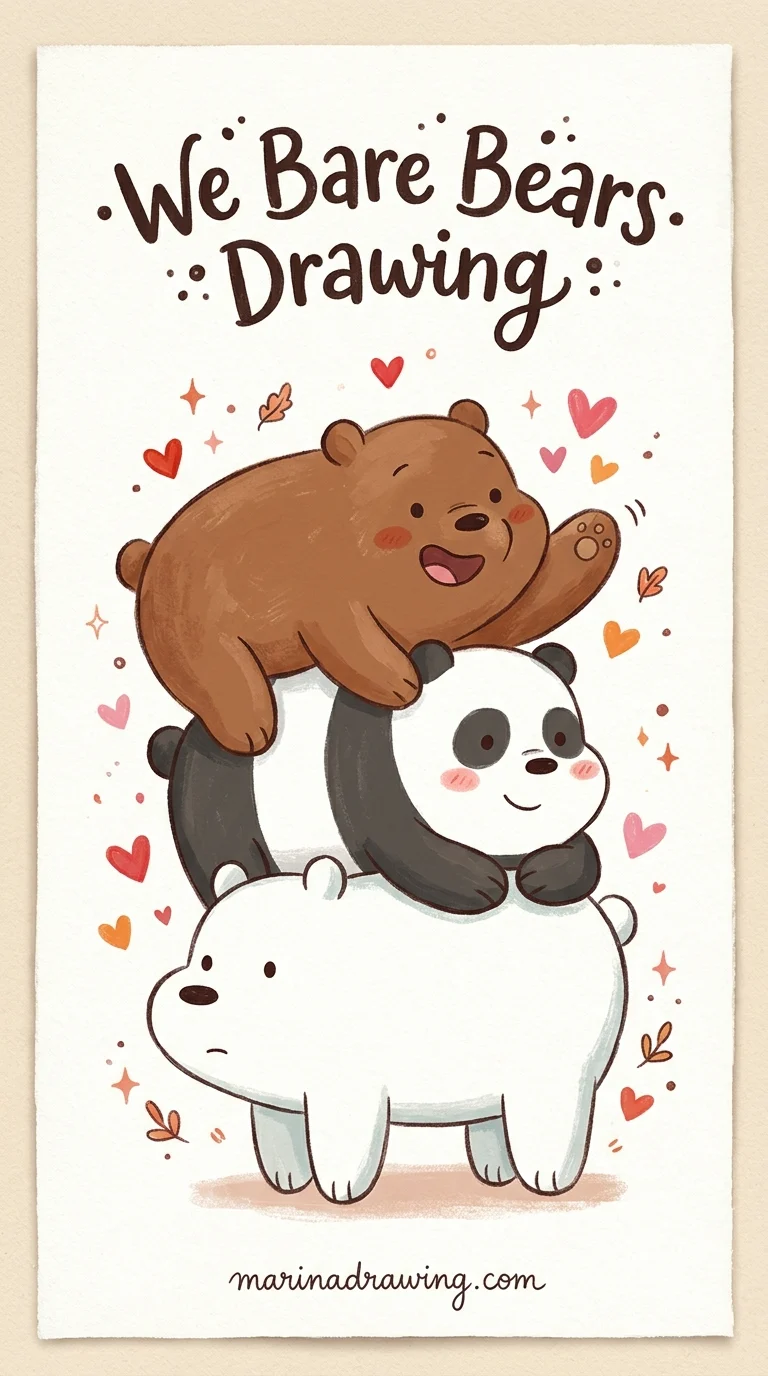
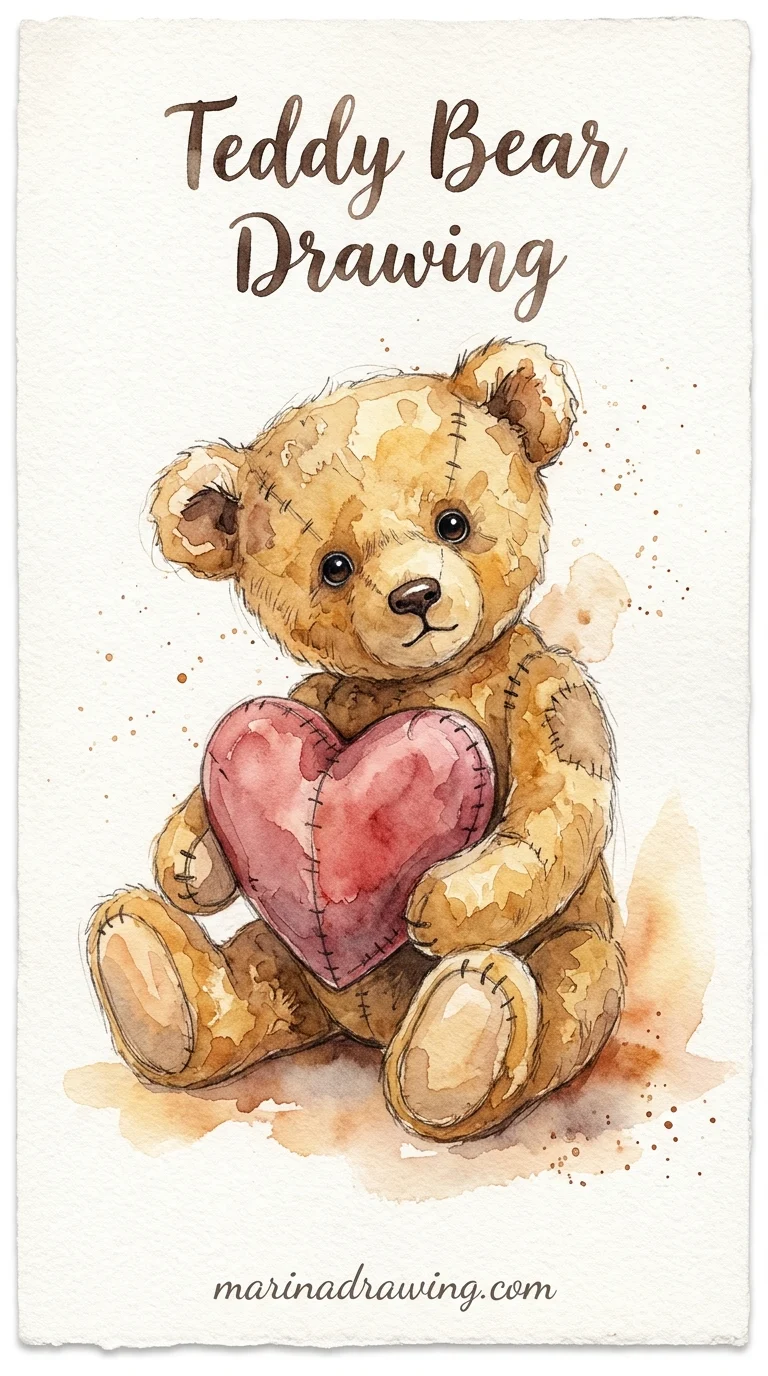
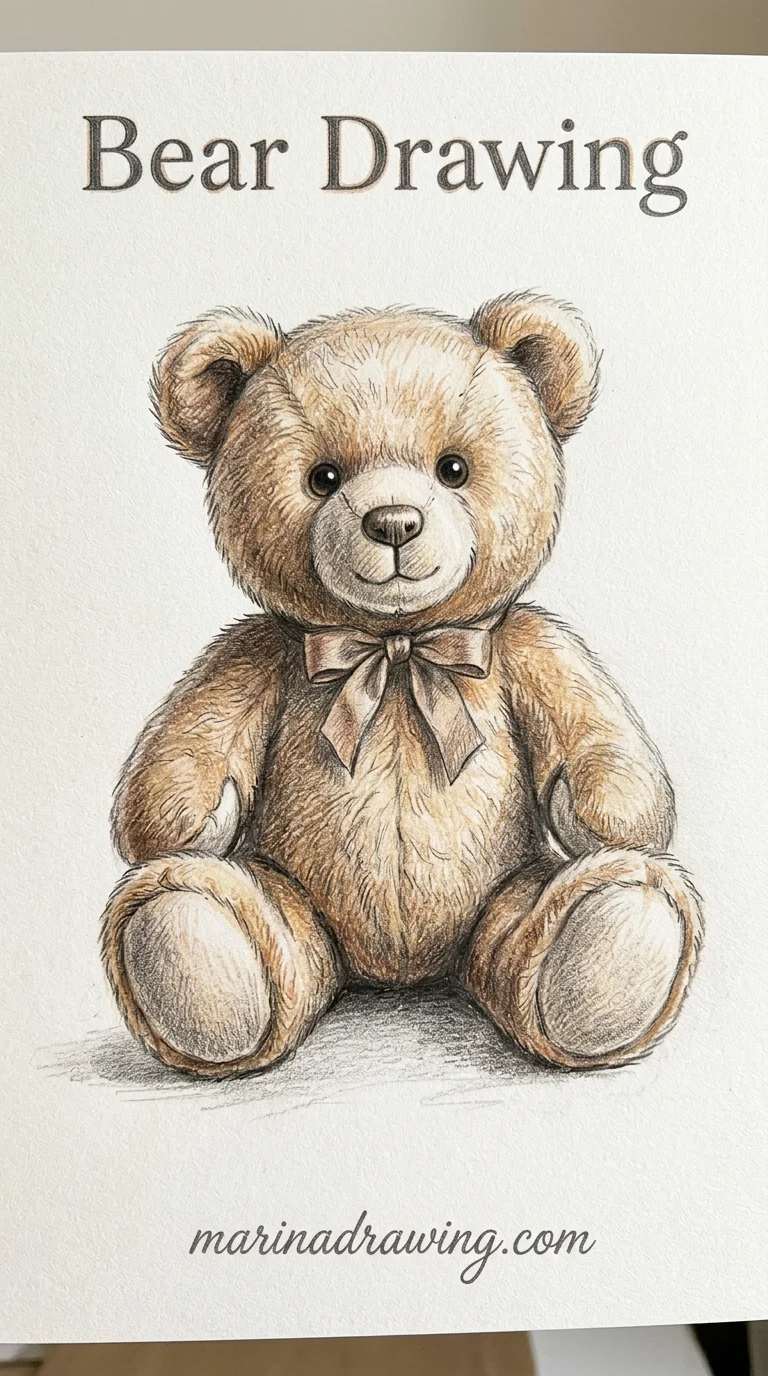
Two ovals and a muzzle make the bear, not the face
Every bear here starts with the same four light marks, put down before any detail.
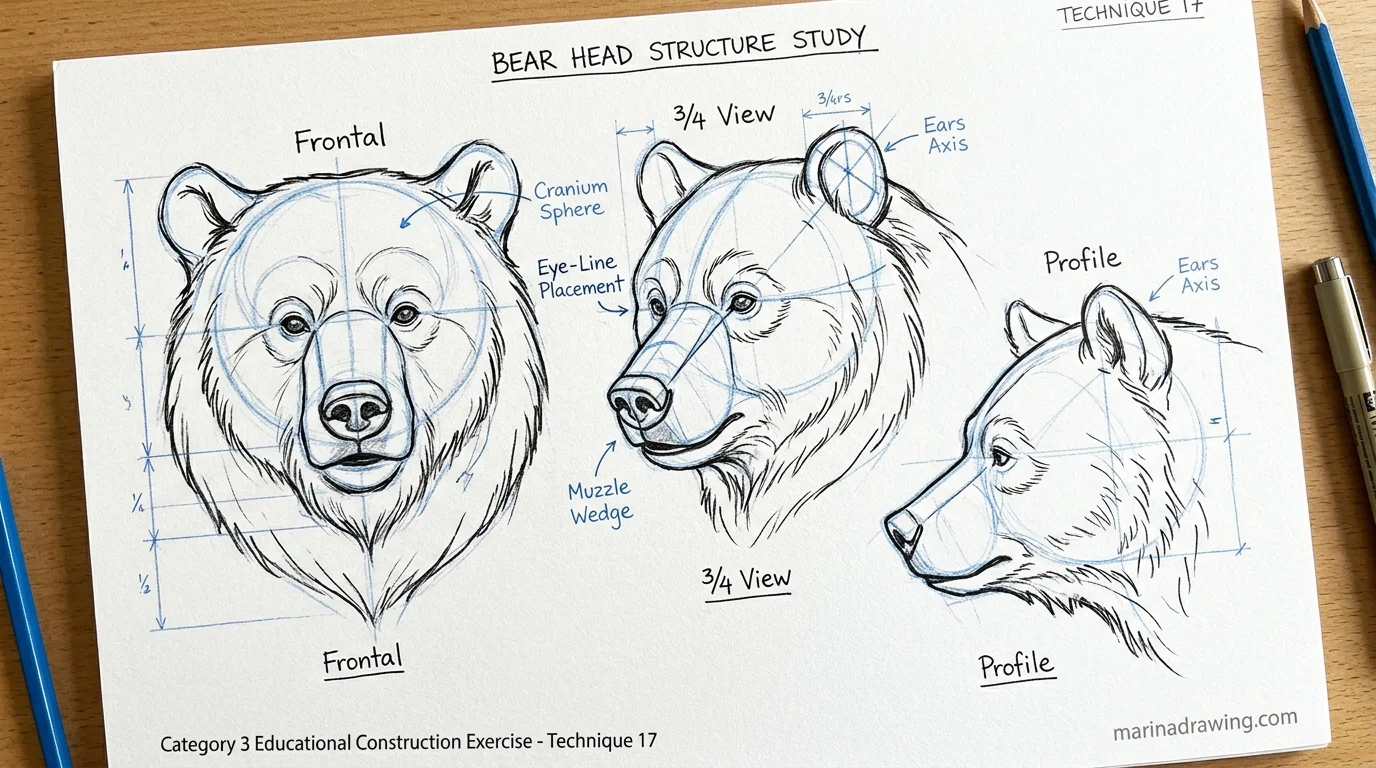
- The head. A wide circle, slightly flattened on top. Wider than tall gives you a bear. Taller than wide gives you a mouse.
- The muzzle. A smaller oval in the lower middle of the face. It sits low, because a muzzle set at the centre pushes the eyes up and makes the face flat.
- The ears. Two half-circles on the upper corners of the head, set apart. Add a smaller curve inside each one for depth.
- The body. A pear or a chubby bean under the head, overlapping it slightly so the head sits on the body instead of floating above it.
Now the face. Two small dots for eyes sit above the muzzle, a dark rounded triangle makes the nose, and a short line and a little curve give the mouth.
I leave a tiny dot of bare paper in each eye. That dot is the light.
Without it the face goes dull and the bear looks stuffed. Check these four placements while your pencil still lifts.
You decide whether your bear works when you place the muzzle. Everything after that is filling in a decision you already made. I lean on the same muzzle-first habit in easy koala drawing ideas, where the nose does most of the work.
Why your bear looks like a pancake: four mistakes
Among the eight pages that hold the top spots for this subject, none has a section on what goes wrong, and none shows nine different bears in one place. You get one bear per page, usually a single cute style.
| What was checked | Pages that had it |
|---|---|
| A section on common mistakes | 0 of 8 |
| A set of different bears, each with its own method | 0 of 8 |
| A teddy and a grizzly compared by proportion | 0 of 8 |
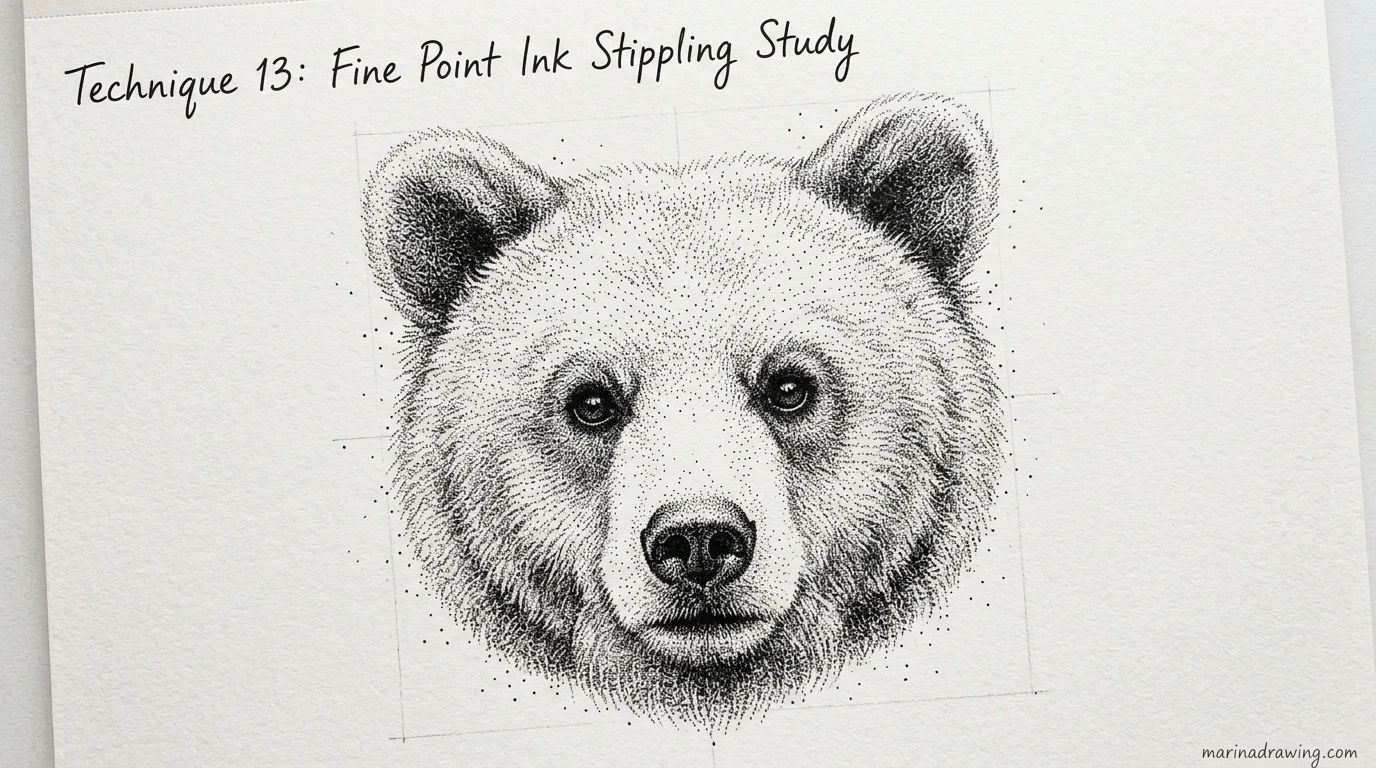
Four mistakes account for almost all of the pancakes, and you have probably made one of them:
- Your muzzle sits in the middle of the face, so the head reads as a flat disc.
- Your ears sit on top of the head like horns, instead of on the upper corners, wide apart.
- Your head and body are two separate circles that touch, so the bear has no weight and no neck line.
- Your arms and legs are thin sticks, so a bear that should look heavy looks like a toy on a string.
All four are placement problems you settle in the first minute, which is why another set of steps rarely helps. The steps are fine. The thing they skip is the thing you got wrong.
The same trap shows up on the panda and the penguin.
What you actually need: one pencil and a soft eraser
You need very little for every bear here.
- One sharp 2B pencil for the construction lines and the fur.
- A soft kneaded eraser that lifts guides out without scrubbing the paper.
- Cheap printer paper. Bear drawings go wrong in the first minute, so spend nothing on the surface.
1. Teddy bear drawing easy: circle head, pear body
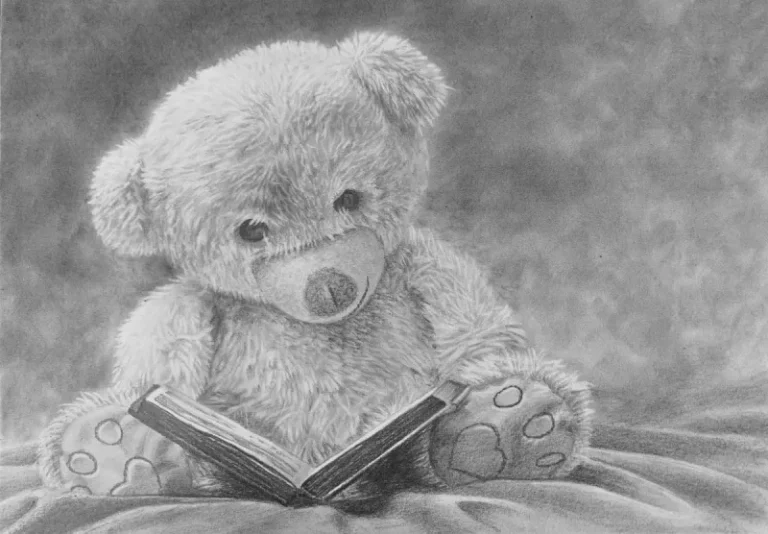
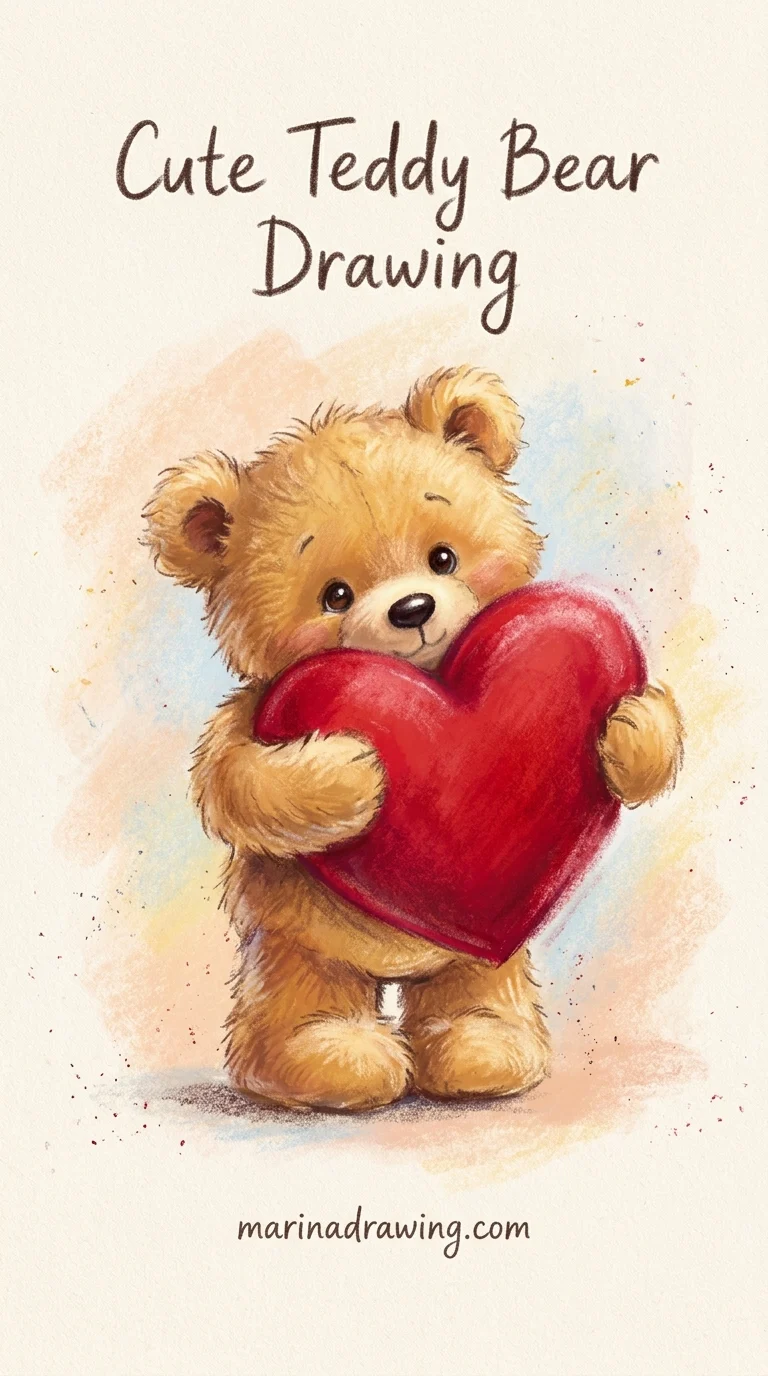
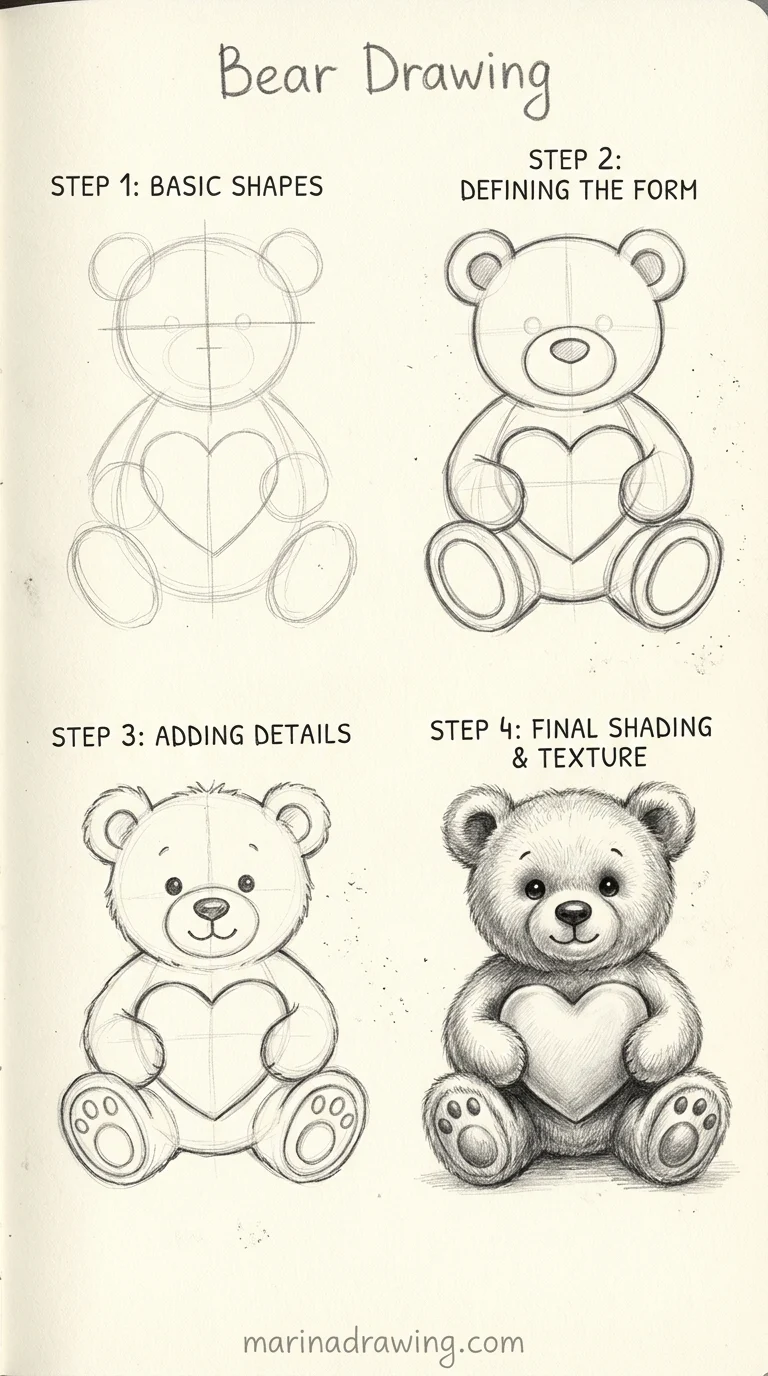
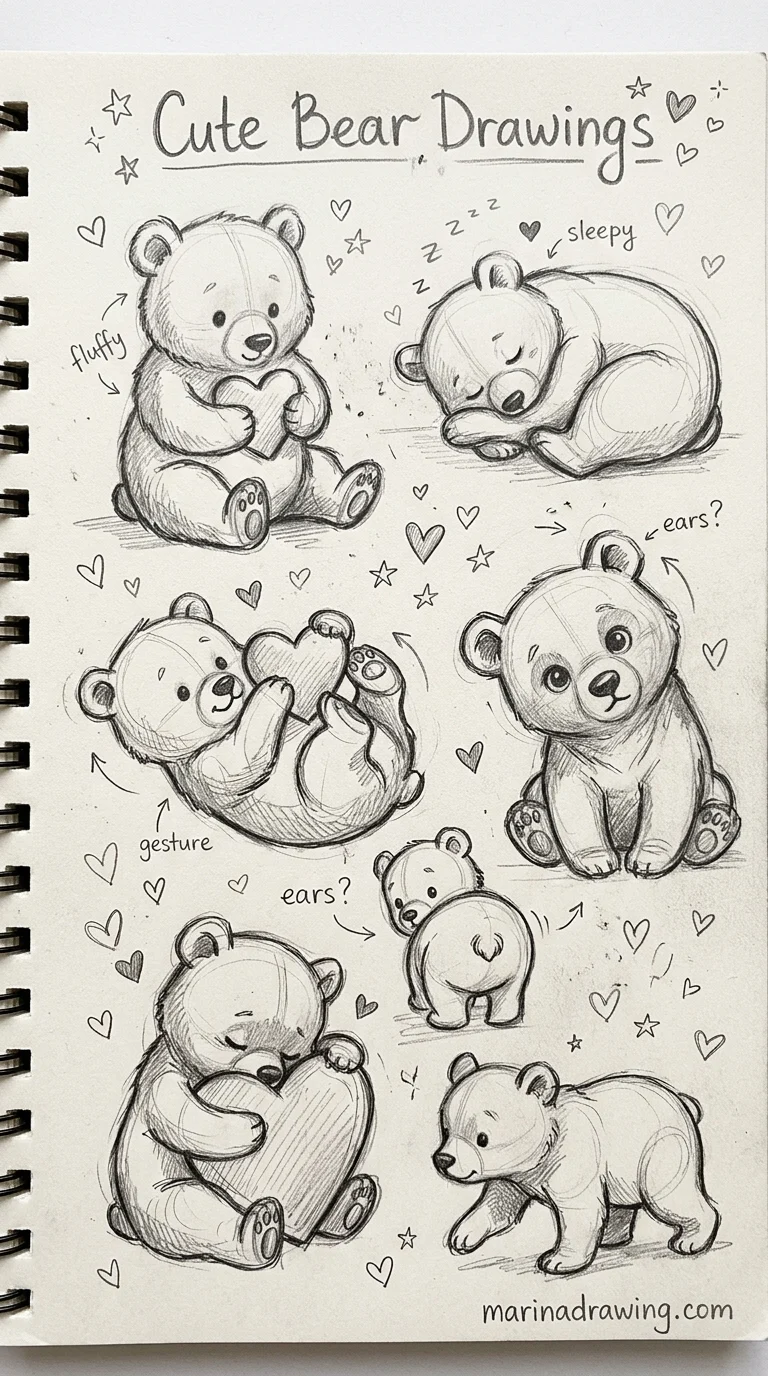
I draw this one first. It takes under a minute: a wide circle, a low muzzle, two half-circle ears, a pear body, short rounded arms and two oval feet. Nothing else.
You make a handful of marks, and it reads as a teddy from across the room. For a cute teddy bear drawing, soften the corners and round the ears a little more.
I treat it as a five-day challenge: I draw it five times, moving the muzzle a little each time: higher, lower, wider. Keep your hand loose and let the line wander before you commit. You will see the character change before you add a single detail.
2. A cute kawaii bear drawing
A cute bear drawing is a ratio, not a style.
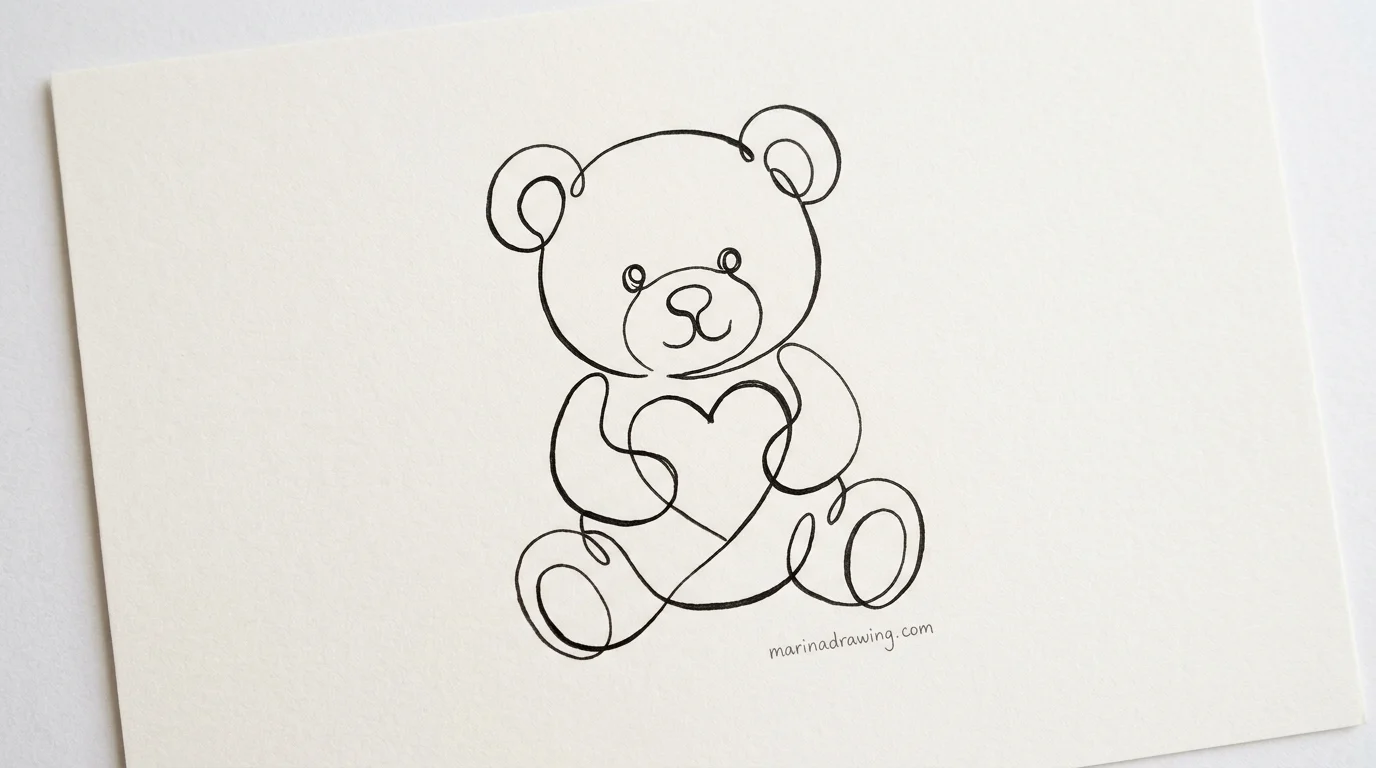
Give a kawaii bear a head that is nearly as big as the body, so the shape is closer to a rounded square than a pear. You drop the eyes lower than feels right, set them wide apart, and keep the muzzle small, with a tiny nose and a simple W for the mouth. Low and wide reads as young. High and close reads as grown up.
Use one line weight for the whole outline, a little thicker than you think, and close every shape. The silhouette carries everything. If it still reads as a bear when you fill it solid black, the drawing is done.
Keep the arms and legs stubby and rounded. A kawaii bear works because the limbs look too small for the body. For ready-made kawaii reference sheets, a library of drawing guides saves guessing.
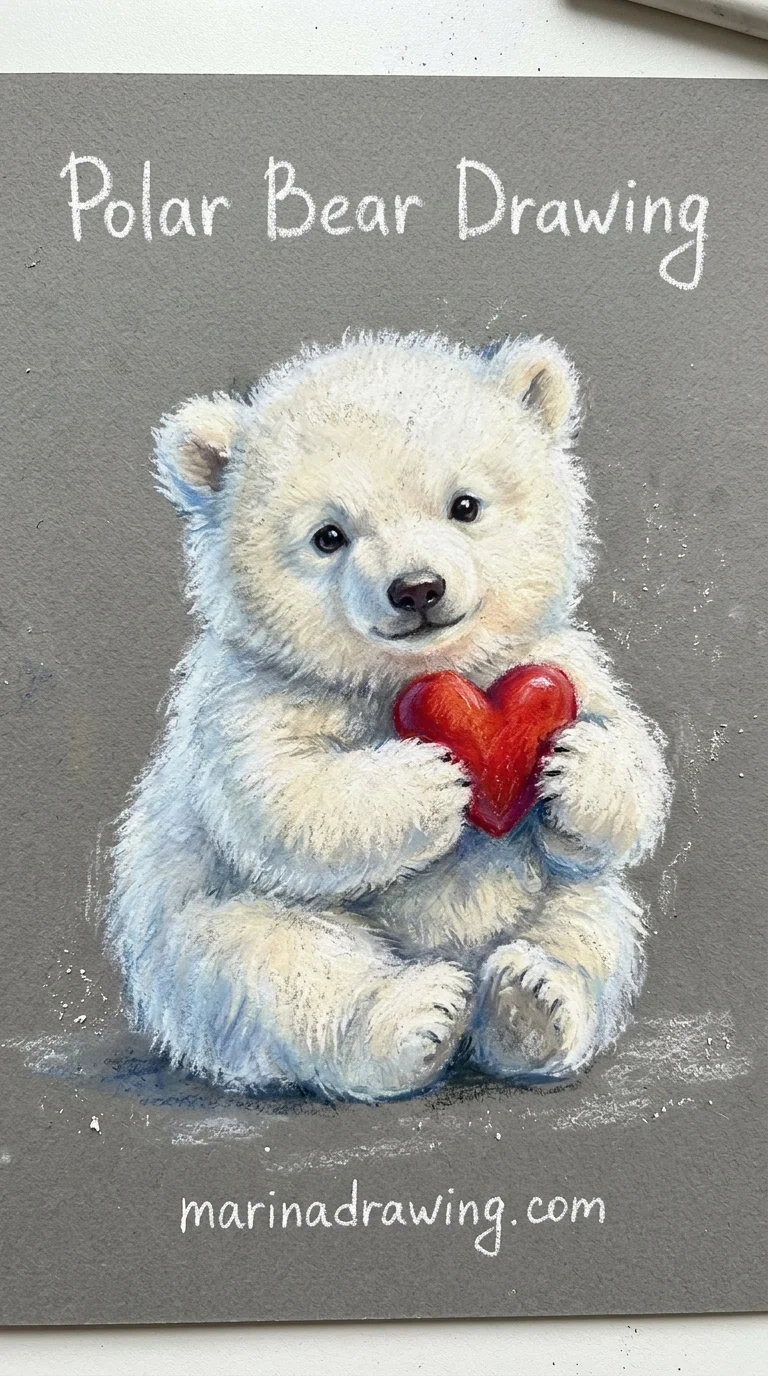
3. A polar bear drawing in a striped scarf
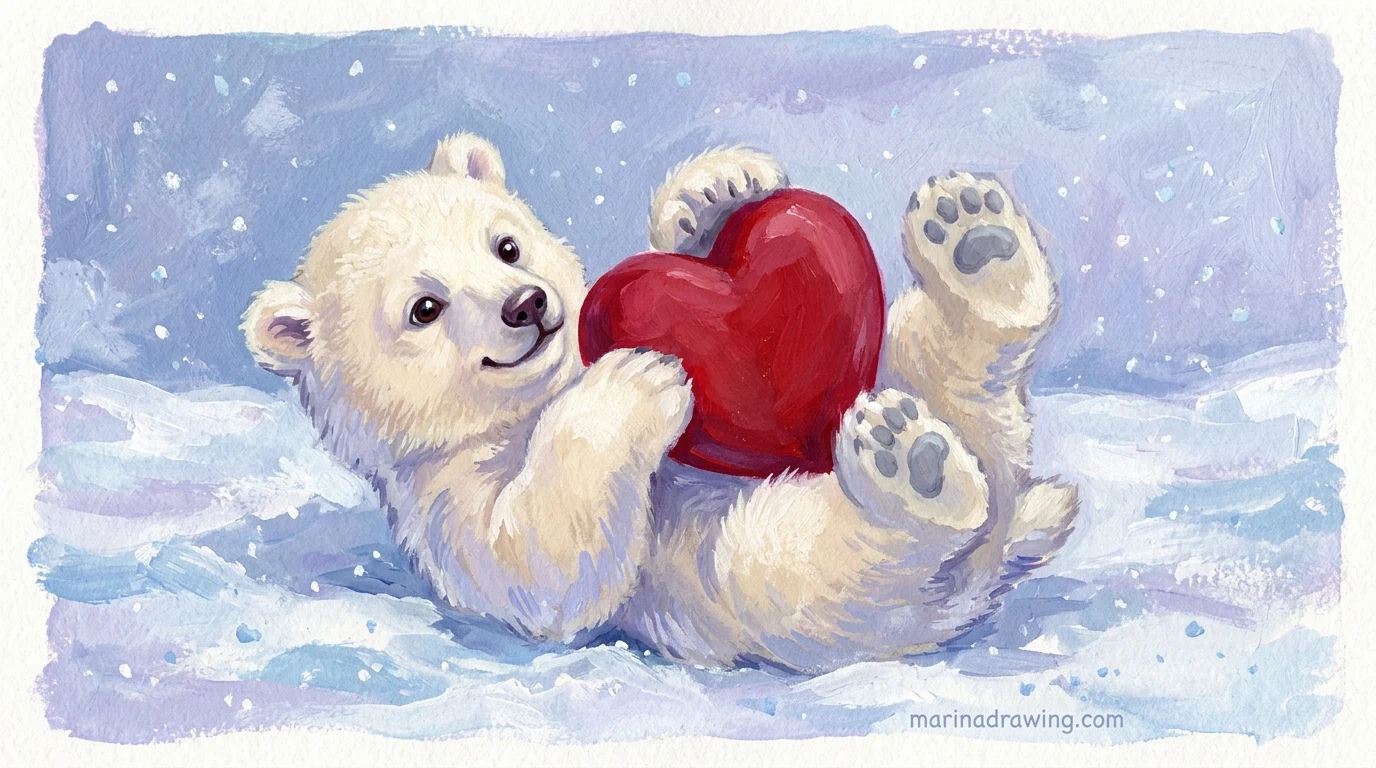
A polar bear is a long bear: a longer muzzle, a flatter head and a neck that is almost as wide as the skull. Sketch it sitting in the snow, then wrap a striped scarf where the head meets the body.
The scarf is two curved bands that follow the roundness of the neck and hide the join. If your stripes are straight lines, the scarf looks like a sticker.
Polar bears are white, so I do the drawing with shadow, not outline. Shade under the chin, along the belly and behind the front legs, and leave the top of the head as bare paper. I lift the lightest areas with the eraser rather than trying to keep them clean from the start. Pale markings on grey skin work the same way in whale shark drawing ideas.
4. A sleepy bear on a pillow
Here the only change to the base bear is the face and the pose. Replace the dot eyes with two closed curves, like small downward arcs, and add a pillow under the head: a soft rectangle with pinched corners.
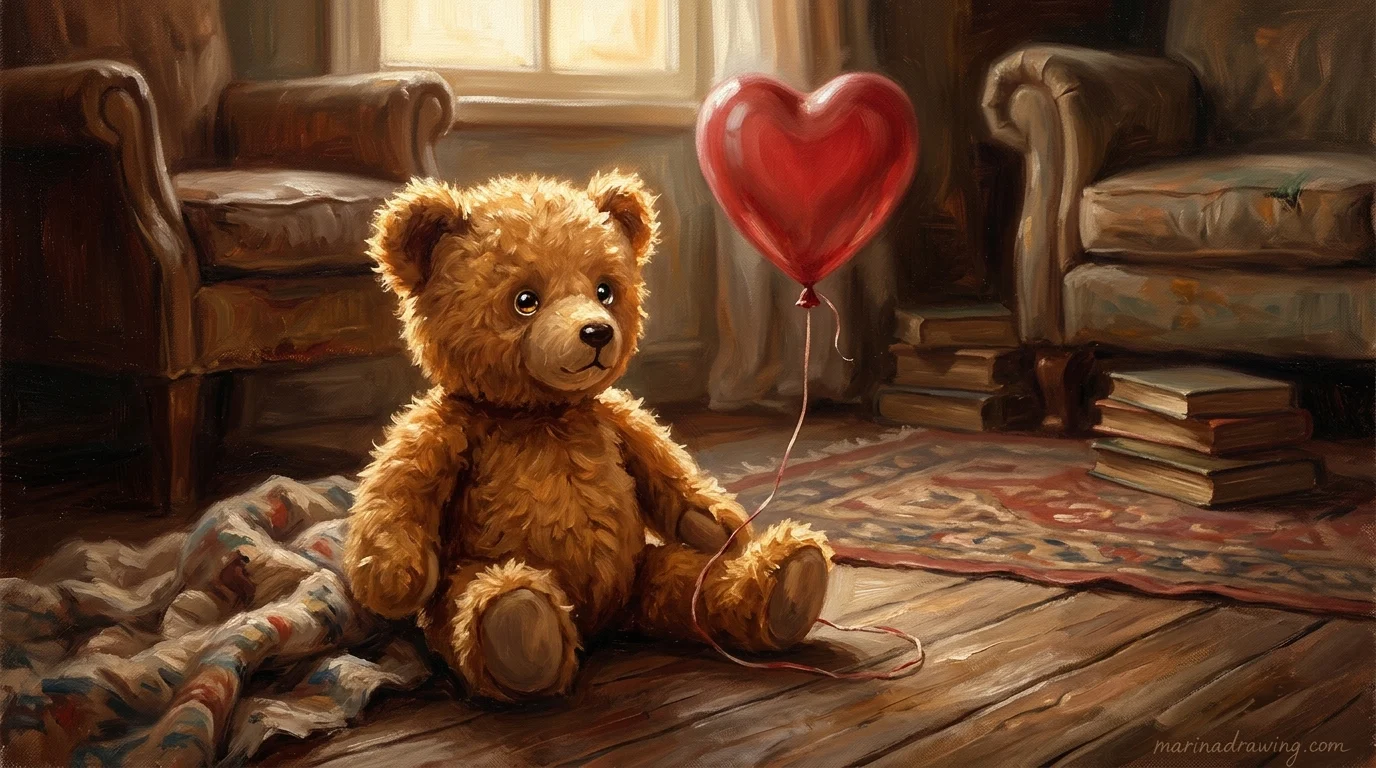
Your order matters here:
- Draw the pillow first, with the sides sagging a little where the head presses in.
- Place the head so it overlaps the pillow, tilted slightly to one side.
- Let one arm drop over the edge, and add the body behind.
If the bear looks stiff, tilt the head and let the cheek sink into the cushion.
5. A bear with a honey pot
I sit the bear down and draw a small rounded jar against its belly, with both paws wrapped around it. The jar gives the paws a job, and a bear with a job is much easier to believe.
Keep the jar about as wide as the muzzle. Draw it bigger and it takes over the page, so the bear becomes the accessory.
6. A bear in a teacup
I let the ears, the face and two paws stick up over the rim of the cup, and hide the rest of the body. It is the shortest way to a finished drawing, because the cup does half the work.
Draw the cup first as an ellipse for the opening and a bowl underneath, then place the head so it overlaps the back edge of the rim. The front edge of the rim crosses over the chest, and that overlap is what tells you the bear is inside.
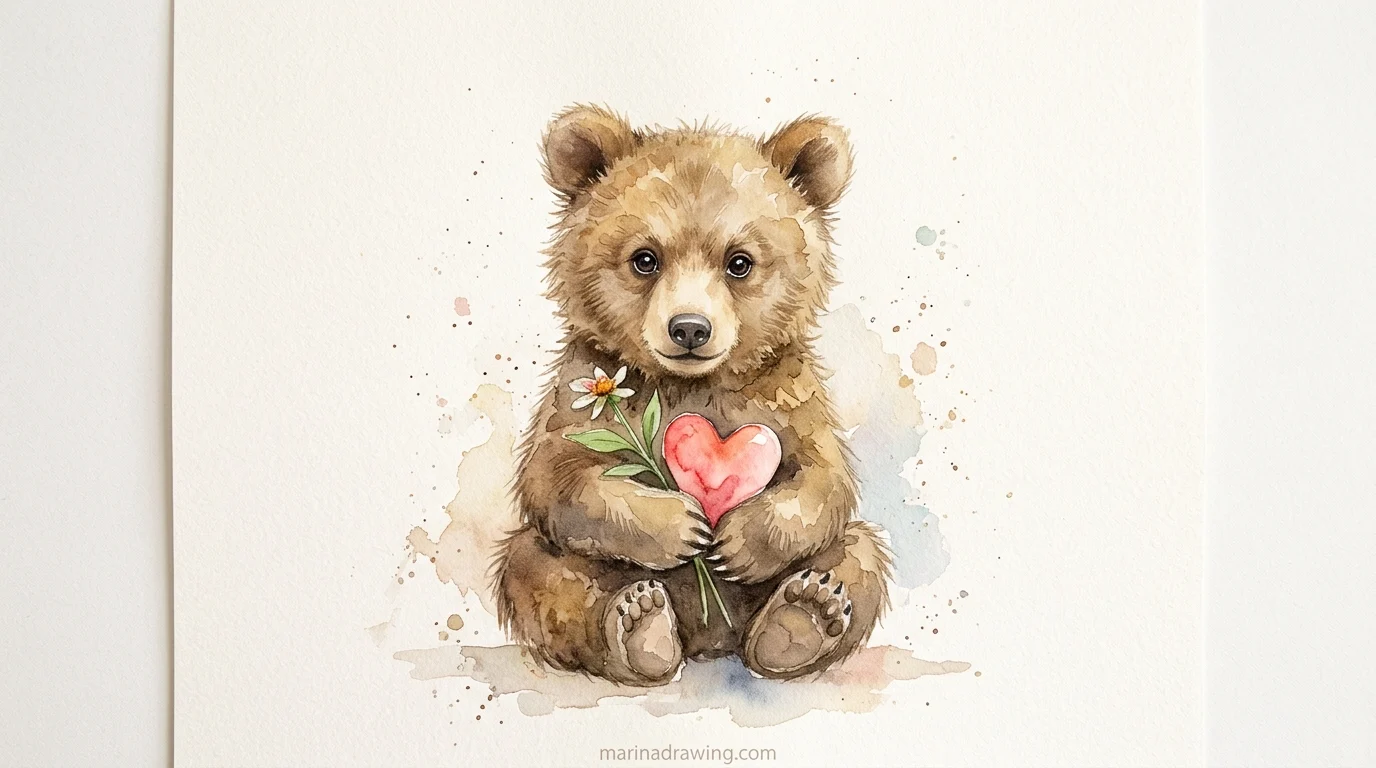
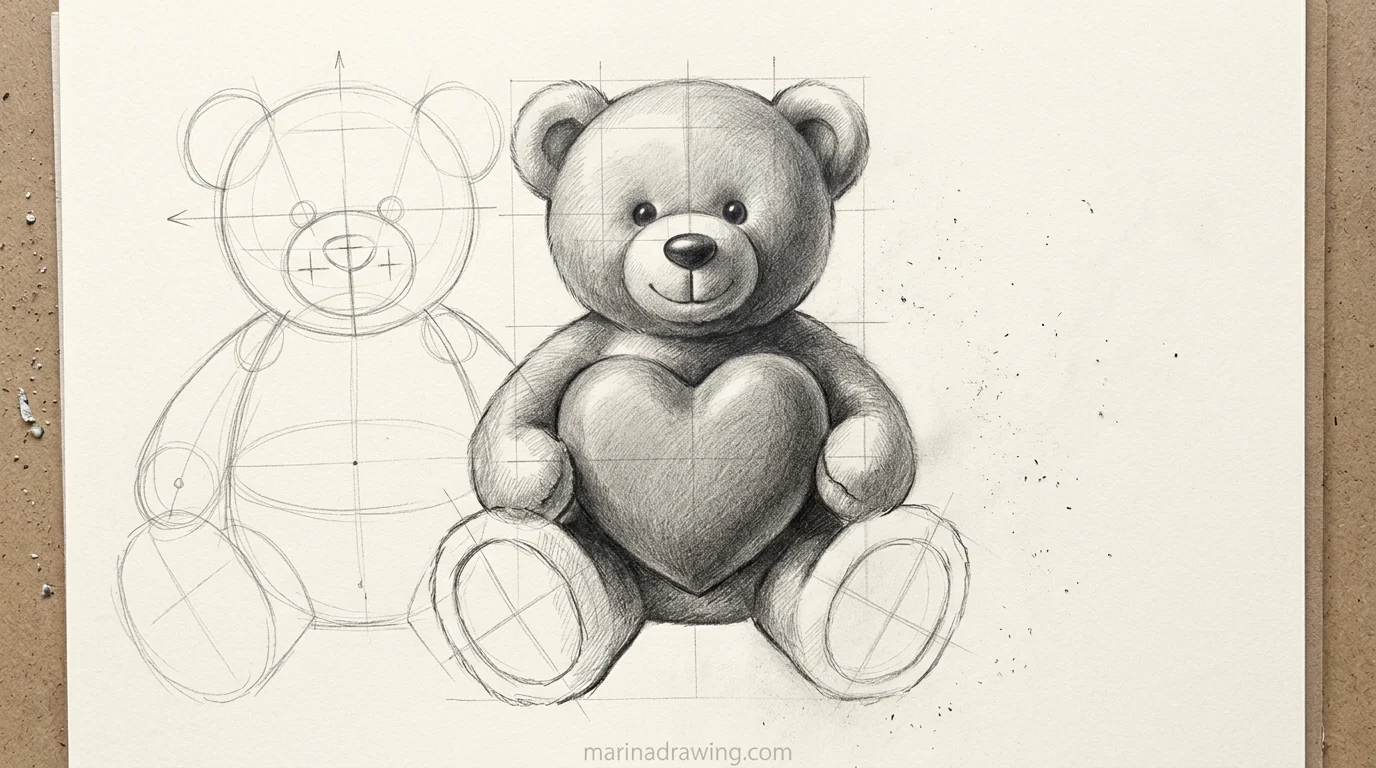
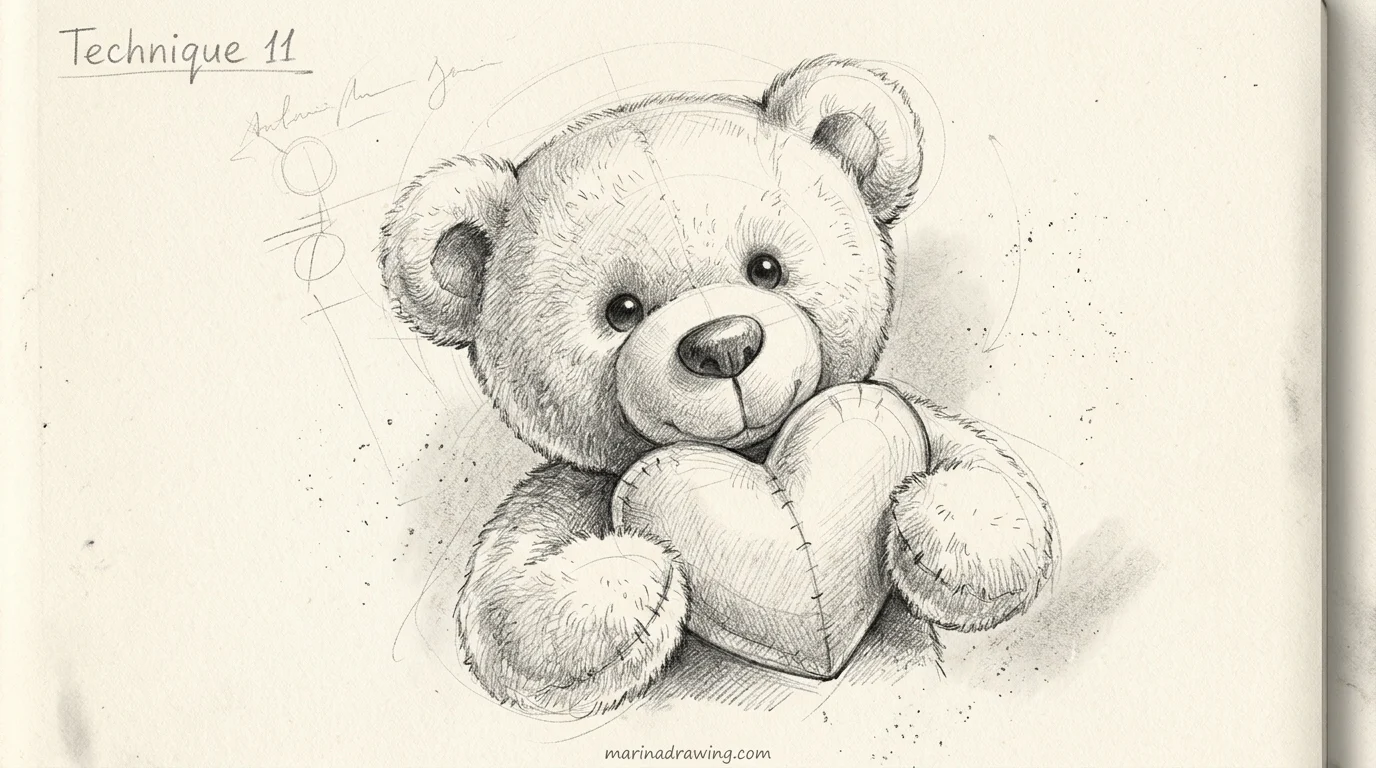
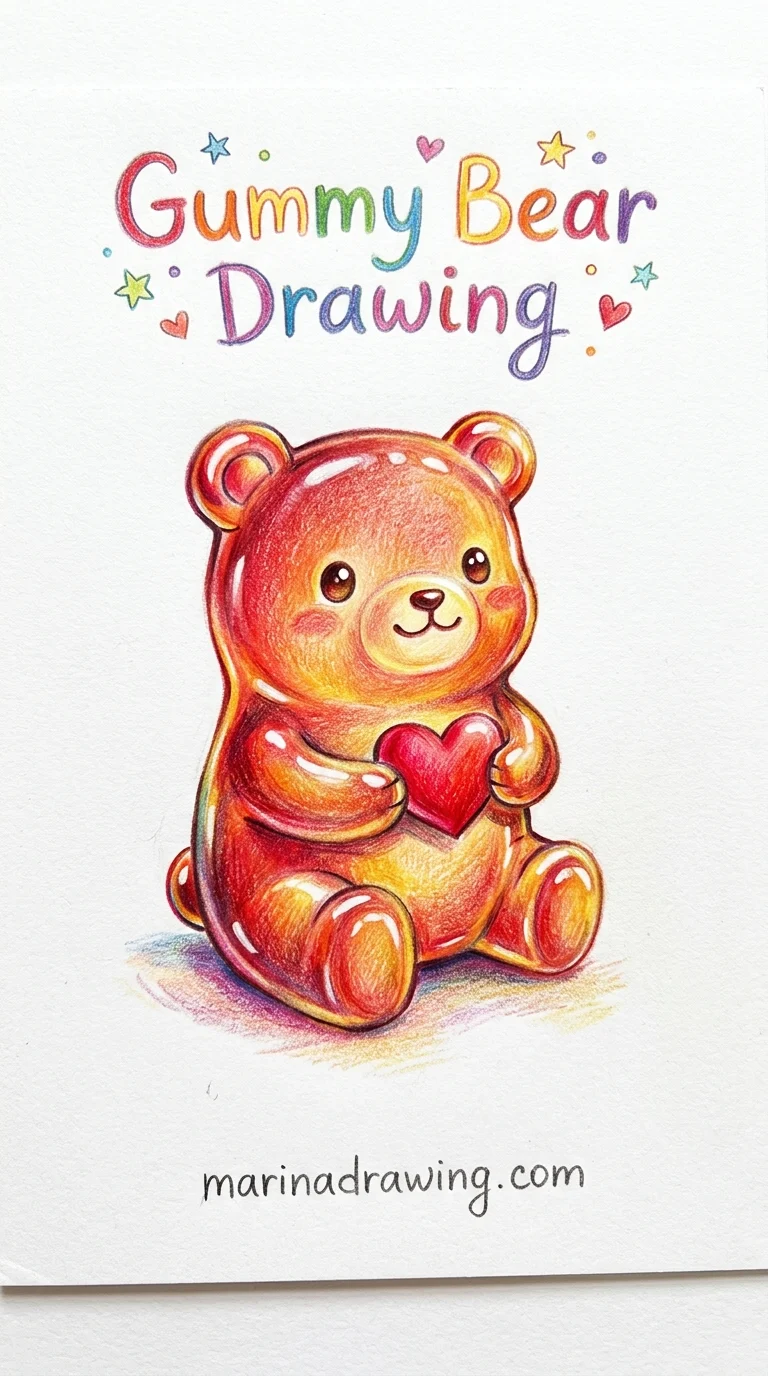
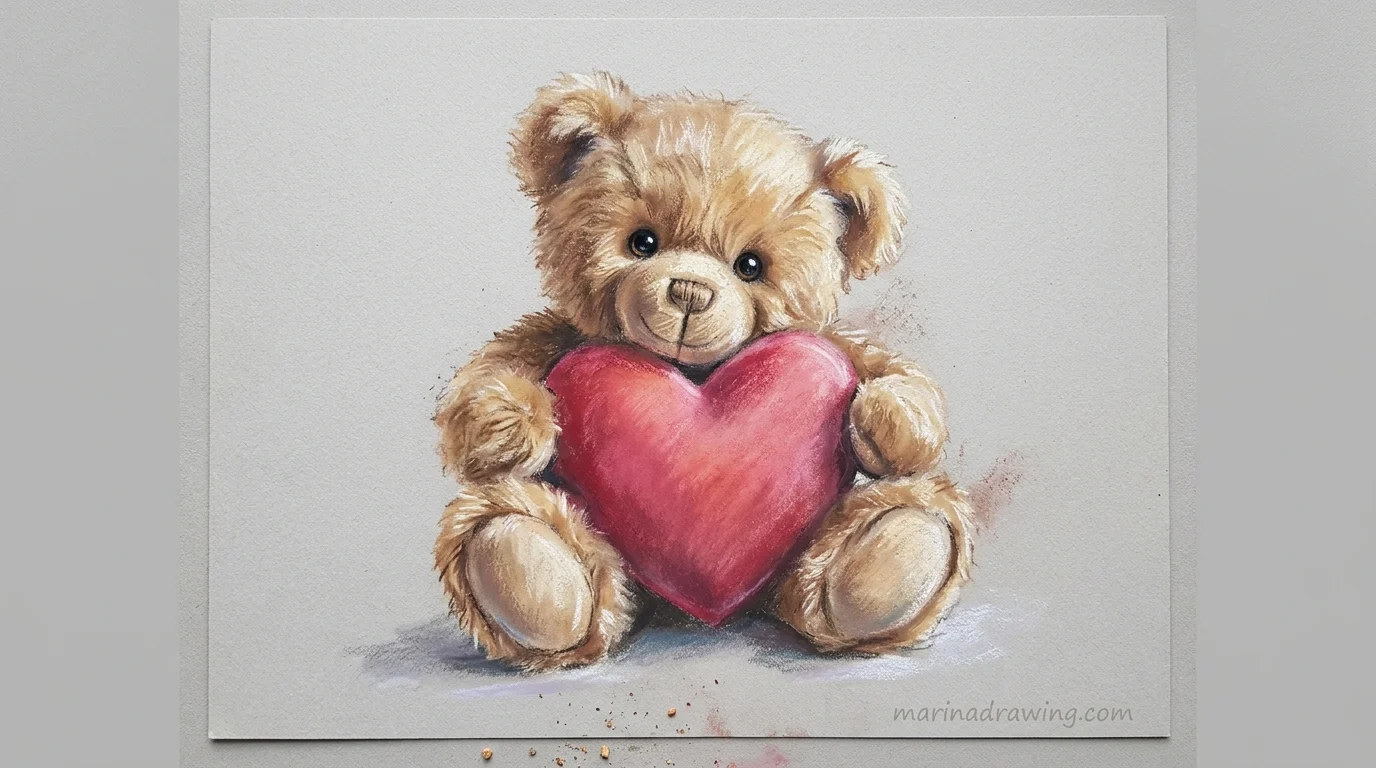
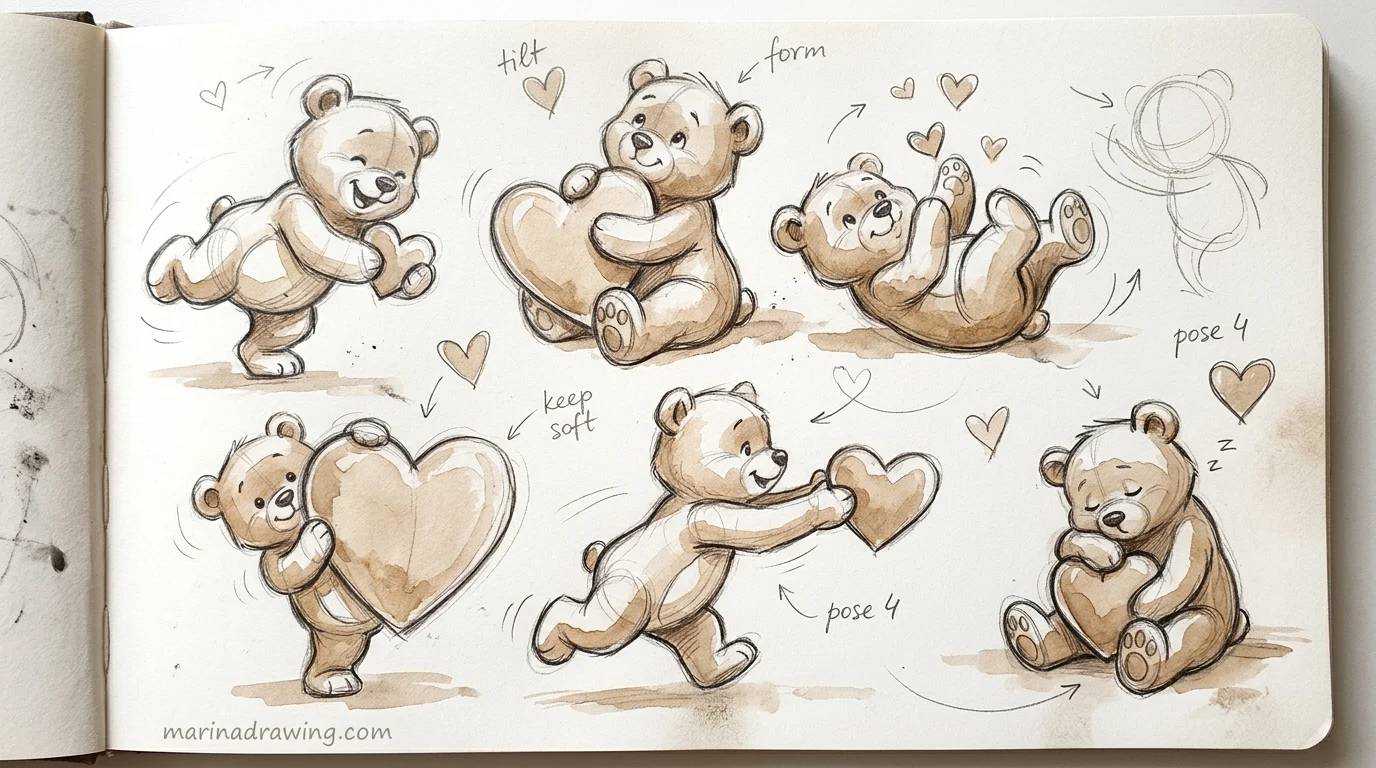
7. A bear holding a heart
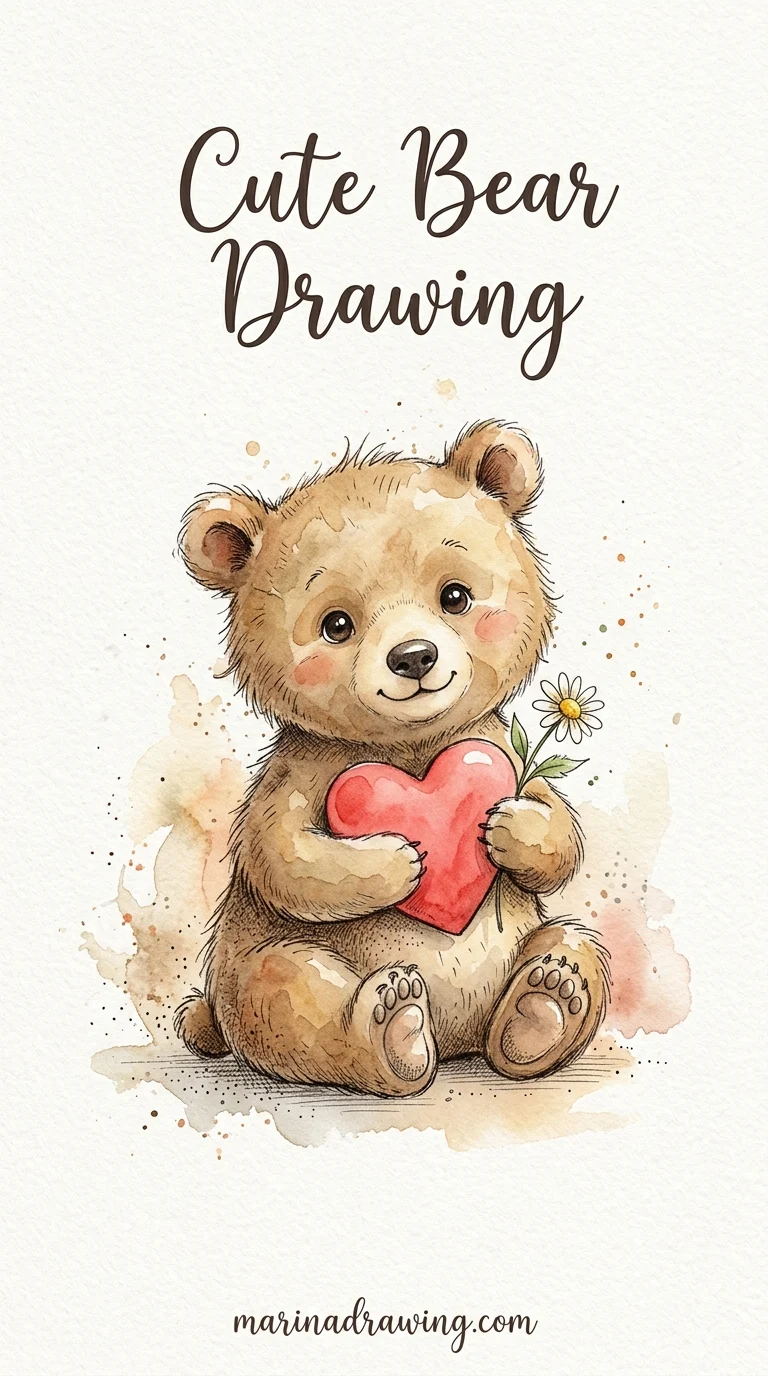
I place a big heart between the paws, held against the chest. The heart is the focus, so keep the bear simple underneath it: round head, small ears, a tiny face.
Your paws overlap the lower edge of the heart, so the heart is held rather than pasted on. Tilt the head a little toward one side, and the whole figure softens.
Make the heart slightly lopsided on purpose, because a perfectly symmetrical one looks like a stamp.
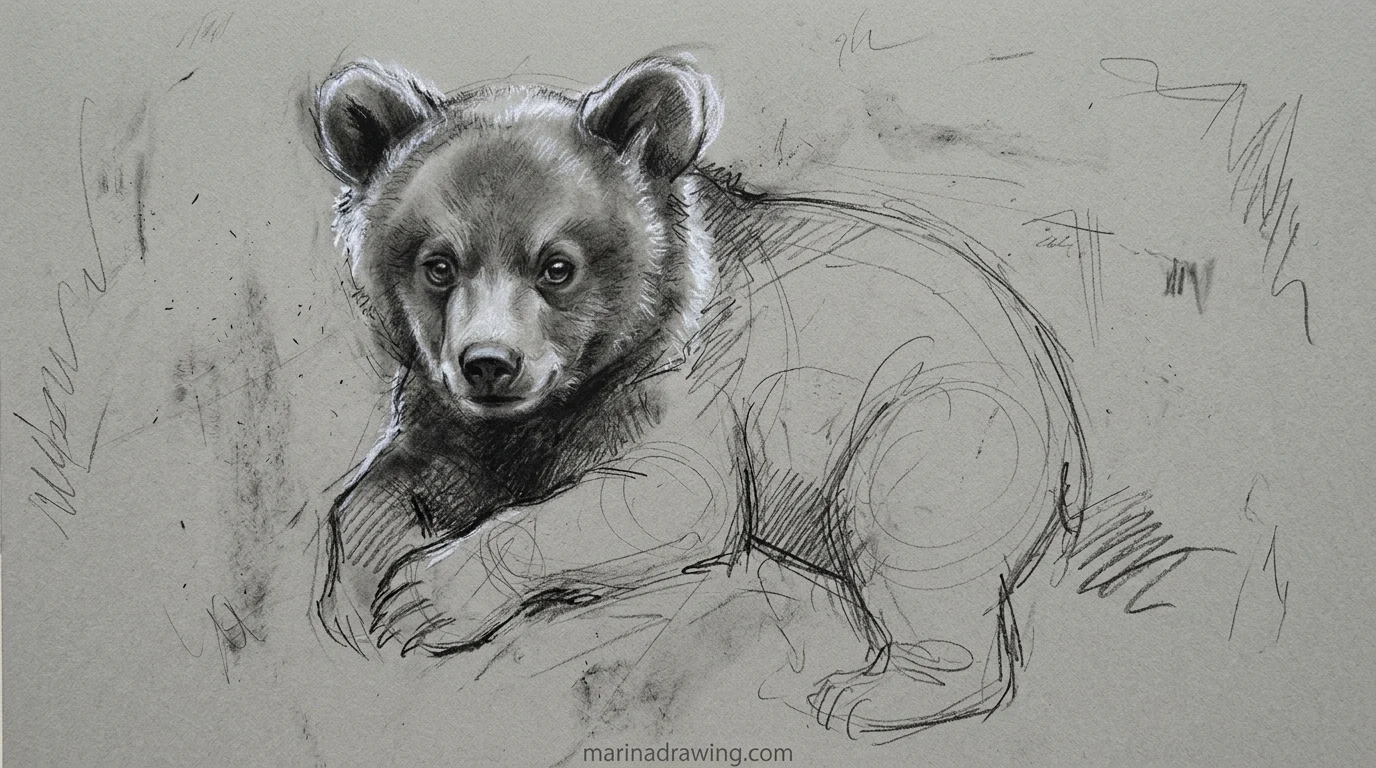
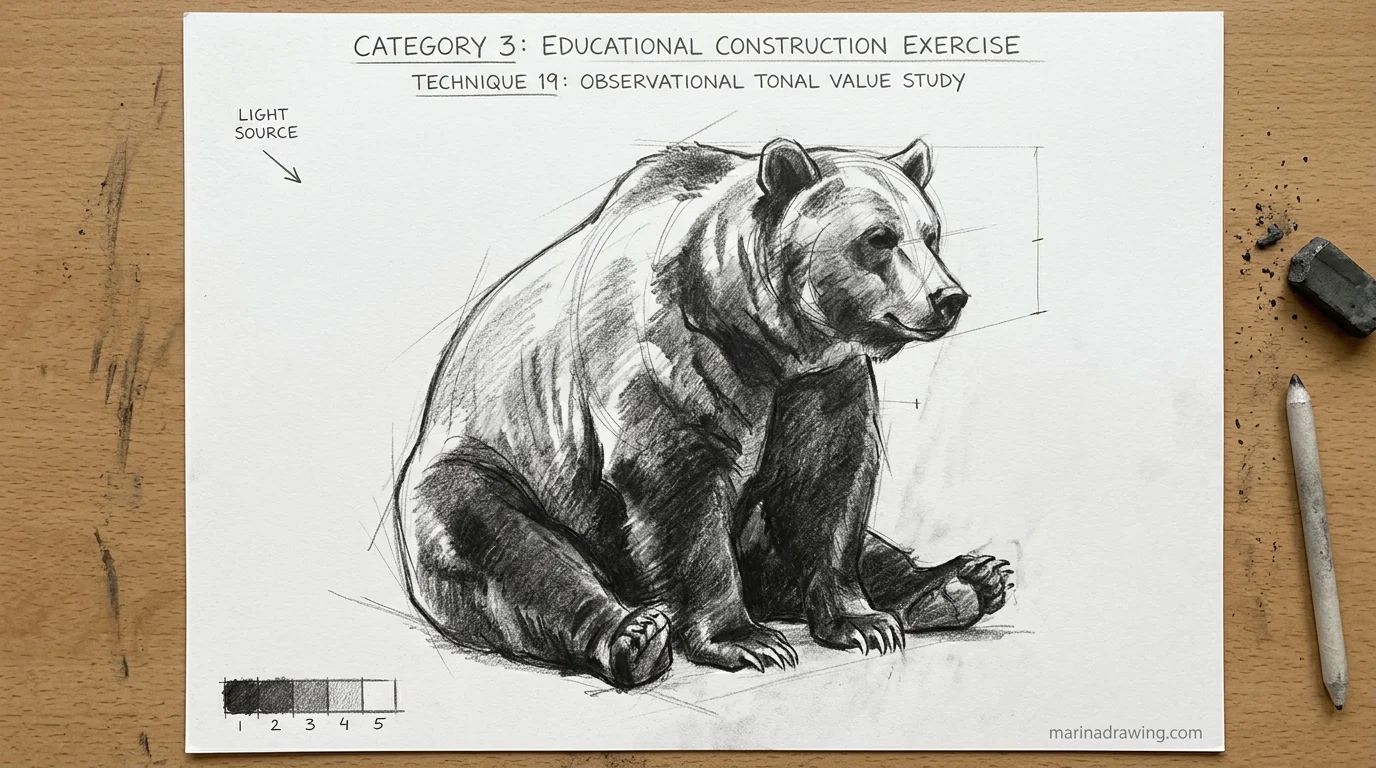
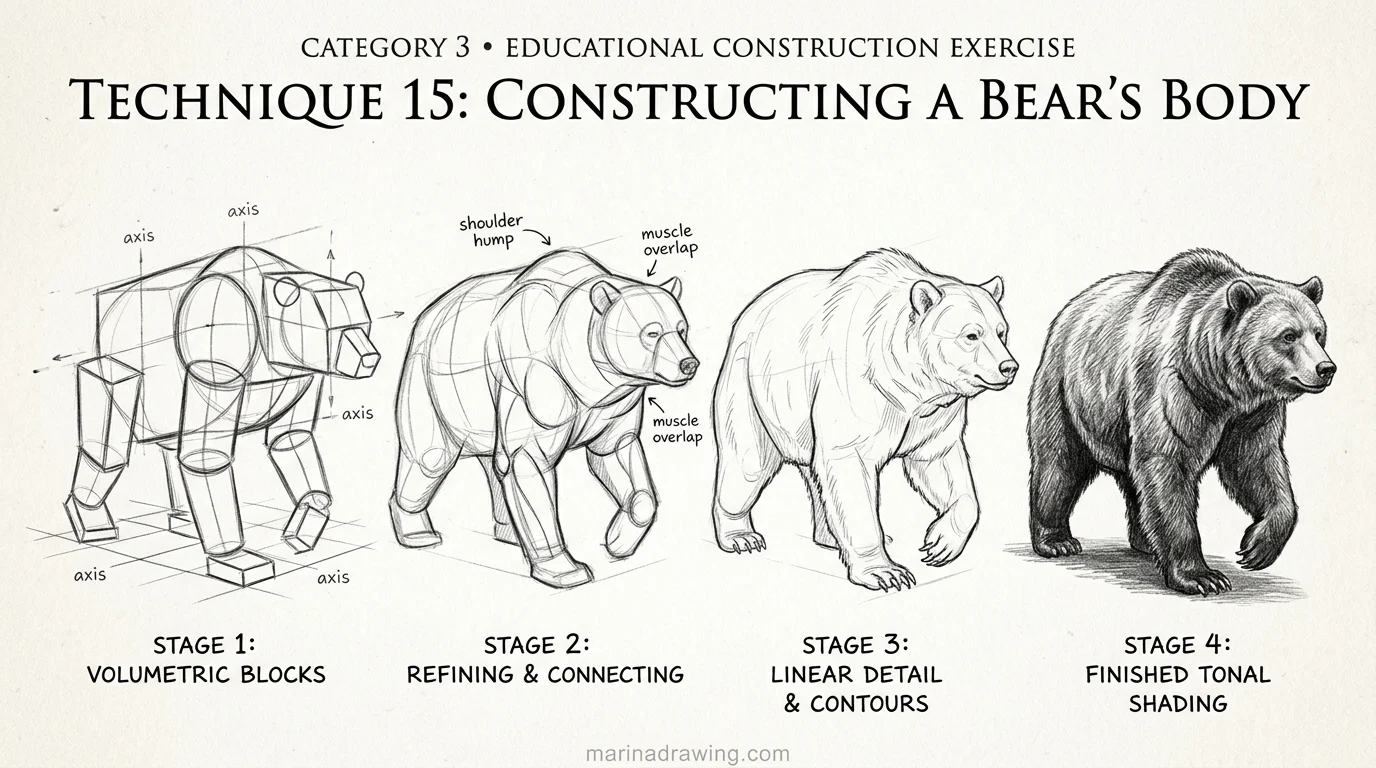
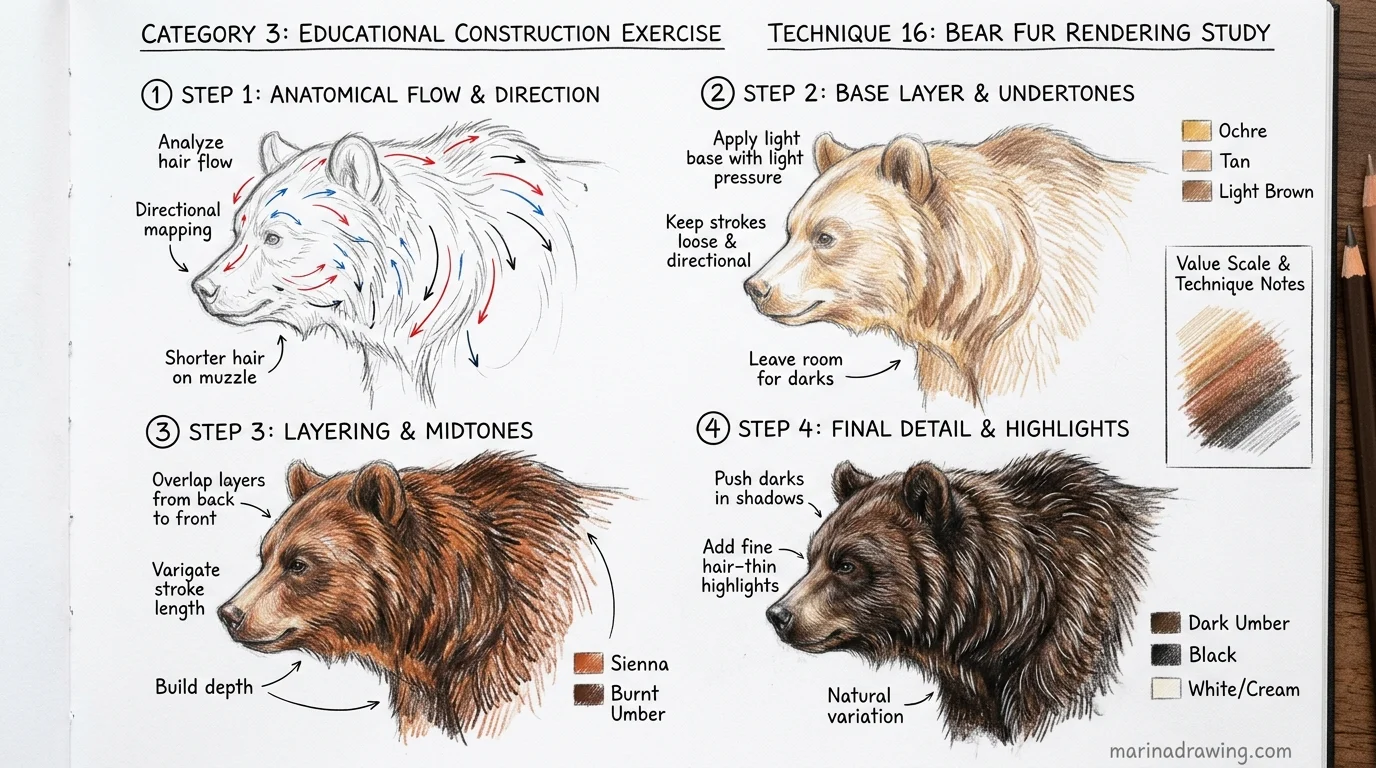
8. A grizzly bear drawing, realistic
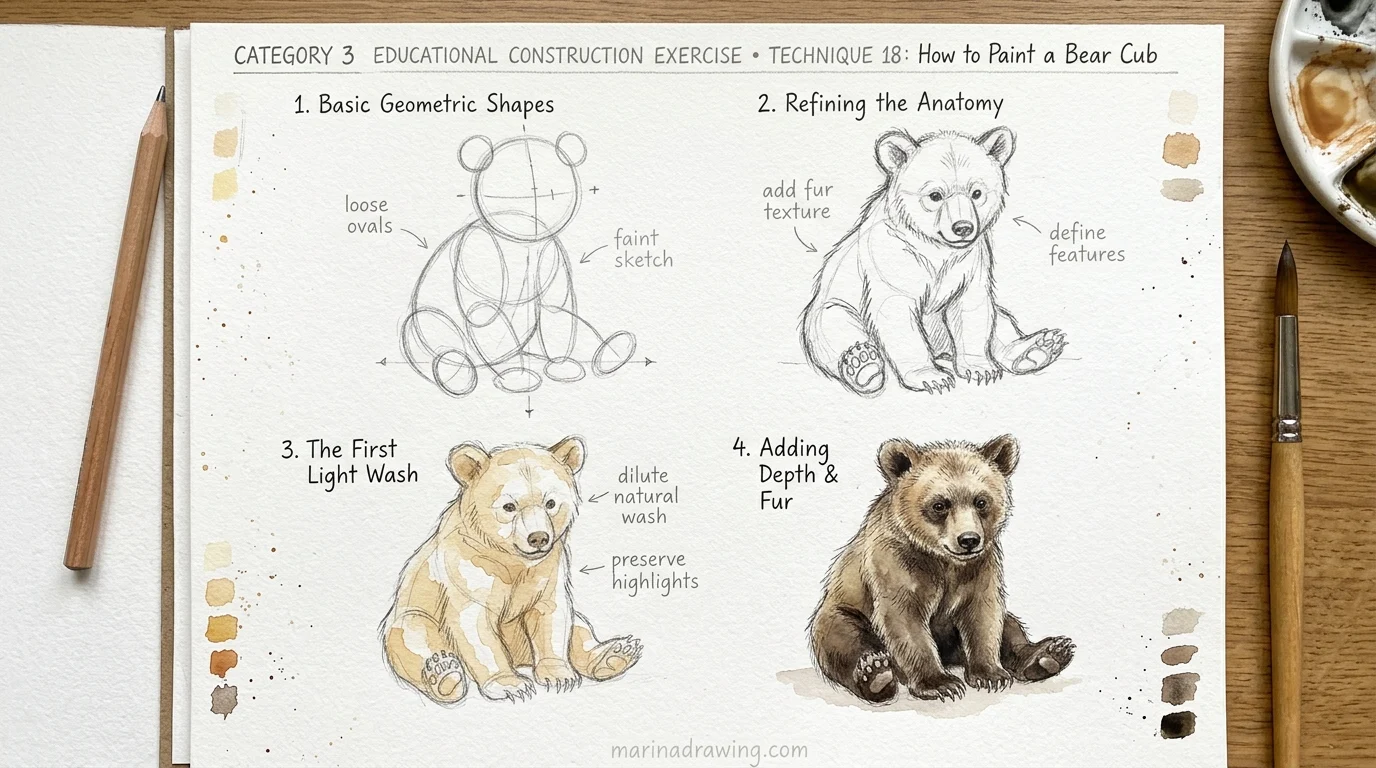
The grizzly is the one that needs structure. I lightly sketch three overlapping circles: a medium one for the head, a very large one next to it for the shoulder hump, and another large one behind for the hindquarters.
Connect them with a sloping back that drops from the hump toward the tail. Give the head a wide forehead, small ears set far apart, and a blunt muzzle pushed out from the circle. The legs are heavy columns, and the paws sit flat on the ground with short claw strokes at the tips. Heavy column legs carry the weight again in elephant drawing ideas, only bigger.
Once the outline is right, erase the circles and build fur with short quick strokes along the neck, belly and legs. Shade under the belly and behind the front legs.
The same value habit runs through realistic shading. If yours looks flat, you are missing a dark, not a detail.
This one takes an hour, and it is where knowing the shapes stops being enough.
9. A grizzly catching a salmon
The same grizzly, standing in a river with a fish leaping at its mouth. Draw the bear first, with the head lowered and the mouth slightly open, then the fish as a curved lens shape with a forked tail, caught mid-jump.
Water lines go across the legs, not behind them. That cut is what puts the bear in the water. Keep the splash light and the fish small. For a river backdrop, a pack of nature scenes gives you reference.
Which mistake did you make?
Put your drawing next to this and read down the left column. I still check my own bears against it.
| What you see | What is actually wrong | Your fix |
|---|---|---|
| It looks like a pancake | The head is a flat disc and the muzzle sits in the middle | Move the muzzle low and let it stick out as an oval |
| It looks like a mouse | The head is taller than wide and the ears are close together | Widen the head and push the ears to the upper corners |
| It looks like it has horns | The ears sit on top of the head | Set them on the upper corners as half-circles |
| It looks like a toy on a string | The arms and legs are thin sticks | Draw them as short, thick columns with flat paws |
| The head floats above the body | The two circles only touch | Overlap the head onto the body so it sits on it |
If the same row describes every bear you draw, your gap is construction rather than practice.
Questions people ask about drawing a bear
How to draw a bear easy?
Draw a wide circle for the head, a low oval muzzle, two half-circle ears, a pear-shaped body, short arms and oval feet.
How to draw a bear step by step?
Start with the head, then the muzzle and ears, then the body, arms and feet. Eyes and nose come last, on the muzzle. Erase the guides after the shapes are right.
How to draw a cute bear?
Make the head nearly as big as the body, drop the eyes low and wide, keep the muzzle small, and shorten the limbs. It is a ratio, not extra detail.
How to draw a bear for kids?
Use the circle and pear version and let them add the face and the colour. Nothing to shade, so it finishes before interest runs out.
How to draw a bear realistic?
Build three overlapping circles for the head, shoulder hump and hindquarters, connect them with a sloping back, then add heavy legs. Build fur in short strokes and shade under the belly.
How to draw a teddy bear?
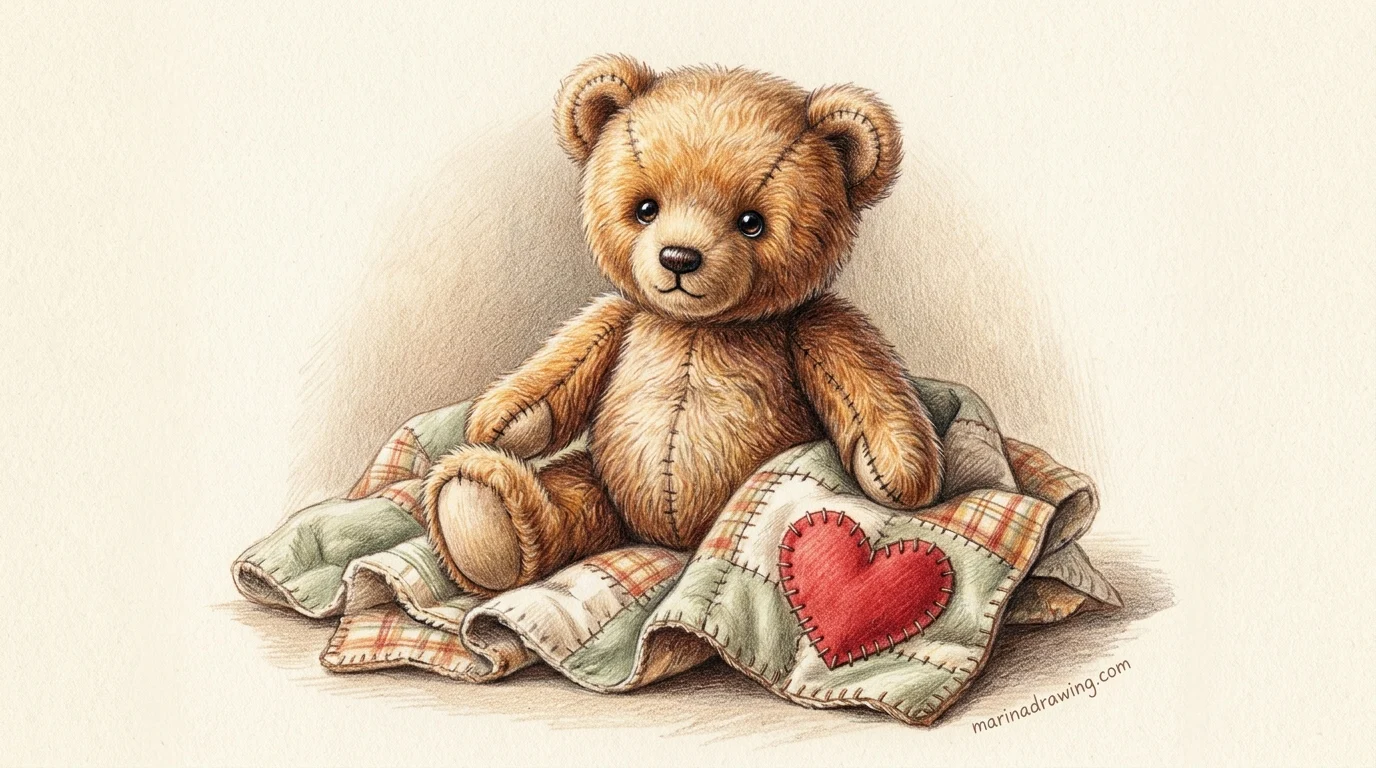
Use the base bear with a round head, a low muzzle and a soft pear body, and add a small bow or stitched patch if you like. Keep the outline soft and rounded.
Which bear should I draw first?
The easy teddy, then the kawaii one, then the honey pot.
Key takeaways
- A bear is read by its wide head, low muzzle and widely set ears. Get those right and the eyes barely matter.
- The muzzle is a low oval that sticks out, not a patch in the middle of the face.
- Ears sit on the upper corners, wide apart, never on top like horns.
- Limbs are short thick columns, not sticks.
- Cute is a ratio: big head, low wide eyes, a tiny muzzle, stubby limbs.
- The grizzly needs structure, so build the three circles first.
Draw two or three and you will know which row is yours. I keep the same habit on other animals: the fox, the duck, plain drawing practice. Want to see a bear painted? An acrylic teddy bear class covers a fluffy texture and depth in the hair.