Quick answer: the best simple drawing ideas are the ones you can name as one to three shapes before the pencil lands: a star, a cloud, a leaf, a cup, a round cat. Pick one, draw it five times on the same page, then move on to the next.
If you search for simple drawing ideas, or easy drawing ideas, you already have a pencil in hand. What you lack is a reason to pick one idea over another, so you take the first and quit when it comes out childish.
Below is my test, then sixty ideas by theme. If your drawings come out wrong, jump to the checks or to the pencil drawing course that trains the fix.
A drawing idea is simple when you can name the one to three shapes it is made of before you touch the paper. If you can’t, it isn’t simple yet.
Why a Blank Page Kills Most Simple Drawing Ideas
Quick answer: a blank page fails you when you ask it two questions at once, what to draw and how to draw it. Settle the first with a short list, then spend the sitting on the second.
Here is how your evening goes. You scroll for ideas, save a few, start the one that looks cutest. Halfway through the proportions drift, you erase, you redraw, you erase again. Twenty minutes later the page is grey and you close the sketchbook.
Forum threads read the same way. One self-taught artist wrote that they get so focused on getting a part right that they “just do the thing” without thinking about how it works. Your idea was never too hard; the drawing died while you were fixing it.
- Choosing the idea and drawing it are two jobs. Do them at different times.
- Pick before you sit down: one idea, written in the top corner.
- Decide in advance that the first attempt is allowed to be bad. A simple idea is cheap to redo.
If you would rather not choose every evening, a pencil course with a fixed order picks for you.
This is for someone who has drawn on and off for years, can put down a clean line, and still closes the sketchbook annoyed. None of these is a child’s exercise: each is worth construction lines and tone on one side.
The Three-Shape Test: How to Pick a Simple Drawing Idea
Quick answer: say the idea out loud as shapes. “A cat” is not simple; “a circle, two triangles and a curved tail” is. More than three, split it.
Run every idea through these three steps first. Thirty seconds, and they have saved me more bad evenings than any tutorial could.
1. Name the shapes
Circle, oval, triangle, rectangle, curve, line. Say them in the order you will draw them. A mug is a rectangle with a curve; a cloud is three circles.
2. Count them
One to three shapes: go. Four or five is a medium idea. More than that and you are drawing a scene.
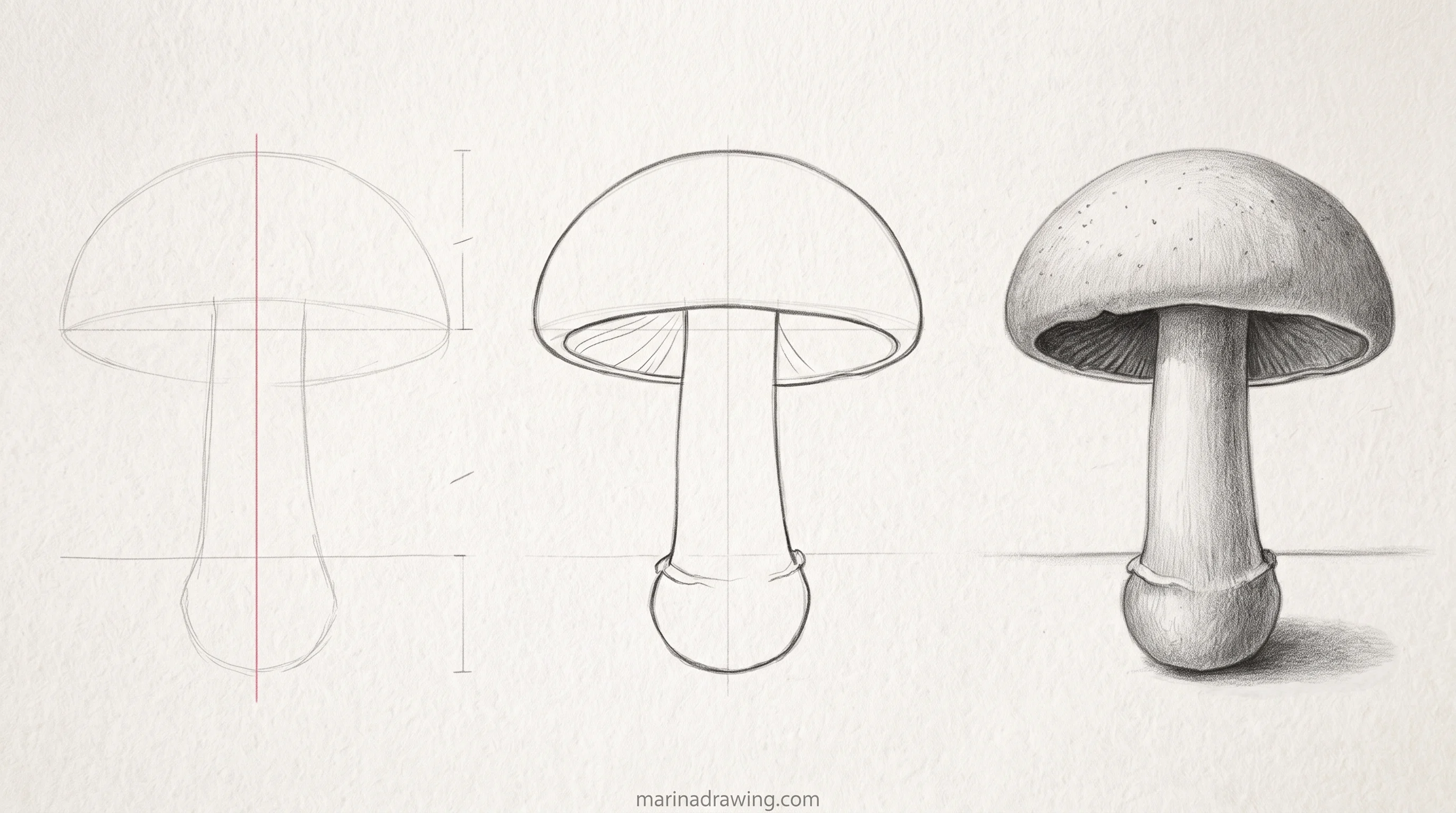
The ladder: one shape is a full moon, two a cup, three a mushroom. Four is a bird on a branch, already a medium evening. Six is a house, a scene in the clothes of a simple idea.
Ten ideas that pass the shape test
A full moon, a leaf, a cup, a jar, a mushroom, a fish, a sitting cat, a whale, a plant in a pot, a pointed raindrop. Nothing is rotated.
3. Check that nothing has to be shaded, rotated or foreshortened
Flat, front-on and outlined is the easy version. The moment a shape turns away or holds a shadow, your idea has moved up a level.
Every idea below has its shapes named next to it, so you can run the test without thinking. To build the habit of seeing objects as shapes, the shape-based practice gives a full set of warm-ups.
Still unsure why one of your ideas works and another falls apart? A course that reviews your page names the shape.
What You Need: One Pencil and Any Paper
You don’t need a kit. I draw most of these with three things, and you are better off starting tonight than after a shopping trip.
- A pencil you already own. Softer than HB is nicer, but an office pencil works for every idea here.
- Any paper. The back of an envelope is fine. Keep a sketchbook only if you like the feeling of a finished page.
- An eraser, used late. Draw the first shapes light and draw over them instead of erasing.
- A fine marker, optional. Only for the marker section below.
Simple Drawing Ideas Easy Doodles: Ten Shapes to Copy Tonight
Quick answer: doodles are the lowest-risk simple drawing ideas: one or two shapes, no shading, under two minutes each.
Start here if you have not drawn in a while. These are what I give anyone who tells me they can’t draw anything.
- Star – five straight lines, or one zigzag you never lift.
- Heart – two humps and a point below.
- Cloud – three overlapping circles, flat bottom, my warm-up.
- Sun – a circle, short straight rays you space by eye.
- Moon – one big circle with a smaller one cut out.
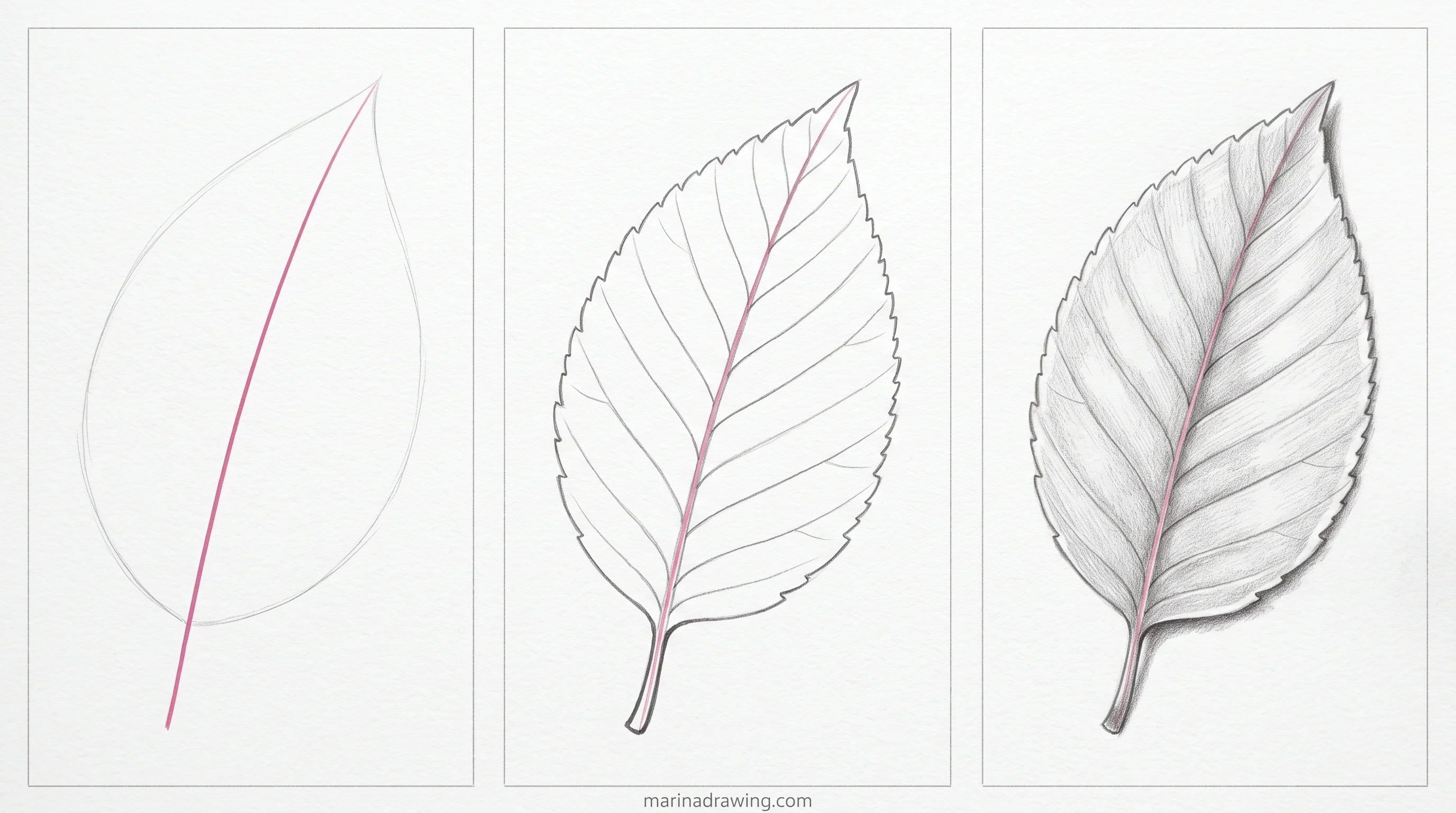
- Leaf – a pointed oval, one line down the middle. My first idea on a cold morning.
- Spiral – one line you keep turning inward.
- Raindrop – a teardrop: one point, one round bottom.
- Wave – one line rolling up and down.
- Four-point star – two long points, two short, curved sides.
Draw each one five times in a row on the same page. Your fifth is usually the best, and seeing that does more than any advice. The drawing practice routine stretches a doodle into a proper warm-up. I do this with every new shape I learn.
To take one doodle into a careful drawing, a step-by-step pencil course walks you through the same shapes.
Cute Simple Drawing Ideas Built From Circles
42 hours of pencil drawing training, lifetime access
The video course I point plateaued students to — full lessons on portraits, hands, and realistic shading, not another short tutorial.
Cute is a proportion trick, not a talent. A big round head, a small body and a tiny face placed low make anything read as cute. Lean on circles: your wobbly circle still reads as a circle. Ten of them:
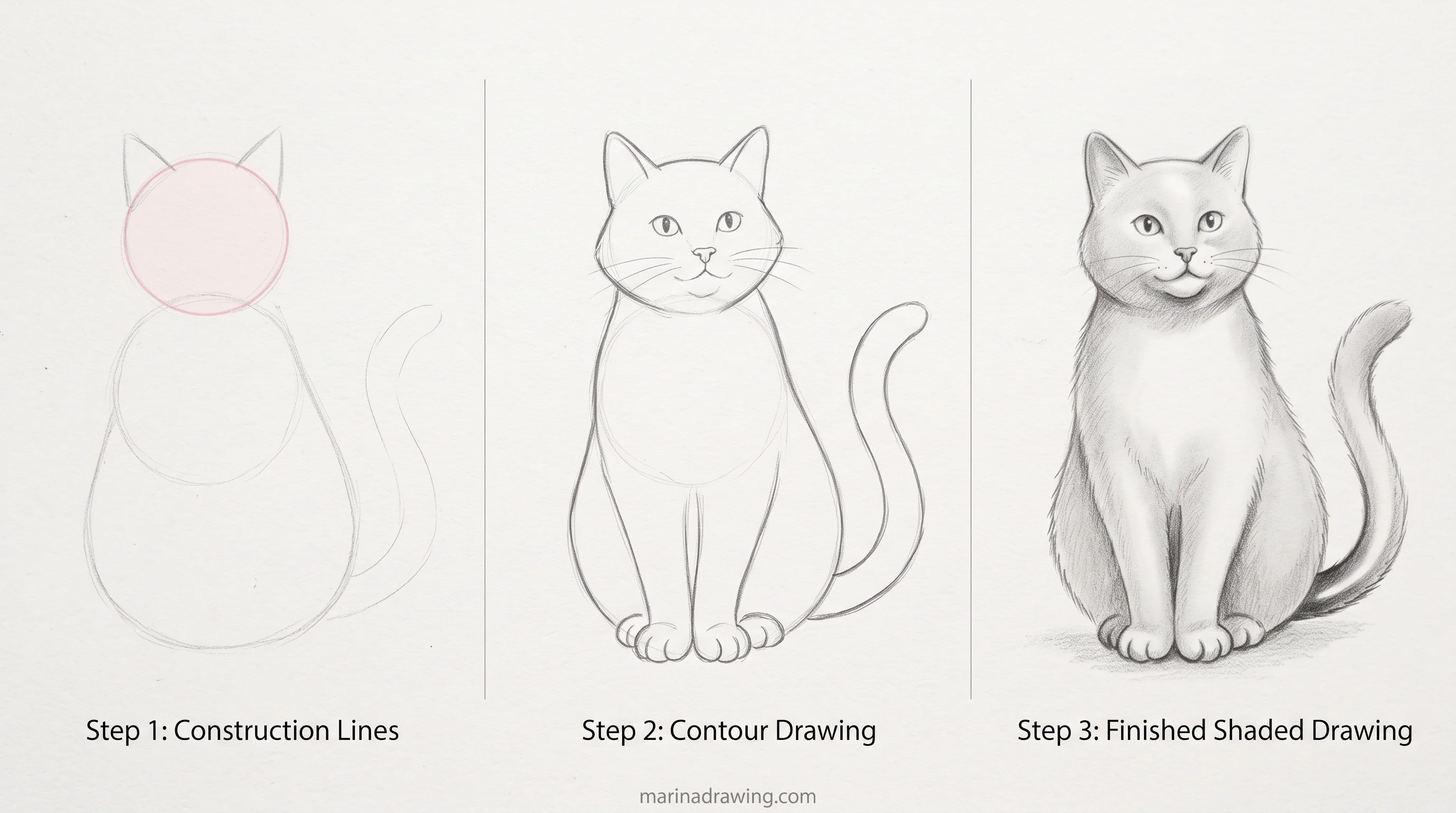
- Round cat – a circle head, two small triangles for ears, two dots and a small “w”.
- Bunny – a circle head, two long ovals rising off your first line.
- Little ghost – a rounded top, a wavy bottom, two dots.
- Cloud with a face – the doodle cloud plus two dots and a curved smile.
- Mushroom – a half circle on your short rectangle.
- Sleeping hedgehog – a circle with short spines along one side.
- Bear – a circle head, two small circle ears on top.
- Frog – a wide circle, two circle eyes on the top edge.
- Chick – a circle body, a tiny beak, two short legs.
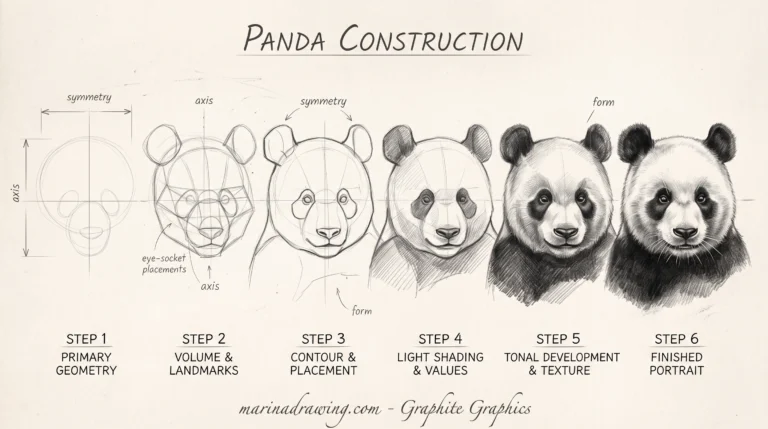
- Panda – the bear, with two filled circles. My niece’s favourite.
If it looks off, the eyes are too high
The rule that makes them work: keep the face small and low on the shape, and put the eyes further apart than feels natural. If a cute drawing looks “off”, the eyes are almost always too high or too close together. I check the eyes first on every cute drawing I make.
If yours keep landing wrong, a course with work review shows you where on your own page.
Simple Aesthetic Drawing Ideas That Look Planned
“Aesthetic” mostly means repetition and space. One small drawing in the middle of a clean page looks deliberate; ten in a row look like a pattern. That is a layout decision you make, not a skill you lack.
- A row of eight moons in phases – the same circle eight times with a different curve cut into each: full, gibbous, half, crescent, the empty outline, then back out the other side.
- A line-drawn plant in a pot – a curved stem, pointed ovals, a trapezoid pot.
- Tiny stars scattered – four-point stars in three sizes.
- A hand-drawn border – repeating leaves or dots along the page edge.
The row of eight moons, phase by phase
Nothing changes between the eight moons but the cut, and the row reads as planned because the shape repeats. Hatch the lit part rather than filling it flat.
Three marks give your page away as deliberate: the same small drawing repeated in a row, one line weight throughout, and more empty paper than feels comfortable. A crowded page reads messy even when every drawing is good. I use the same checks on my own pages.
If your circles still look wobbly, lessons that start from basic shapes train your hand faster than you can on your own.
Simple Drawing Ideas From Nature: Leaf, Moon, Mountain
Nature is forgiving because nobody knows exactly how your leaf should look, so it is where you practise being loose. I sketch leaves from a real branch whenever I can.
- Single leaf – a pointed oval, a centre line, side lines.
- Mountains – two or three overlapping triangles, one smaller in front.
- Tree – a rectangle trunk, a cloud shape on top.
- Simple flower – a small circle, round petals, a straight stem.
- Sunrise – a half circle on your flat horizon, straight rays.
If flowers pull you in, easy flower drawings goes further with petal shapes and stems.
Simple Food and Everyday Object Drawing Ideas
Once you are tired of doodles: real things from your desk, still simple, and you can look at them while you draw. Six are within reach of your hand right now.
- Apple – a wide circle, a dip at the top, a short stem and one leaf.
- Banana – one long curve you thicken, with a dark tip.
- Cup – a rectangle narrowing at the bottom, plus a curved handle.
- Ice cream cone – a triangle pointing down, a circle on top. I draw it when I want two shapes and nothing else.
- Jar – rounded corners and a narrow band for the lid.
- Scissors – two long ovals and two straight blades crossing below.
Draw the cup five times, keep all five
Draw the cup five times across one spread, same size and angle, erasing nothing. The first is a search, the third settles the proportion, the fifth is worth tone and a cast shadow. Keeping all five shows the improvement. I redo this cup whenever my proportions feel rusty.
To go beyond outlines, the still life setup arranges two or three objects so they stay easy to draw, and a guided pencil course takes you from outline to tone.
Simple Animal Drawing Ideas Without Fur or Anatomy
You can draw an animal without knowing what is under the skin. Draw the silhouette as basic shapes and let one feature carry the character.
- Fish – an oval and a triangle tail, your two-shape animal.
- Bird on a branch – a circle head, an oval body, a triangle beak, a line for the branch.
- Cat sitting – a triangle body, a circle head, a curved tail. My most-drawn animal.
- Turtle – a half circle shell, a small head, four stubby legs.
- Owl – a large oval, two big circles for eyes, a tiny triangle beak.
- Whale – one rounded shape and a tail you curve once.
- Butterfly – two mirrored pairs of rounded wings.
- Duck – a round body, a smaller circle head, a flat beak.
The owl, layer by layer
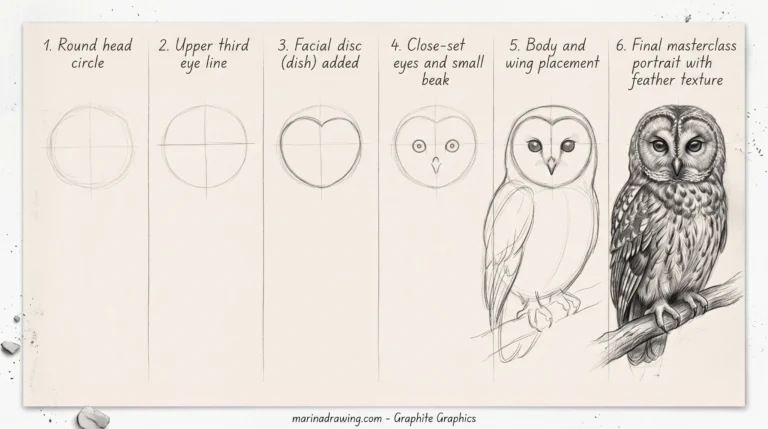
The owl is worth doing slowly because each layer keeps everything under it, and that habit transfers to every other animal here.
Oval, then eye circles set wide and low, then beak and ear tufts drawn on the skull rather than stuck to the edge, then hatching down one side, then the darkest marks only where two forms meet. Nothing gets erased.
For a specific animal, the duck and the five simple animals have step-by-step versions. For softer, shaded animals, a guided pencil course is your next step.
Simple Marker Drawing Ideas for When You Cannot Erase
42 hours of pencil drawing training, lifetime access
The video course I point plateaued students to — full lessons on portraits, hands, and realistic shading, not another short tutorial.
Quick answer: with a marker you cannot erase, so pick ideas with single lines and no overlap: stars, leaves, waves, patterns, outlines.
A marker is a good teacher because it removes the option that ruins most drawings: the eraser. You commit to the line and you learn to turn a wobble into part of your style. I keep one on my desk for exactly this reason.
- Repeating patterns – dots, dashes and small squares in rows.
- Outlined leaves – one pointed oval each, no fill. My warm-up with a marker.
- A checkerboard border – squares alternately filled.
- Zigzags and scallops – fast lines in one motion.
- A single-line face – one continuous line, barely lifting the pen.
- Cacti and pots – flat shapes, one hatch for all.
The second pass is where it goes muddy
Cross a stroke while it is still wet and the overlap goes two tones darker and feathers into the paper fibres. Let a pass dry, or plan the drawing so no two strokes meet.
Two things help. Move your whole arm, not just your fingers, for long lines. And draw a lighter pencil version first when the idea has more than two shapes. When you want the same control in pencil, structured lessons build it in order.
Simple Y2K Doodle Ideas: Star, Butterfly, Heart, Smiley
The Y2K look is a small set of shapes drawn chunky: fat outlines, rounded corners, everything too big for the page. You can fake it on the first try.
- Chunky star – a four-point star with sides I keep curved.
- Butterfly – two rounded wings on each side, thick outline.
- Heart with a highlight – a fat heart, one curved line inside.
- Smiley – a circle, two oval eyes, a wide curved mouth.
- Flame – a tall teardrop with a smaller one inside.
- Bubble letters – letters with double outlines.
- Cherry pair – two circles, two stems joining at the top.
Draw the outline twice as thick as you normally would: the Y2K look is line weight, not detail. Draw the first four shapes four times each, one row apiece. Your fourth is where the weight steadies, and a course with a fixed sequence practises that.
Simple Drawing Ideas for Kids and for Drawing Together
The best ideas for a child are the ones they repeat alone after seeing them once. Give one shape at a time, said out loud.
- Face – a circle, two dots, a curved line.
- House – a square, a triangle, a small rectangle door.
- Sun over a hill – a half circle and a long curve.
- Caterpillar – a row of circles, each a little smaller. I say the shapes out loud.
- Snowman – three circles, your largest at the bottom.
- Rocket – a tall oval, a triangle nose, two fins you flare.
Say the shapes while you draw: “big circle, small circle, two dots”. The sentence is the lesson. A longer list for this age: easy drawings for kids.
Why a Simple Drawing Still Looks Off, and What to Check
Quick answer: when a simple drawing looks off it is almost always one of three things: wrong relative sizes, lines too dark too soon, or a drawing fixed until it stopped moving. Check them in that order.
You picked an idea that passed the three-shape test, you drew it, and it still looks wrong. This is the part free lists skip, so here are the checks you run on your own page.
1. Compare the sizes of your shapes
Hold the page at arm’s length. Is the head about as wide next to the body as you meant it to be? Most “childish” drawings are a proportion problem, not a line problem.
2. Look at where the darkest lines are
If every line is dark from the start, you can’t correct anything. Draw the first pass with the pencil barely touching the paper, then darken only the lines you have decided to keep.
The reverse is just as common: an even outline all the way round reads flat. Darken one edge, leave the paper bare where the light lands, and the drawing picks up weight without an extra shape.
3. Count your erasing
Four rounds on one shape and your page is grey before the drawing is done. If you have erased a shape more than twice, start a fresh one beside it. Your second is almost always better, because you know where the mistake was. I stop at two erasings myself.
These three catch most wobbly simple drawings, but they can’t tell you why yours keeps coming out the same way page after page. That takes someone looking at your actual sheet, which is what a course with work review is for.
One Idea a Day for a Week: A Plan That Fits Ten Minutes
Ten minutes is enough if you choose the idea in advance. You draw one idea a day from the sections above, each a little harder than the last.
- Day 1 – a doodle. Star or cloud, five times.
- Day 2 – a cute shape. Round cat or ghost.
- Day 3 – a leaf and a plant. Single leaf, then pot.
- Day 4 – an object. Cup or apple, from life.
- Day 5 – an animal. Fish or bird from shapes.
- Day 6 – a marker page. One pattern, no erasing.
- Day 7 – redo Day 1. Put the two pages side by side.
The last day matters most: the gap between Day 1 and Day 7 is the proof you improved, and that proof is what keeps you drawing.
After the week, your next step is easy drawings and sketches, or the eye once faces interest you. To have the order laid out instead of choosing every day, the course with a fixed sequence does that.
Questions That Come Up Before You Start
Which simple drawing ideas easy enough for a first sketch should I try?
Start with the ten doodles above: star, heart, cloud and the rest. They are simple easy drawing ideas of one or two shapes each, and none needs shading.
What are the best easy drawing ideas for beginners?
The best easy drawing ideas for beginners are flat, front-on and outlined: doodles, leaves and simple objects from your desk. Save shaded and turning shapes for later.
What should I draw when I want something simple?
Draw some everyday things within reach: a cup, your keys, a jar. Name the items as shapes, then draw them one step at a time.
How do I know if a drawing idea is too hard?
Name its shapes. More than three, or any shape that turns away from you or carries a shadow, means it is a medium idea.
Can I use a pen instead of a pencil?
Yes, and it is good practice. Pick ideas with single lines and no overlap, and sketch lightly in pencil first.
Why does my drawing look childish even when the idea is simple?
Check the proportions first: hold the page at arm’s length and compare your shapes. Then check that the first lines were light enough to correct. If the same flaw keeps returning, lessons with feedback find the cause faster.
What are good simple drawing ideas for kids?
A face, a house, a snowman or a caterpillar: one shape at a time, said out loud while drawing. The child can repeat them alone.